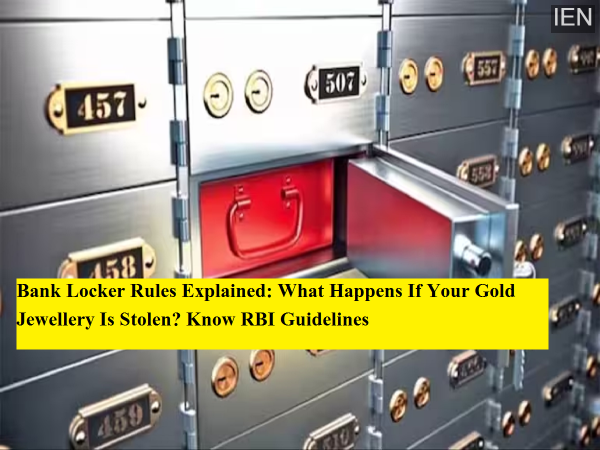
Keeping gold jewellery at home often feels risky due to the fear of theft, which is why many people prefer storing their valuables in bank lockers. While bank lockers are considered a safer alternative, an important question remains—what happens if your jewellery gets stolen from a locker?
Here’s a clear and complete explanation of the rules, compensation limits, and what you should do to stay protected.
Bank lockers are offered by both public and private banks, and customers pay an annual fee to use them. These lockers are commonly used to store gold jewellery, important documents, and other valuables.
While banks take several security measures—such as CCTV surveillance, restricted access, and fire-resistant vaults—no system is entirely risk-free. Theft, fire, fraud, or unforeseen incidents can still occur in rare cases.
The rules governing bank lockers are issued by the Reserve Bank of India and apply uniformly across all banks.
A key point that many customers misunderstand is about compensation. Contrary to popular belief, banks do not compensate customers based on the actual value of the items stored inside the locker.
As per RBI guidelines, a bank’s liability in case of loss or damage is limited.
For example:
If your annual locker rent is ₹3,000, the maximum compensation you can receive is ₹3 lakh—even if the value of your jewellery is much higher.
The main reason behind this limitation is that banks are not allowed to know or record what customers store inside their lockers. This rule exists to maintain privacy and confidentiality.
Since banks do not maintain any inventory or valuation of locker contents, it becomes impossible to determine the exact value of the stored items. Therefore, a standard compensation formula is applied instead of item-based reimbursement.
This was also clarified by Nirmala Sitharaman in Parliament, highlighting that locker contents are private and cannot be monitored by banks.
No, banks do not insure the items kept inside lockers.
However, customers have the option to take separate insurance policies for their valuables. Typically, insurance companies charge around 0.5% to 1.2% of the total value of the items as premium.
This means if you store high-value gold jewellery, getting it insured separately is a smart move to avoid financial loss.
Even though compensation is limited, banks are required to follow strict security protocols:
These measures significantly reduce the risk of theft or damage.
To ensure maximum safety of your valuables, consider these steps:
Bank lockers are a secure and reliable option for storing gold jewellery and important documents, but they do not guarantee full financial protection. The compensation in case of theft or loss is capped at 100 times the annual rent, which may be significantly lower than the actual value of your belongings.
Therefore, while lockers provide physical security, combining them with proper insurance is the best way to ensure complete peace of mind.