Ayurveda seems to have found a sweet spot in India’s FMCG playbook as national players turn to regional and niche brands in this space to drive growth amid a slowdown.
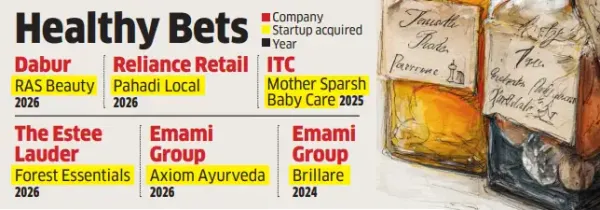
Emami on Thursday said it is acquiring 100% stake in Axiom Ayurveda, known for ayurvedic beauty products and herbal juices, for aggregate consideration of up to Rs 200 crore.
Last month, Dabur India picked up 51% stake in Raipur-based RAS Luxury Oils for around Rs 110–120 crore, marking its foray into the premium ayurvedic skincare segment, while Reliance Retail acquired Himachal-based Pahadi Local.
Globally, Estee Lauder Companies is moving to fully acquire Forest Essentials in a deal estimated at Rs 5,800–6,600 crore, underlining rising international interest in India’s ayurveda-led brands.
“Ayurveda has always been at our core. It’s not a new opportunity for us, it’s our foundation. What has evolved is the way consumers engage with ayurvedic and natural products today,” Abhinav Dhall, executive director, group head corporate strategy at Dabur, told ET.
There is growing interest in specialised, premium, digitally native products rooted in nature, and RAS Beauty will help Dabur gain access to new-age consumers, he added.
Harsha Vardhan Agarwal, vice chairman and managing director of Emami Ltd, said the Axiom buy marks Emami’s entry into the fast-growing beverage segment. “Axiom is a profitable and growing company, expected to achieve a topline of around Rs 180 crore in FY26,” he said in a statement.
These developments come amid a slowdown in the fast-moving consumer goods space.
“Most FMCG majors have been struggling with volume growth for the last two to three years,” said Ankur Bisen, senior partner at management consulting firm The Knowledge Company. “Either their portfolios are not aligned with changing consumption patterns, or demand itself has plateaued. In India, both are true.”
According to market tracker NielsenIQ’s latest India FMCG Growth Landscape report, volume growth across India’s FMCG sector remains subdued, with rural markets up 2.9% and urban markets growing 2.3% in the fourth quarter of calendar 2025, sharply lower than the previous quarter when growth stood at 7.7% and 3.7%, respectively.
Karan Taurani, executive vice president at brokerage Elara Capital, said there will be many more acquisitions in the premium beauty and personal care category, where ayurveda is a sub-set, in about 12-18 months.
Funding activity in ayurvedic and natural brands is also picking up.
The Ayurveda Co raised around Rs 100 crore (approximately $12 million) in March 2023 led by Sixth Sense Ventures, while Nat Habit raised $10.2 million in a series B round in December 2023 led by Bertelsmann India Investments.
As per Tracxn data, total funding in such D2C firms saw a slight uptick to $54.3 million in 2025 from $51.4 million in 2024, even as the number of rounds declined to 22 from 28, indicating more concentrated activity.
Early 2026 has seen four rounds so far, although overall investment remains muted.
Niche focus
FMCG companies have been consistently building exposure to newer, niche brands.
Data sourced from Tracxn shows that acquisitions of D2C ayurvedic and natural brands have remained steady over the past five years, with 2-3 deals annually. Disclosed transactions together account for over $150 million, largely in strategic mid-sized buys.
Among the relatively bigger players, Kapiva’s ayurvedic and herbal healthcare business has been built over the past decade. In 2025, the company, founded by Ameve and Anuj Sharma, raised $60 million in a round led by 360 ONE Asset and Vertex Growth, taking its total funding to around $90 million.
“Herbal healthcare in India is less than 5% of the overall healthcare market, compared to about 15% in China. That shows how underpenetrated it is,” said Ameve Sharma. “Even in areas like diabetes, penetration is extremely low, which leaves a lot of room for growth,” he said.
Emami on Thursday said it is acquiring 100% stake in Axiom Ayurveda, known for ayurvedic beauty products and herbal juices, for aggregate consideration of up to Rs 200 crore.
Last month, Dabur India picked up 51% stake in Raipur-based RAS Luxury Oils for around Rs 110–120 crore, marking its foray into the premium ayurvedic skincare segment, while Reliance Retail acquired Himachal-based Pahadi Local.
Globally, Estee Lauder Companies is moving to fully acquire Forest Essentials in a deal estimated at Rs 5,800–6,600 crore, underlining rising international interest in India’s ayurveda-led brands.
“Ayurveda has always been at our core. It’s not a new opportunity for us, it’s our foundation. What has evolved is the way consumers engage with ayurvedic and natural products today,” Abhinav Dhall, executive director, group head corporate strategy at Dabur, told ET.
There is growing interest in specialised, premium, digitally native products rooted in nature, and RAS Beauty will help Dabur gain access to new-age consumers, he added.
Harsha Vardhan Agarwal, vice chairman and managing director of Emami Ltd, said the Axiom buy marks Emami’s entry into the fast-growing beverage segment. “Axiom is a profitable and growing company, expected to achieve a topline of around Rs 180 crore in FY26,” he said in a statement.
These developments come amid a slowdown in the fast-moving consumer goods space.
“Most FMCG majors have been struggling with volume growth for the last two to three years,” said Ankur Bisen, senior partner at management consulting firm The Knowledge Company. “Either their portfolios are not aligned with changing consumption patterns, or demand itself has plateaued. In India, both are true.”
According to market tracker NielsenIQ’s latest India FMCG Growth Landscape report, volume growth across India’s FMCG sector remains subdued, with rural markets up 2.9% and urban markets growing 2.3% in the fourth quarter of calendar 2025, sharply lower than the previous quarter when growth stood at 7.7% and 3.7%, respectively.
Karan Taurani, executive vice president at brokerage Elara Capital, said there will be many more acquisitions in the premium beauty and personal care category, where ayurveda is a sub-set, in about 12-18 months.
Funding activity in ayurvedic and natural brands is also picking up.
The Ayurveda Co raised around Rs 100 crore (approximately $12 million) in March 2023 led by Sixth Sense Ventures, while Nat Habit raised $10.2 million in a series B round in December 2023 led by Bertelsmann India Investments.
As per Tracxn data, total funding in such D2C firms saw a slight uptick to $54.3 million in 2025 from $51.4 million in 2024, even as the number of rounds declined to 22 from 28, indicating more concentrated activity.
Early 2026 has seen four rounds so far, although overall investment remains muted.
Niche focus
FMCG companies have been consistently building exposure to newer, niche brands.
Data sourced from Tracxn shows that acquisitions of D2C ayurvedic and natural brands have remained steady over the past five years, with 2-3 deals annually. Disclosed transactions together account for over $150 million, largely in strategic mid-sized buys.
Among the relatively bigger players, Kapiva’s ayurvedic and herbal healthcare business has been built over the past decade. In 2025, the company, founded by Ameve and Anuj Sharma, raised $60 million in a round led by 360 ONE Asset and Vertex Growth, taking its total funding to around $90 million.
“Herbal healthcare in India is less than 5% of the overall healthcare market, compared to about 15% in China. That shows how underpenetrated it is,” said Ameve Sharma. “Even in areas like diabetes, penetration is extremely low, which leaves a lot of room for growth,” he said.