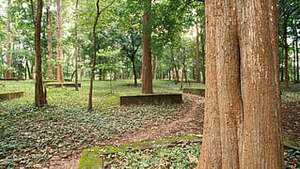
The BJP-led Mahayuti government in Maharashtra, which once credited the Ladki Bahin scheme with delivering a decisive electoral dividend, may now have to cut down teak (sagwan) trees worth about Rs 12,000 crore to keep the politically prized programme afloat — a development that suggests the “winning” scheme may be costing rather more than advertised.
During the recent Budget session, forest minister Ganesh Naik informed the Vidhan Parishad that a proposal would be placed before the state cabinet to permit felling mature teak trees owned by the Maharashtra Forest Development Corporation (FDCM). The timber sale is expected to help repay loans of roughly Rs 6,000 crore raised from financial institutions — because apparently, when welfare arithmetic stops adding up, the forests must step in.
Launched ahead of the 2024 Assembly elections, the Ladki Bahin scheme promises Rs 1,500 per month to women beneficiaries and was widely seen as a key factor in the ruling coalition’s electoral pitch to women voters. But the scheme has since run into what might politely be described as 'implementation issues', and less politely as a full-blown verification mess.
By March 2026, scrutiny revealed that around 71 lakh beneficiaries were ineligible, including men and government employees — categories not traditionally associated with “beneficiary women”. Despite this, approximately Rs 21,300 crore had already been disbursed to these ineligible recipients over about 20 months. Recovery of these funds, inconveniently, does not appear to be on the government’s immediate agenda.
Eligibility checks through Aadhaar-PAN linked e-KYC have now been extended till April 2026, prolonging the awkward process of determining who exactly qualified for a scheme touted as both targeted and transformative.
Meanwhile, the fiscal strain of maintaining the programme appears to be reshaping budget priorities across departments. Funds have reportedly been diverted from the tribal affairs and social justice departments — ironic, given that both sectors deal with constituencies usually considered more structurally vulnerable than the average election-season beneficiary.
Officials in these departments have flagged shrinking allocations and slowing development work, but the Ladki Bahin scheme appears politically too useful to trim. Instead, other parts of the state apparatus are being quietly hollowed out.
The forest department is the latest to feel the pinch. Naik told the legislative council that the financial burden of welfare commitments such as Ladki Bahin has contributed to the state’s fiscal stress, prompting the department to monetise assets. The FDCM’s teak plantations, valued at roughly Rs 12,000 crore, are now considered harvest-ready — a phrase that, in this context, reads suspiciously like “budget adjustment”.
That forests must be liquidated to sustain a scheme marketed as both affordable and efficient raises obvious questions about fiscal planning. It also underscores the widening gap between headline welfare announcements and the messy realities of execution.
According to official figures, 1.90 crore women completed e-KYC verification, of whom 1.75 crore were found eligible. The remaining 71 lakh were declared ineligible after payments had already been made — a reminder that in the rush to distribute benefits, verification occasionally became an afterthought.
The Economic Survey presented in March 2026 estimates Maharashtra’s total public debt will reach Rs 9.32 lakh crore by the end of the 2025–26 financial year, up 18.3 percent from Rs 8.39 lakh crore the previous year. Against that backdrop, monetising teak forests to sustain a cash transfer scheme once projected as fiscally manageable adds a certain unintended symbolism.
After all, few welfare schemes can claim to have moved so seamlessly from campaign promise to budgetary juggle to forestry strategy — proving once again that in politics, growth sometimes means trees disappearing rather quickly.