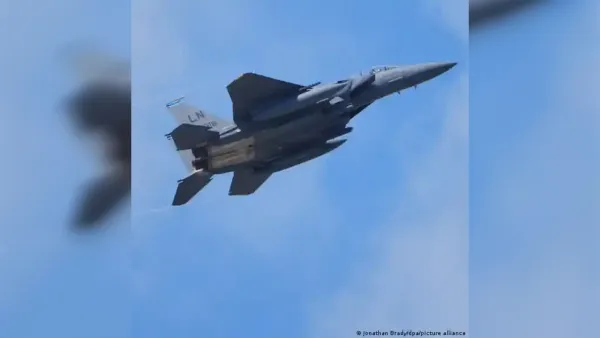
A missing crew member from a downed F-15E fighter jet has been recovered after a “heavy firefight”, a US government official told Al Jazeera on Sunday, April 5, marking a key development on day 37 of the US–Israel war on Iran.
The recovery comes amid a sharp escalation across the Gulf, where a drone strike hit Kuwait’s Shuwaikh oil sector complex, triggering a fire at the strategic facility.
The US official said the second crew member was located and extracted after intense fighting, as search operations continued in the conflict zone. Details on the condition of the crew member were not immediately disclosed.

The development follows ongoing uncertainty over the fate of personnel from the downed aircraft, underscoring the risks faced by forces operating in the region.
Kuwaiti authorities said the Shuwaikh oil facility — which houses key government and oil offices — caught fire following a drone strike.
Emergency teams contained the blaze, with no casualties reported.
Separate attacks targeted power and water desalination plants, causing significant infrastructure damage and forcing two power generation units out of service. A government ministries complex was also hit, while air defences intercepted multiple missiles and drones.
The strikes mark a significant escalation, bringing Gulf energy infrastructure directly into the conflict.
An Iranian security official said Tehran is operating based on a defined “target bank” and warned of an impending escalation, the Fars News Agency reported.
“We have a big surprise for America and the regime. It only takes a little time,” the official said, adding that US assessments were flawed and recent threats reflected battlefield setbacks.
Senior commanders reinforced the warning, stating that any expansion of US involvement would make the region “hell”, with one official cautioning that the “gates of hell will be opened”.
Iran also rejected US President Donald Trump’s 48-hour ultimatum over the Strait of Hormuz, while Trump claimed major strikes had hit Tehran and eliminated senior military figures.
Iran said it fired “Qadr” missiles at multiple Israeli locations, including Tel Aviv and nearby cities.
Israel reported intercepting incoming missiles and said it had destroyed a mobile launch platform near Tabriz. It also confirmed more than 200 strikes across Iran and Lebanon over the weekend targeting military infrastructure.
Hostilities continued to spill into neighbouring countries:
Lebanon’s health ministry said more than 1,400 people have been killed in Israeli strikes since early March, including children.
Strikes on petrochemical facilities in Mahshahr in southwestern Iran killed at least five people and injured around 170, according to state media.
Iran’s mission to the United Nations accused the US and Israel of targeting civilian infrastructure, calling the attacks violations of international law.
Authorities in Tehran also ordered asset freezes and bank account seizures for more than 100 individuals accused of supporting foreign adversaries, including media-linked personnel and overseas figures.
A Bloomberg report said the United States has used a significant portion of its JASSM-ER missile stockpile in strikes on Iran, raising concerns about sustained operational capacity.
An Israeli soldier was killed in a friendly fire incident during operations in southern Lebanon, while a missing US pilot has yet to be located. Iranian sources said a reward has been offered for information.
Former UN nuclear watchdog chief Mohamed ElBaradei urged urgent diplomatic intervention, warning of severe regional consequences.
Pope Leo called for peace, cautioning against growing global desensitisation to conflict, while Egypt announced electricity price increases linked to the wider energy crisis.
Satellite imaging firm Planet Labs said it would withhold imagery of the conflict zone following a request from the US administration.