Astronauts aboard the Artemis II mission splashed down safely in the Pacific Ocean on Friday, 10 April, marking the end of humanity’s first crewed lunar voyage in more than 50 years and a major milestone in NASA’s renewed push to establish a long-term presence on the moon.
The four-member crew — commander Reid Wiseman, pilot Victor Glover, Christina Koch and Canadian astronaut Jeremy Hansen — completed a record-breaking flyby of the moon that offered unprecedented views of the lunar far side and a total solar eclipse.
Travelling at Mach 33, or 33 times the speed of sound, the Orion capsule, named Integrity, re-entered Earth’s atmosphere in a fiery descent reminiscent of the Apollo-era missions of the 1960s and 1970s. The spacecraft operated on automatic pilot during re-entry, enduring intense heat as it passed through a communications blackout caused by plasma surrounding the capsule.
Tension mounted in Mission Control as engineers monitored the performance of the capsule’s heat shield, a critical safety feature designed to withstand temperatures of several thousand degrees. The spacecraft’s previous uncrewed test flight in 2022 had revealed pockmarks on the shield’s exterior, raising concerns about its durability.
The capsule eventually emerged from blackout conditions before deploying parachutes and splashing down near the recovery vessel USS John P. Murtha, off the coast of San Diego. Family members watching from Mission Control erupted in cheers as the spacecraft successfully completed its descent. “A perfect bull’s-eye splashdown,” Mission Control commentator Rob Navias said.
Launched from Florida on 1 April, Artemis II did not land on the moon but surpassed Apollo 13’s distance record, travelling 252,756 miles (406,771 km) from Earth — the farthest distance ever reached by humans.
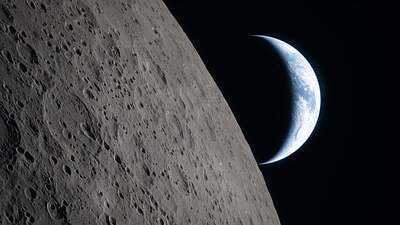
During the flyby, astronauts captured images of parts of the moon’s far side never previously seen directly by human observers, as well as a striking view of a total solar eclipse. The crew also recreated a modern version of Apollo 8’s iconic Earthrise photograph, showing Earth appearing to set behind the moon’s horizon.
NASA administrator Jared Isaacman described the mission as a key step in the agency’s plan to establish a sustainable human presence on the moon. “We are back in the business of sending astronauts to the moon, bringing them back safely and to set up for a series more. This is just the beginning,” Isaacman said.
The mission drew global attention, with messages of congratulations from political leaders and public figures including US President Donald Trump, Canadian Prime Minister Mark Carney, Britain’s King Charles III, actor Ryan Gosling and Star Trek actor William Shatner.
Despite the mission’s success, the nearly 10-day flight encountered minor technical issues, including valve problems affecting drinking water and propellant systems, as well as repeated malfunctions with the onboard toilet. Crew members said such challenges were part of the risks inherent in deep-space exploration.
“We can’t explore deeper unless we are doing a few things that are inconvenient,” Koch said. “Unless we’re making a few sacrifices, unless we’re taking a few risks, and those things are all worth it.”
Under NASA’s Artemis programme, Artemis III is expected to test docking manoeuvres with lunar landers in Earth orbit, while Artemis IV aims to land astronauts near the moon’s south pole in 2028, advancing plans for a sustained human presence on the lunar surface.
Reflecting on the mission, Wiseman said the crew hoped the journey would remind people of Earth’s fragility and shared responsibility. “We really hoped … the world pause and remember that this is a beautiful planet and a very special place in our universe,” he said.