India's upcoming Moon mission, Chandrayaan-4, presents a significant challenge for the Indian Space Research Organisation (ISRO). The mission aims to land on the Moon's southern pole and return samples to Earth, with a planned launch in October 2027. This mission will involve drilling into the lunar surface and collecting soil samples, which will be stored in vacuum-sealed containers for the journey back.
No country has successfully landed on the Moon's southern pole before. While the USA, the Soviet Union, and China have retrieved samples from the Moon, none have done so from this specific region, making this mission a historic endeavor. In preparation for this ambitious project, ISRO is considering a change in the rocket configuration.
Why Does Chandrayaan-4 Require Two Rockets?
To understand the need for two rockets, it's essential to recognize that Chandrayaan-4 consists of five spacecraft modules: an ascender module, a descender module, a re-entry module, a transfer module, and a propulsion module.
Think of this mission as a relay race with five participants, collectively weighing around 9,200 kilograms. India's most powerful operational rocket, the Launch Vehicle Mark-III (LVM3), can carry approximately 8,000 kilograms into low Earth orbit.
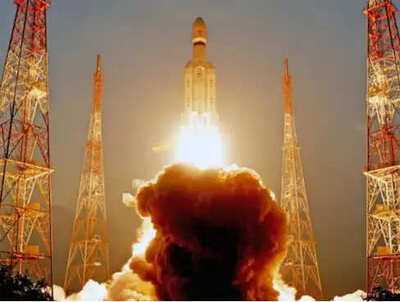
Chandrayaan-4 will be launched using two separate LVM3 rockets, each carrying different modules. This approach allows the mission to stay within the weight limits that a standard LVM3 can handle.
The first LVM3 rocket will carry the landing stack, which includes the descender and ascender modules, into Earth orbit. Shortly after, the second LVM3 rocket will launch the remaining modules—propulsion, transfer, and re-entry units—to rendezvous in space.
Once both rockets are in Earth orbit, they will perform a docking maneuver to combine into a single integrated unit. After this orbital handshake, the combined spacecraft will use its engines to travel to the Moon.
Upon reaching lunar orbit, the modules will separate for surface operations. The descender module will land on the Moon, while the ascender module will collect samples and return them to lunar orbit.
The transfer module will then take the samples to the re-entry module, which is the capsule that will bring them back to Earth. The propulsion module serves as the engine room for the entire operation, providing the necessary power to transport the spacecraft to and from the Moon.
ISRO is utilizing upgraded SE2000 engines on both rockets to ensure they have sufficient power and fuel for the docking process in space.
What Changes Has ISRO Made to the Rockets?
A parliamentary committee reported in March 2026 that the procurement of raw materials for the launch vehicle was postponed due to changes in the rocket's configuration, which now includes a semi-cryogenic engine.
This semi-cryogenic engine uses liquefied gas as an oxidizer and liquid hydrogen as fuel. The standard LVM3 employs a liquid-fueled core stage known as L110, which burns a propellant mixture of unsymmetrical dimethylhydrazine and nitrogen tetroxide.
Why Has ISRO's Budget Increased?
These modifications have led to an increase in ISRO's budget. For the 2025-26 fiscal year, ₹150 crores were allocated for Chandrayaan-4, but by January 2026, only ₹34.6 crores had been spent.
The parliamentary committee highlighted that the planned procurement of components was delayed because the launch vehicle's layout was still being finalized.
Will the Rocket Be Ready on Time?
The timeline for the project has become complicated. The SE2000 semi-cryogenic engine completed its third power head test article hot test in May 2025. This test focuses on the internal pumps that deliver fuel at high speeds.
The target for a fully integrated engine hot test is set for the end of 2026. According to the official mission calendar, the SC LVM3 equipped with this engine is expected to be ready by 2028-29.
Chandrayaan-4 is scheduled for launch in October 2027, but ISRO has not publicly clarified the gap between the engine's readiness and the mission's launch date.
There is a possibility that the engine crucial for this mission may not complete its testing before the scheduled launch date.