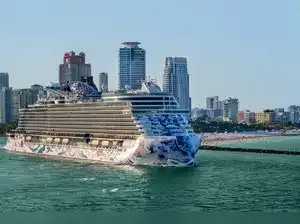
The cruise industry may be on the verge of a major transformation. This week, German shipbuilder Meyer Werft unveiled Project Vision, described as the world’s first fully battery-electric cruise ship. Designed to carry nearly 1,900 guests, the massive vessel could dramatically reduce emissions while reshaping how future cruise liners are built and operated.
ALSO READ: Big break ahead in Nancy Guthrie case? Detective says kidnappers may have made critical health error
With growing criticism over the industry’s carbon footprint, the timing of this reveal has sparked significant attention. More than just a design concept, Project Vision presents a bold attempt to make large-scale cruise travel cleaner and quieter.
German shipbuilder Meyer Werft has introduced what could become one of the most significant developments in sustainable maritime travel. Revealed this week at the Seatrade Cruise Global conference in Miami, Project Vision is being described as the world’s first fully battery-electric cruise ship.
At an impressive 902 feet long and weighing approximately 82,000 metric tonnes, or 90,000 US tons, the proposed ship is built on a scale rarely seen in zero-emission concepts. The vessel is designed to accommodate up to 1,856 passengers, making it dramatically larger than most sustainable ship concepts currently in development.
Can this cruise ship cut emissions by 95%?
According to Meyer Werft, the answer could be yes. “We asked ourselves how we can use innovation to reduce CO₂ and contribute to decarbonization — not in 50 years, but much sooner. We enable a reduction in greenhouse gas emissions of up to 95%,” Tim Krug from the Meyer Werft Concept Development Group said in a press statement.
This projected emissions reduction is one of the biggest talking points surrounding Project Vision. Cruise ships have long faced criticism for their environmental impact, particularly because of the large amount of energy required to power onboard amenities such as air conditioning systems, heated pools, lighting and hospitality services.
Unlike conventional liners, Vision would operate solely on battery power during standard journeys, eliminating direct exhaust emissions in normal operation.
ALSO READ: Roman Proverb of the Day: 'If you have done it, deny it'—The Timeless Roman proverb that exposes our instincts
The scale of Vision is what truly sets it apart. For comparison, Norway’s Hurtigruten Sea Zero concept, also designed with sustainability in mind, can carry around 500 passengers and combines battery systems with solar energy and rotor sails. Project Vision, however, takes the concept much further by going fully electric while still maintaining the size expected from a major cruise vessel, as per a report by The New York Post.
The ship’s battery system will be powered by Norwegian battery specialist Corvus Energy, using maritime battery technology that is already in active use.
“Scaling to fully electric cruise ships shows the world that the technology is safe, mature, and ready to change the game,” said Corvus Energy CEO Fredrik Witte.
The vessel is currently expected to be operational by 2031, with planned routes focused on Europe, where charging infrastructure is projected to expand significantly over the next few years.
Meyer Werft cited the Barcelona to Civitavecchia route near Rome as an example of an itinerary suited for the ship’s charging needs. Experts believe that by 2030, around 100 European ports may have charging facilities in place, as per a report by The New York Post.
The cruise sector has often been criticized for emissions and air pollution, particularly in busy port cities. Studies have shown that cruise liners generate more carbon dioxide annually on average than many other types of ships because of their heavy hotel-style energy demands. A 2019 report identified Barcelona as the most polluted European city from cruise ship sulfur oxide and nitrogen oxide emissions among 50 major ports.
Project Vision aims to directly address that issue.
“With battery‑electric cruise ships, we offer a competitive product that relies on existing technologies,” said Johannes Bade, leader of the development program behind the Vision concept.
“We are opening up entirely new opportunities for our customers to operate sustainably and profitably in the long term.”
Beyond sustainability, the design also focuses on passenger comfort. Without large main engines, the ship is expected to offer a quieter onboard experience with significantly reduced noise and vibration.
Another notable design change is the removal of the traditional exhaust funnel, which leaves the sun deck fully open and unobstructed for guests, as per a report by The New York Post.
The ship has also been designed as an all-season, all-weather vessel, with the standard water park concept reimagined as an indoor space for year-round use.
As one of the world’s leading cruise ship builders, Meyer Werft’s Vision concept could mark a major shift in how the next generation of cruise ships is designed — cleaner, quieter, and far more sustainable.
Q: How many passengers can Project Vision carry?
Up to 1,856 passengers.
Q: When is the ship expected to begin operations?
The current target is 2031.
ALSO READ: Big break ahead in Nancy Guthrie case? Detective says kidnappers may have made critical health error
With growing criticism over the industry’s carbon footprint, the timing of this reveal has sparked significant attention. More than just a design concept, Project Vision presents a bold attempt to make large-scale cruise travel cleaner and quieter.
German shipbuilder Meyer Werft has introduced what could become one of the most significant developments in sustainable maritime travel. Revealed this week at the Seatrade Cruise Global conference in Miami, Project Vision is being described as the world’s first fully battery-electric cruise ship.
At an impressive 902 feet long and weighing approximately 82,000 metric tonnes, or 90,000 US tons, the proposed ship is built on a scale rarely seen in zero-emission concepts. The vessel is designed to accommodate up to 1,856 passengers, making it dramatically larger than most sustainable ship concepts currently in development.
Can this cruise ship cut emissions by 95%?
According to Meyer Werft, the answer could be yes. “We asked ourselves how we can use innovation to reduce CO₂ and contribute to decarbonization — not in 50 years, but much sooner. We enable a reduction in greenhouse gas emissions of up to 95%,” Tim Krug from the Meyer Werft Concept Development Group said in a press statement.
This projected emissions reduction is one of the biggest talking points surrounding Project Vision. Cruise ships have long faced criticism for their environmental impact, particularly because of the large amount of energy required to power onboard amenities such as air conditioning systems, heated pools, lighting and hospitality services.
Unlike conventional liners, Vision would operate solely on battery power during standard journeys, eliminating direct exhaust emissions in normal operation.
ALSO READ: Roman Proverb of the Day: 'If you have done it, deny it'—The Timeless Roman proverb that exposes our instincts
Why is Project Vision different from other green ships?
The scale of Vision is what truly sets it apart. For comparison, Norway’s Hurtigruten Sea Zero concept, also designed with sustainability in mind, can carry around 500 passengers and combines battery systems with solar energy and rotor sails. Project Vision, however, takes the concept much further by going fully electric while still maintaining the size expected from a major cruise vessel, as per a report by The New York Post.
The ship’s battery system will be powered by Norwegian battery specialist Corvus Energy, using maritime battery technology that is already in active use.
“Scaling to fully electric cruise ships shows the world that the technology is safe, mature, and ready to change the game,” said Corvus Energy CEO Fredrik Witte.
The vessel is currently expected to be operational by 2031, with planned routes focused on Europe, where charging infrastructure is projected to expand significantly over the next few years.
Meyer Werft cited the Barcelona to Civitavecchia route near Rome as an example of an itinerary suited for the ship’s charging needs. Experts believe that by 2030, around 100 European ports may have charging facilities in place, as per a report by The New York Post.
Could this change the future of cruising?
The cruise sector has often been criticized for emissions and air pollution, particularly in busy port cities. Studies have shown that cruise liners generate more carbon dioxide annually on average than many other types of ships because of their heavy hotel-style energy demands. A 2019 report identified Barcelona as the most polluted European city from cruise ship sulfur oxide and nitrogen oxide emissions among 50 major ports.
Project Vision aims to directly address that issue.
“With battery‑electric cruise ships, we offer a competitive product that relies on existing technologies,” said Johannes Bade, leader of the development program behind the Vision concept.
“We are opening up entirely new opportunities for our customers to operate sustainably and profitably in the long term.”
Beyond sustainability, the design also focuses on passenger comfort. Without large main engines, the ship is expected to offer a quieter onboard experience with significantly reduced noise and vibration.
Another notable design change is the removal of the traditional exhaust funnel, which leaves the sun deck fully open and unobstructed for guests, as per a report by The New York Post.
The ship has also been designed as an all-season, all-weather vessel, with the standard water park concept reimagined as an indoor space for year-round use.
As one of the world’s leading cruise ship builders, Meyer Werft’s Vision concept could mark a major shift in how the next generation of cruise ships is designed — cleaner, quieter, and far more sustainable.
FAQs:
Q: How many passengers can Project Vision carry?
Up to 1,856 passengers.
Q: When is the ship expected to begin operations?
The current target is 2031.