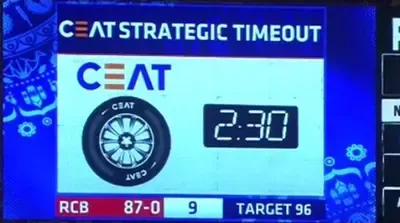
During an IPL match between MI and CSK in 2019, Rohit Sharma had called for a timeout at the beginning of the 14th over. MS Dhoni's team required 47 off 42.
It appeared achievable. After the timeout, three subtle changes in the field settings and aggressive bowling had left CSK 9 short of the target off the last ball. The match was entirely different following the 2.5-minute break. This was neither luck, nor a dropped catch; rather, a cleverly used Strategic Timeout.
What is the IPL Strategic Timeout?
The IPL Strategic timeout is a mandatory break of 2.5 minutes in each innings, where each team is allotted only one timeout per innings. This is not a matter of choice. Each team is required to avail this timeout only in a predetermined timeframe. The bowling side's timeout has to be taken between the 6th and 9th overs and that of the batting side must be between the 13th and 16th over of an innings.
While the fielding captain decides to call the timeout for the bowling team, the batting team usually reacts to their captain or team support staff. While fans may have an opinion that this time is merely a channel for advertising, players perceive it as an opportunity for tactical recalibration.
Why Was it Introduced?
Introduced in the year of the very first IPL in 2008, primarily for the benefit of broadcasters, the strategic timeout idea was based on simple reasoning: to give the television channels a scheduled break to telecast advertisements in a fast-paced game format. Teams, however, were quick to realize the strategic potential of the timeout. In T20 cricket, games can turn around in merely a couple of overs; coaches thus had an unprecedented opportunity to interact with players mid-match.
By IPL Season 3 & 4, teams were designing the game with the strategy of taking the timeout on the specific tactical cue, not just when prompted by the broadcaster. The commercial aspect rapidly transformed into a vital strategic maneuver.
Also Read | List of Mumbai Indians Batters to Score a Century in IPL History
When Captains Calls the Timeout
A good captain doesn't call the timeout as soon as the door opens. They know the perfect time. A good partnership can be disrupted, when both batters are scoring, they know to use this opportunity to change bowlers and change field. The delay alone can cause the timing to be off
A timeout taken at the right time can end a period of aggressive batting (e.g after 3 or 4 boundaries). Both teams have a chance to reset. Captains often take the timeout before their key bowler starts his final spell. During this break, the field settings and lines are decided to perfection.
For the batting side, timeout is taken once the wickets are down early in the innings. There is always a panic setting when quick wickets are falling. Timeout offers the batsmen a chance to reset, recalculate the chase, clarify roles of both the batsmen.
What they do in the 2.5 minutes?
The best sides utilize timeout very effectively and there is not just a lot of talk, there are strategies too.
For the bowling side, the focus is on match-ups, which bowler goes after which batter and which field setting is needed to tackle this batter. Frequently after a timeout, we have extra boundary fielders, before even a ball has been bowled.
The batting sides go about this differently. If the run rate needed keeps mounting up then it's the call of which batters will take the charge and who will keep the strike rotating. If the roles are not clarified it ends in both batsmen going for big hits.
The two overs that follow after a timeout seem to make or break a game as per data and it appears the sides that took the timeout at the appropriate time often make it through those overs better.
Mental Effects on Players
A short break changes the mental state. For a batter in the flow of play, a stoppage of 150 seconds may prove to be a hindrance. He may get in a defensive mindset, or, conversely be desperate for attacking play.
A breather helps the fielders. This applies especially for the Indian summer which may see teams suffering the strain of long matches. The timeout will help them sip water, get their breath back and get proper advice from a trusted captain.
For a bowler, it is a pause in the storm. It can allow a bowler who has conceded boundaries a chance to reassess and try a new tactic as opposed to reacting in haste and anger.
Also Read | 5 IPL Stars Who Went Unsold Once but Became Match-Winners
Does the Timeout Really Make a Difference?
Yes, the only caveat is that it needs to be well-timed. Teams that take a tactical timeout when the partnership is somewhere in the region of 30 to 50 are more likely to end the spell with a wicket. The break proves to be a little less beneficial if used with a partnership in the region of more than 60.
For teams batting second, a tactical timeout is more effective when the rate required has crossed 10 runs per over compared to when the rate crosses 14. Taking the break at the earlier instance helps maintain control.
However, a plain and simple fact remains: if the window is missed, no advantage would be gained.
Key Figures About the Strategic Timeout
| Situation | Impact |
| Timeout during 30–50 run partnership | Higher chance of wicket in next 2 overs |
| Timeout after 60+ partnership | Lower impact |
| Batting timeout at 10 RPO | Better chase success |
| Batting timeout at 14 RPO | Higher pressure, lower success |
| Leading team at timeout | Wins 61% of matches |
| Opponent forced early timeout | Wins 67% of post-timeout phases |
These stats demonstrate how it is the timing that matter more than the timeout itself.
Mistakes Commonly Made by Teams
Some teams squander the timeout. They call it at an inconvenient stage. Calling it over the 6 over mark without being in any trouble doesn't give you an opportunity later on.
Other teams will wait too long. Once a batter is on a roll, he isn't going to stop at a couple of minutes break.
Not being clear. The instructions must be crystal clear. Otherwise, that can be more problematic. Not being in sync with specific roles.
Captains tend to forget the window in their urgency of wanting to take it. That's one of the more expensive mistakes in the context of a match that is tightly poised.
Also Read | List of Batters Dismissed for 99 in IPL History
How Smart Teams Use It
Good teams see the timeout as an event in itself. A turning point, rather than simply another break in play. They should be focusing on both bowling changes and field changes simultaneously. When both change, that can be very impactful.
In chase situations, teams that called the timeout well ahead of the run rate needed to win have been much more successful. The purpose is often just to regroup and make it clear and stop them from panicking.
Conclusion
The strategic timeout in the IPL looks very innocuous. A little break in proceedings. However, it has proven to be decisive on numerous occasions. More often than not it is not about the timeout but the moves they make after taking it.
In fact the MI vs CSK match in 2019 at the Wankhede stadium illustrates how an effective 2.5 minutes break is more than enough to decide an entire game and when balls are going to fly at you thick and fast, even a brief lull in the action can indeed prove to be all important in the end.