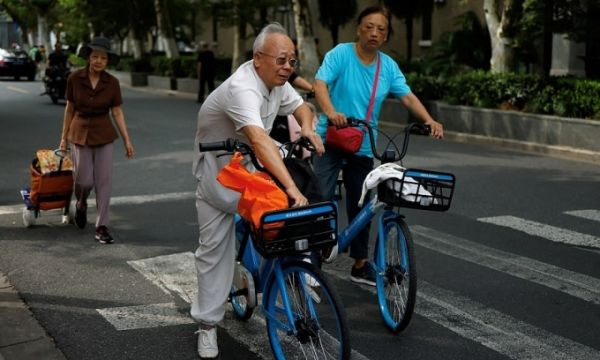
Bao Yi, a 73-year-old retiree in Shanghai, developed rheumatoid arthritis that left one arm nearly immobile last winter.
She began relying on her husband, Shi Mingao, 75, for daily tasks such as dressing, washing her face and opening bottles, according to Sixth Tone.
|
Elderly people ride bikes from a bike-sharing service on a street in Shanghai, China September 28, 2024. Photo by Reuters |
She had planned to have children after getting married in the 1980s. But a series of miscarriages, demanding work and the burden of caring for her sick father forced Bao to abandon the idea.
“By 38, I was at the peak of my career. I was probably in a state of constant exhaustion,” Bao said.
She said her father found it difficult to accept that he might never have grandchildren. When a cat she was raising gave birth, he threw the kittens out one by one, upset that she was “raising cats instead of children.”
Some of her colleagues also urged her to stop keeping cats, saying they were taking the place of future children.
“At first I took it to heart, but over time I made peace with it,” Bao recalled. She says she was never completely ready to have a child. “I wasn’t sure I could offer a child a stable family,” she said. “There were too many small things, too many uncertainties, and too many crucial moments in my career.”
Bao is part of the generation, when remaining childfree within marriage was uncommon and often criticized. Over the past decade, however, lifestyles like Bao’s have become more common. According to its 2020 census, China had about 188 million dual-income households without children, mainly in major cities such as Shanghai and Beijing.
As China ages rapidly, Bao’s generation is slowly confronting what old age looks like without children to rely on.
She said she does not regret her decision, adding that “even if we had a child, they would be busy with their own careers, their own lives, their own families.”
She lives in a 30-square-meter apartment and follows a fixed routine that includes waking up late, shopping online, drinking coffee and walking their two dogs. After retiring, Bao obtained a driver’s license, studied psychology and spends time interacting with artificial intelligence.
She sometimes scrolls through her phone contacts and stops at a friend’s name but does not call.
“If you bother friends just to chat. They may find you troublesome…But when you talk to technology like this, it doesn’t judge you,” she said.
She recently bought a robot dog and calls it the “youngest daughter.” In the evenings, she sits with her dogs and talks to them. “They should have been our daughter and son,” she said.
Zhou Ming and Jin Chenghua, another childless couple in Shanghai, present a different case.
Zhou retired early from his job after experiencing sudden, severe hearing loss. He does not use a smartphone and spends most of his time at home or in a nearby park. His wife is his main caregiver, taking him to medical appointments and helping him communicate.
“I could not even bear to see other people spending time with their kids. I felt so sad, in such immense pain,” Jin said. “I will never get to be a mother in this lifetime.”
She said she cannot fully understand younger Chinese choosing not to have children, especially for financial reasons. “A family without children remains incomplete,” she added.
During quarrels with her husband or on days when sickness leaves her home alone in bed, she still finds herself imagining what it might be like to have a child nearby, a little voice asking: “Mom, do you want some water?”