The 63-year-old says: “They wouldn’t let me book a hotel. They said I should stay with them so they could take care of me. That’s very unusual for Americans.”
The trip left a lasting impression. He is now considering selling his assets in the U.S. and retiring in Vietnam. He owns a machinery repair business in Georgia. After his wife passed away he lived with his youngest son, Nicholas, 28.
In 2023 Nicholas moved to Vietnam, where he married Vu Thi Huong, 25, of Bac Ninh. Wanting to understand their life, Timothy decided to visit.
Huong’s father, Vu Dinh Tu, prepared his home in Hiep Hoa Commune to welcome his son-in-law’s father. He explains: “He traveled a long way to visit us. In our culture, letting a guest stay in a hotel would feel impersonal.”
When he arrived during Lunar New Year festival (Tet) 2024 Horn found everything carefully arranged: towels, fresh bedsheets, a hair dryer, and even a separate set of utensils. “That level of care made me feel like I was being welcomed as a family member,” he says.
|
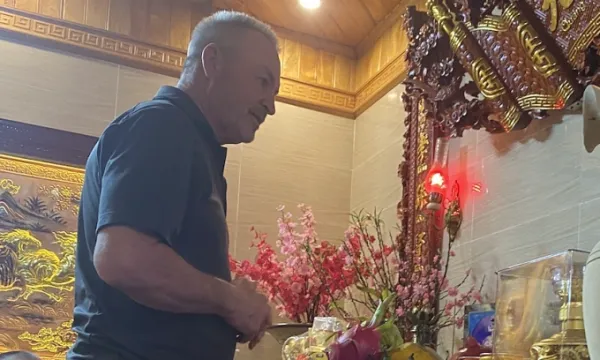
Timothy Dean Horn lights incense at the family altar during Tet 2026. Photo courtesy of the subject |
In the following days he joined the Tet preparations. He learned how to burn incense and arrange the traditional fruit tray, was shown how to cut banh chung using thin bamboo strings instead of a knife to create neat portions without the rice sticking.
The festive atmosphere reminded him of family gatherings in the U.S. in the 1970s when his family used to meet regularly at his grandmother’s home.
However, those connections gradually faded after her passing. “I feel like I have rediscovered something I lost a long time ago,” he says.
Within a few months, in May 2024, he visited Vietnam again to attend Huong’s sister’s wedding. He was struck by the strong sense of community, as neighbors and relatives shared responsibilities, from preparing food to decorating, without relying on professional services.
During his two-week stay he often woke up early to help with chores, causing Tu, fearing he might become tired, to frequently tell him to take it easy. The family also declined any financial contributions he offered.
From these experiences he noticed the evident differences in culture: Americans tend to value individual freedom but are often occupied with work and expenses, while Vietnamese place greater emphasis on sharing and community support.
 |
|
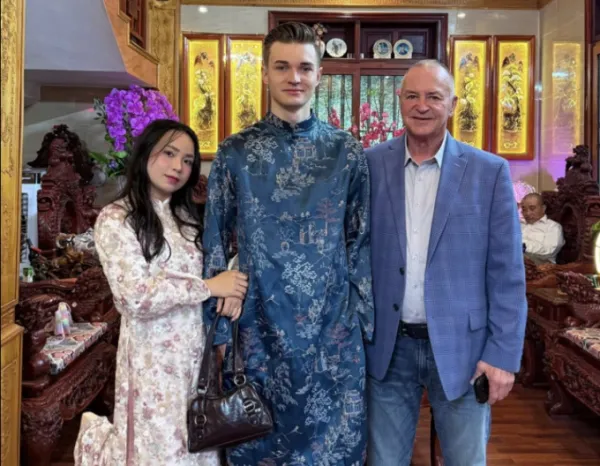
Vu Thi Huong, her husband Nicholas, and Timothy Dean Horn in northern Bac Ninh province during Tet 2026. Photo courtesy of Huong |
He returned once again in early 2025, this time taking the liberty of traveling directly to his son’s in-laws’ home by himself without either of them being present. The only challenge was the language barrier, as Tu’s grandson, the only English-speaking family member, was not around either.
But the two men managed using translation apps.
Tu recalls having to use his phone several times to clearly explain the ingredients of a pork intestines dish. “He tried every dish we offered, even shrimp paste. He also helped with everything, from cleaning to housework. His simplicity made us feel close.”
Huong says she was surprised by how quickly her father-in-law adapted to life in Vietnam. Her husband had told him how friendly Vietnamese people are and how they help each other without hesitation. “At first he could not imagine it, but he understood after living here.”
Every morning the two men would wake up early to drink tea and go for a walk. During his walks, he began greeting neighbors. An elderly woman would regularly smile and wave at him, and he would respond with “xin chao.” Occasionally, she would offer him snacks.
In the afternoons he would help pick up Tu’s granddaughter from school. His presence would pique the curiosity of local children, who would gather around him. At times he would stand and watch them play soccer in a field in front of the school.
When going into town, he learned how to navigate Vietnam’s traffic and the simple rule of “Once you step onto the road, do not hesitate; look straight ahead and keep going.” “Life in Vietnam is so engaging that I feel like I belong here,” he says.
Back in the U.S. he returned to living alone, going to work and tending his garden. He found himself missing the lively atmosphere of the house in Bac Ninh, where people were always coming and going.
By his fourth visit in February 2026, he felt fully integrated into daily life, helping with chores, washing dishes, cleaning the house, cutting banh chungand stuffing envelopes with “lucky money” for children during Tet.
“I am seriously considering selling everything in the U.S. and moving here long term,” he adds.