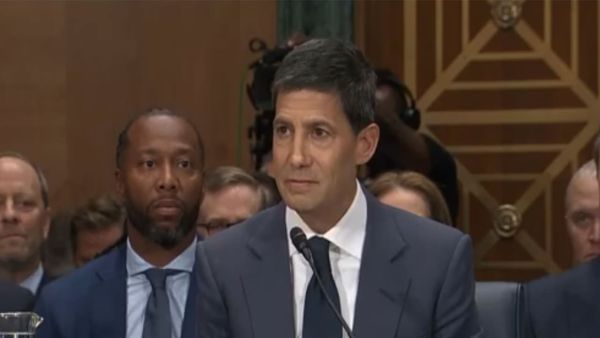
Fed Chair nominee Kevin Warsh on Tuesday said artificial intelligence could prove to be the "most productivity enhancing wave of our lifetimes," but the central bank must first secure better data and resist making policy bets on gains that may not materialise.

Testifying before the Senate during his confirmation hearing on Monday, Warsh positioned AI as both an opportunity and a challenge for monetary policy, while underscoring the Fed's role in defending the dollar's dominance amid geopolitical rivalry. Pressed on whether his interest-rate views depend on AI-driven productivity gains arriving quickly, Warsh said the supply-side impact could be large but uncertain. He warned against using AI as "an excuse for making good policy," saying "too many families' lives depend on it."
At the same time, he argued that "the interest rate tool is the tool that allows you to help working Americans much more than the balance sheet tool." Warsh said the Fed needs to "get access to better data and to dig deeper into the productivity possibilities that can come out of this new investment wave." He stressed that monetary policy operates with "long and variable lags," forcing policymakers to make "informed judgments." And if those judgments are wrong, "you've got to call the flag on yourself and correct them."
The nominee also outlined how the Fed can reinforce confidence in the dollar outside of monetary policy. "The dollar is the linchpin of the global economy. The United States and the Federal Reserve is a beneficiary of the strength of the dollar," he said. While the Treasury leads the economic statecraft agenda, the Fed should play a "supporting role in ensuring that the financial system is as safe as it can be" and work with Treasury and State to keep the U.S. "on its front foot" during rivalry with other nations.
On the challenge from China's digital yuan and payments outside SWIFT, Warsh said the answer lies in a "more robust payment system." He was blunt about the Fed's current infrastructure: "The Fed has a number of payment systems that most financial participants in the world use. I would say they all are in need of substantial reform. There's a system called FedNow, which some describe as FedYesterday." He urged the Fed to "oversee and architect" new technologies so that the U.S. payment system remains "the safest, most efficient, most capable in the world. Otherwise, we'll be losing to adversaries around the world in being the linchpin of the global economy."
Warsh clarified that when he has spoken of "regime change" at the Fed, he meant "policy regime change," not removing the 12 regional bank presidents whose terms were renewed in December. He also reaffirmed Fed independence, saying the institution is "independent inside of government, not independent of government."
The nominee distanced himself from the idea of a central bank digital currency, stating: "They don't have the right and I think it would be a bad policy choice." He added that under his chairmanship, the Fed would not "explore or any way move towards a central bank digital currency."
Warsh said average working Americans are "better off than they were three years ago because three years ago you were getting demolished by generationally high inflation," though he added that "we're not done and we have a long way to go."
The hearing concluded with the committee setting an April 22 deadline for written follow-up questions, with responses due by April 23. (ANI)
(Except for the headline, this story has not been edited by Asianet Newsable English staff and is published from a syndicated feed.)