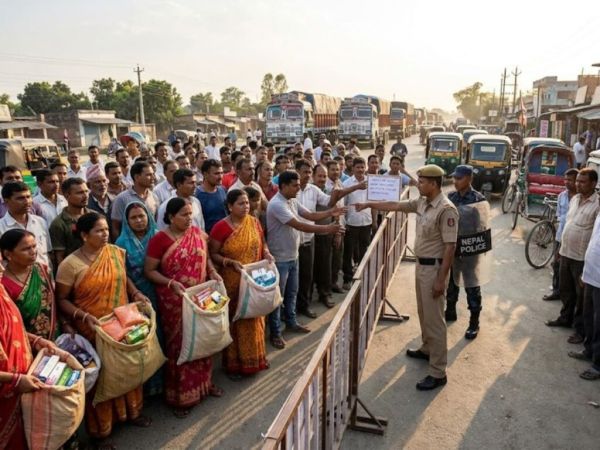
The seamless border movement between India and Nepal is witnessing a strain. Over the decades, Kathmandu has been importing essential items form India including groceries, medicines, wedding essentials and electronics. However, the new Prime Minister of the neighboring country, has enforced stricter customs duties, triggering widespread protests within just a month of his assuming office. The Nepal government has mandated customs duties on goods worth more than Nepalese Rupees (NPR) 100 (approximately INR 63) brought in from India. Depending on the category, duties reportedly range between 5% and 80%.
While the rule itself is not new, authorities have begun strictly enforcing it since last week, following the Nepali New Year. This move has sparked anger, especially in border regions where reliance on Indian goods is deeply entrenched.
The India-Nepal border, among the most open in the world, has traditionally enabled daily cross-border movement. Labourers and professionals from Nepal come to India regularly, while many others visit border bazaars for essentials such as food, clothing, utensils, electronics, and festival- purchases.
Officials maintain that the strict enforcement aims to address economic concerns. According to reports, the government acted after receiving complaints that frequent cross-border shopping was hurting local businesses and leading to revenue losses.
The crackdown has led to protests in key locations, including Birgunj and the capital, Kathmandu. Demonstrators argue that the decision directly impacts their daily lives and increases financial strain.
“For the rituals performed here from birth to death, we bring all the essentials from India. Even fertilisers that the Nepal government cannot provide on time, we get them from there. Now the situation has changed; it is an unannounced blockade,” a protester told ANI.
Residents in border areas say the move will significantly disrupt their dependence on cross-border purchases. Reports indicate growing confrontations between civilians and customs officials, with videos surfacing online showing
The decision is not only affecting Nepali consumers but also Indian businesses along the border. Shopkeepers, auto-rickshaw drivers, taxi operators, and porters who rely heavily on Nepali customers are witnessing a sharp decline in footfall.
Incidents at border checkpoints have further intensified public anger. In one widely circulated video from Nepalgunj, a woman carrying a few packets of chips for her children was stopped by authorities and told her items would be seized.
“I have only four-five packets of chips. Give me the money I spent on them, and I’ll allow you to seize them,” she said while confronting officials.
“All these shops in Nepal have Indian products, first stop them and then take action against us,” she added.
A Nepal Police official, responding to the confrontation, said,
“We are only following orders given to us.”
The move has triggered strong political reactions. Binay Yadav termed the enforcement an “undeclared blockade,” arguing that it violates the provisions of the 1950 Peace and Friendship Treaty between India and Nepal.
“This step is against the treaty provisions. The government should immediately remove the customs limit for household items and instruct security personnel to behave in a citizen-friendly manner,” Yadav told The Times of India.
He also warned of larger protests across the border region if the order is not rolled back.
Opposition party Nepali Congress has demanded immediate withdrawal of the policy, calling it “anti-people and insensitive.”
Criticism has also emerged from within the ruling Rastriya Swatantra Party (RSP). Party member Rajiv Jha described the rule as impractical:
“Setting a limit of NPR 100 in today’s inflation era is extremely low and impractical. The government should review the matter immediately.”
Zubair Amin is a Senior Journalist at NewsX with over seven years of experience in reporting and editorial work. He has written for leading national and international publications, including Foreign Policy Magazine, Al Jazeera, The Economic Times, The Indian Express, The Wire, Article 14, Mongabay, News9, among others. His primary focus is on international affairs, with a strong interest in US politics and policy. He also writes on West Asia, Indian polity, and constitutional issues. Zubair tweets at zubaiyr.amin
The post Why Nepal Is Cracking Down On Indian Goods: All About The India-Nepal Border Tensions, Protests & ₹63 Limit Rule Under Balendra Shah appeared first on NewsX.