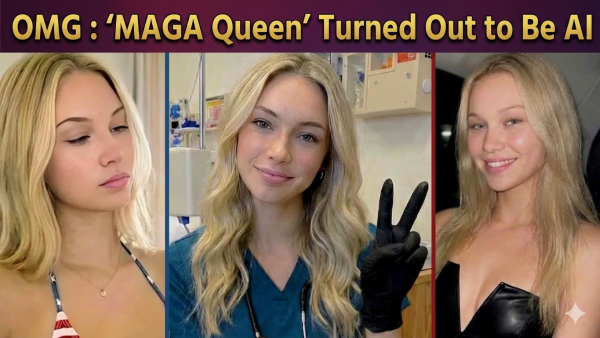
In today’s digital age, can we really trust what we see online? What if you were told that a 22-year-old Indian medical student, sitting in his room in North India, was running a virtual “American woman” whom millions not only followed—but also spent money on without hesitation?
This is the story of “Sam” (name changed), who used Generative AI as his weapon and exposed a dark intersection of technology and politics—one that has left even top global experts stunned.
The Birth of ‘Emily Hart’ to Fund a Medical Dream
Sam aspired to become an orthopedic surgeon and practice in the United States. However, the high cost of medical education and licensing exams made this dream nearly impossible.
That’s when he began an experiment—one so striking that it compelled journalist Azeen Ghorayshi to cover similar AI phenomena in global media.
Using AI tools, Sam created a virtual persona named Emily Hart. She was portrayed as a blonde, attractive, conservative American woman. On Instagram, she appeared as a “nurse” who strongly supported Donald Trump, promoted Christianity, loved guns, and aligned herself with the MAGA (Make America Great Again) ideology.
The ‘Cheat Code’: Targeting a Niche Audience
Initially, Sam posted generic content but saw little success. He then refined his strategy—reportedly using AI guidance—to focus on a niche audience.
He realized:
- The “hot influencer” space was overcrowded
- He needed a distinct niche to stand out
- Conservative/MAGA audiences were highly engaged, loyal, and financially supportive
Soon, Emily began posting provocative captions supporting pro-life views, opposing abortion, and criticizing immigration.
The result? Each reel started generating between 3 million to 10 million views.
From Followers to Profits: AI, Adult Content & Merchandise
As Emily’s following surged, Sam monetized the account further.
He used AI tools to generate explicit images of the avatar and sold them on subscription-based platforms like Fanvue. Additionally, he sold merchandise such as pro-Trump slogan T-shirts.
Shocking detail
Sam reportedly worked just 30–50 minutes a day, yet earned thousands of dollars per month—more than what many established doctors earn in India.
When AI Feels More Real Than Humans
Experts warn that AI-generated personas are becoming nearly indistinguishable from real people.
According to analysts, these fake profiles are now so realistic that detecting them is extremely difficult. While platforms like Instagram attempt to label AI-generated content, savvy users like Sam often find ways to bypass these safeguards.
How to Protect Yourself from AI Scams
Experts recommend a few simple checks:
- Reverse Image Search: Upload suspicious profile pictures to Google to verify authenticity
- Check the Hands: AI images often distort fingers or joints
- Consistency Test: Does the person ever go live or interact in real time? AI profiles often rely on static images and short clips
Sam’s Defense: “I Didn’t Scam Anyone”
Sam’s account was eventually banned in February for fraud, but he remains unapologetic.
His argument:
“I didn’t force anyone. I just gave people what they wanted to see. If they’re ‘mega fools,’ how is that my fault?”
A Growing Threat Beyond Entertainment
This case highlights a dangerous trend: AI influencers and deepfake personas are no longer just tools for entertainment. They are increasingly being used for political propaganda, manipulation, and financial exploitation.