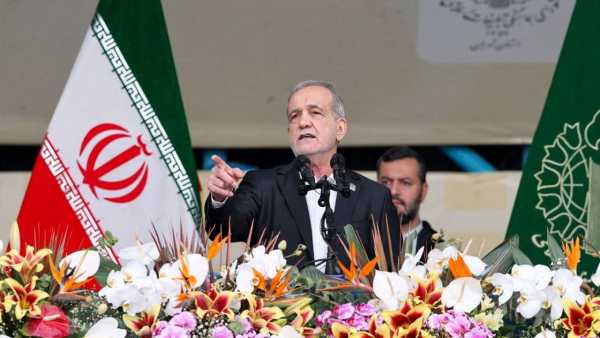
Iranian President Masoud Pezeshkian has adopted a tough stance regarding direct talks with America. He has clearly said that as long as the American naval blockade continues, no direct talks are possible. He has clearly refused direct talks with the US.
He reiterated this in an important phone conversation with Pakistan Prime Minister Shahbaz Sharif on Saturday. He stressed that the main obstacle to peace is not the lack of dialogue, but the hostile actions currently being taken by Washington.
Pezeshkian clearly said that Iran will not negotiate under any kind of pressure, threat or economic-military blockade. He said that the real problem in the current situation is not the lack of communication, but America's hostile policies. He also said that unless America's hostile actions and pressure stop, it will be difficult to create an environment of trust and take the talks forward.
The Iranian President advised the US that if it wants to resume negotiations, it will first have to remove all military and economic obstacles, including the naval blockade. According to him, this step will be the first sign towards restoration of confidence. He further said, 'Our advice to America is that it should first remove the obstacles, including the naval blockade, so that dialogue can resume and a platform can be provided to resolve the issues'.
This statement has come at a time when tension between the two countries has been continuously increasing for the last eight weeks. Many ports of Iran have been affected due to the US naval blockade since April 13. Earlier, the high level peace talks held in Islamabad also could not reach any conclusion, due to which the situation has become more complicated.
Meanwhile, US President Donald Trump canceled the visit of his senior advisor Jared Kushner and special envoy Steve Witkoff to Pakistan. Describing this decision as expensive and lengthy, he said that there is no point in meeting such officials whose international identity is limited.
Speaking at Palm Beach International Airport, Trump also said Iran's offer was enough, but not enough, especially in the context of the US demand that it stop uranium enrichment for 20 years. In fact, Trump had canceled the visit of senior adviser Jared Kushner and special envoy Steve Witkoff, who were scheduled to go to Islamabad for a new round of talks. They cited the long travel period, high cost and the absence of Iran's senior leadership in the proposed meetings.
Describing himself as a cost-conscious person, Trump said that we are not going to travel 15-16 hours to meet people about whom no one has ever heard before. Despite the deal's cancellation, Trump claimed that Iran immediately submitted a revised and much better proposal and reiterated that Washington's original demands remained unchanged. Iran should not acquire nuclear weapons. He also dismissed concerns about a ceasefire, saying he had not even thought about it.
Earlier, Iran's Foreign Minister Abbas Araghchi had said that Tehran has shared a practical framework with the Pakistani leadership to permanently end the conflict. However, he also raised questions on America's diplomatic commitment. The Iranian delegation returned from Islamabad after presenting an official list of demands. Due to which Pakistan's mediation efforts seem uncertain at the moment. Uncertainty surrounded Pakistan's mediation efforts.