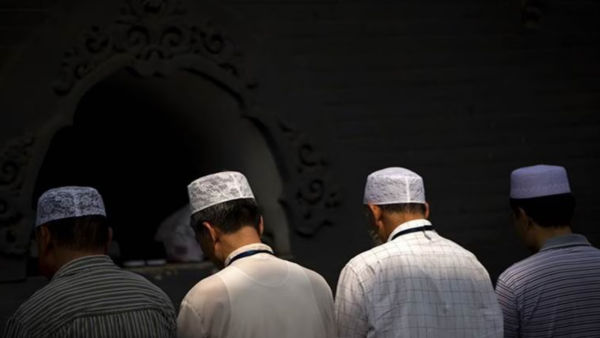
Prayagraj: The Allahabad High Court dismissed a man’s petition seeking directions to offer namaz on his private land in Uttar Pradesh’s Sambhal, and said the right to practice religion is subject to public order and can’t be exercised in ways that interfere with the rights of other individuals.
“The Constitution protects the right to practice religion, but it also makes it clear that this right is subject to public order, morality and health. It is not an unlimited right. It cannot be exercised in a way that affects others or disturbs the normal functioning of public life,” the Court said.
A division bench of Justices Saral Srivastava and Garima Prashad said that if namaz at private property is used for frequent, large-scale prayers, such conduct may shift the primary purpose of the premises. The act may be subject to appropriate laws and local regulations.

The Court said private property may be used for personal and “limited religious activity so long as it remains genuinely private, occasional and non-disruptive.”
If the activity extends into regular and organised congregational activity involving others from outside, “it falls outside the protected domain and may attract regulatory control,” the Court said.
The Court was hearing a petition by Aseen, who sought directions to the District Magistrate to provide security and permission to pray at his private premises in Ikona village in Sambhal‘s Gunnaur.
The petitioner’s counsel furnished the High Court’s recent orders on petitions that asked for similar relief.
The bench clarified that earlier rulings permitting prayer meetings without prior permission cannot be interpreted as holding organised or regular congregational activity on private land.
“They (earlier verdicts) recognise a limited protection, namely where prayer remains confined to a private, non-disruptive setting. Where the activity extends beyond that sphere and begins to affect the public domain, lawful regulation follows. These decisions do not confer a right to convert private premises into an unregulated congregational space,” the Bench observed.
The court also emphasised that authorities are not required to wait for an actual conflict to arise before acting. If an activity is expected to disrupt public peace, the State may intervene, basing the decision on public impact rather than its religious nature.
Appearing for the state, the Standing Counsel claimed the land is public property and the petitioner has no right to it. The government added that the gift deed is invalid because it lacks clear official records.
The court was informed that the Sub-Divisional Magistrate submitted a report stating that prayer is traditionally held there for Eid, and no restriction was imposed then.
However, it was pointed out that the petitioner was attempting to initiate large-scale regular prayers by inviting outsiders. It was further noted that the village has remained peaceful for decades with a mixed population.