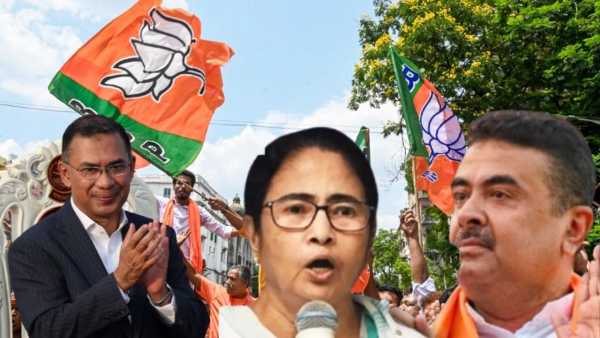
Bangladesh's BNP party leader and Information Secretary Azizul Bari Helal has expressed surprise at the election results of Bengal. He said that I am surprised that TMC lost the elections in West Bengal after being in power for so many years. At the same time, he has expressed happiness over the victory of BJP under the leadership of Suvendu Adhikari and congratulated him. He said that Suvendu's arrival will further strengthen the relations between the two countries.
Helal said that I hope that with the arrival of Suvendu Adhikari, relations between the governments of West Bengal and Bangladesh will become stronger.
He also said that earlier Mamata Banerjee was obstructing the Teesta water agreement. Now with the arrival of Suvendu Adhikari, the way for this agreement will be cleared, which was needed by the Government of Bangladesh and India for a long time. He said that even though the ideologies of his party and BJP are different, they think alike on peace between India and Bangladesh and the Teesta issue.
#WATCH | Dhaka, Bangladesh | On the results of West Bengal assembly elections 2026, BNP Information Secretary Azizul Baree Helal says, “I am stunned that in West Bengal, TMC, was massively defeated after holding power for a long time. I congratulate the winner, Suvendu Adhikari's pic.twitter.com/xKVbWp80Xr
— ANI (@ANI) May 6, 2026
BJP has made a historic performance in West Bengal. BJP is going to form government here for the first time. The new government will be sworn in on May 9. BJP has won 207 seats in Bengal while TMC was limited to only 80 seats. Chief Minister Mamata Banerjee could not even save her seat. He suffered a crushing defeat in Bhawanipur. Suvendu defeated him by 15114 votes.
The Bangladeshi leader said that now with the arrival of Suvendu Adhikari, the way for the Teesta water agreement will be cleared. Mamta was stopping it. Actually, Teesta Water Agreement is an agreement between India and Bangladesh, the objective of which is to ensure fair distribution of Teesta river water. This issue has been a topic of discussion between the two countries for decades. This river originates from the Himalayan region of Sikkim state of India.
After Sikkim, it flows through West Bengal and finally enters Bangladesh, where it joins the Brahmaputra River. It is the fourth largest river of Bangladesh and is the main basis of agriculture and livelihood of crores of people there. There was an agreement in 1983 under which India got 39 percent and Bangladesh got 36 percent of the water, while the distribution of the remaining 25 percent was not decided.
A new treaty was going to be signed between the Government of India and Bangladesh in 2011. Under this, there was a proposal to provide 42.5 percent water to India and 37.5 percent water to Bangladesh during December to March. West Bengal Chief Minister Mamata Banerjee had opposed this agreement.