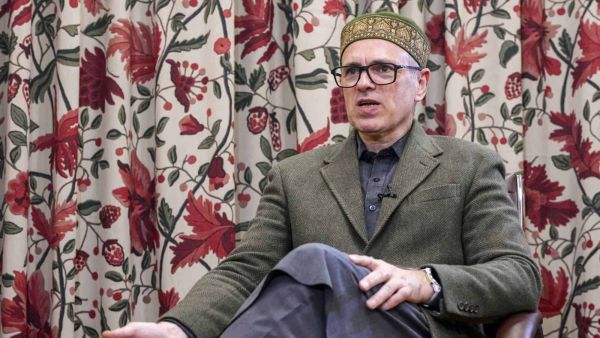
Srinagar: Warning against “working in silos”, Jammu and Kashmir Chief Minister Omar Abdullah has highlighted the disconnect between the security apparatus and the people’s representatives and asserted that the region’s security challenges cannot be resolved only through a purely military lens.
Talking to PTI here about the aftereffects of last year’s Pahalgam massacre of 26 people by terrorists, Abdullah spoke about the complexities of counter terrorism and revival of tourism and argued that keeping the elected government “totally disconnected” from the law-and-order machinery hampers the cross-flow of vital information.
“The problem is that you’re trying to deal with a security situation purely as a security situation. That is never going to be the case. The causes of terror and the effects of terror both have linkages to the wider community.

“And therefore, when you operate in silos, when the elected government and the elected representatives are kept totally disconnected from the security and the law and order apparatus, then you will end up with this situation,” the chief minister said while referring to busting of terror modules recently by the Srinagar police that remained elusive for many months.
In a sharp observation on the disconnect between the law and order machinery and the people’s representatives, Abdullah said that the existing gap is so wide that even basic professional courtesies, like a police officer saluting an elected official, have become a source of professional anxiety.
“Today, a police officer thinks twice before saluting an MLA, a minister, or a chief minister… First, the poor guy is worried about whether he should salute. Then, if he gathers the courage to do so, he looks to his right and left and thinks: ‘Did anyone see me? Will my job be in danger?’ This is the situation you’re dealing with,” he said, laughing at the paradox.
He added that when the police don’t even know whether they should be part of a civil function of the elected government, the cross-flow of information also becomes a bit problematic.
“And again, I make the point, you cannot deal with terror or law and order purely from the security prism. Take, for example, what the LG (Manoj Sinha) is doing these days with the Nasha Mukt Abhiyan. Drug trafficking is primarily a security problem. It is primarily an enforcement problem of stopping drugs from entering Jammu and Kashmir.
“But why is he doing foot marches? Why is he involving the general population? Because it’s not just a law and order problem, right? It’s a societal problem with law and order aspects. Same is true for terror. It is a law and order, it is a security problem. But it is not exclusively a security problem,” he said.
On the rise of terror modules and intelligence gathering, Abdullah shared a stark reality regarding his own access to sensitive data and said, “I get my intelligence from Twitter (X),” while highlighting the exclusion of the elected government from the security loop.
He said that treating terror purely as a security issue, without involving the wider community via their representatives, is a flawed strategy.
The chief minister also touched upon the delicate task of reviving tourism, which faced a setback after the “unfortunate” incident at Baisaran, Pahalgam, on April 22 last year. While domestic arrivals have increased, he noted that the sector remains a “victim of the geopolitical situation” and added that the conflict in Iran had a “dampening effect” on bookings with many potential travellers fearing Covid-style lockdown.
Refusing to focus solely on “numbers and arrivals”, Abdullah said he wants to avoid the “hype” that contributed to the volatile situation last year. “Confidence (of tourists) takes time…you can’t bring it back in a week or a month. While people are more confident than they were last year, we realise that more needs to be done.”
The chief minister said that his government remains aware of the “limitations” it operates under but is committed to chipping away at the atmosphere of fear to ensure that both trekkers and domestic tourists return to the valley in healthy numbers.