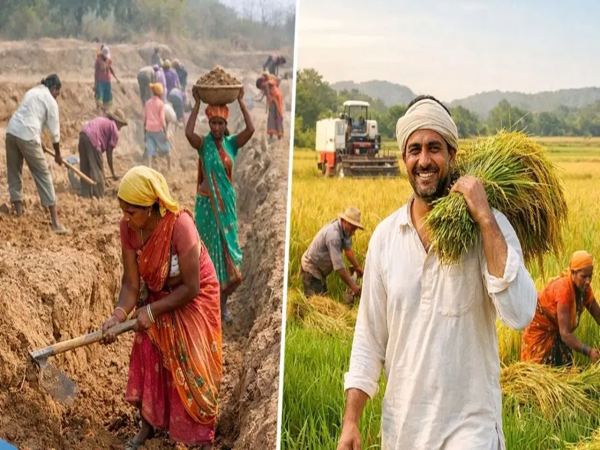
The Central Government announced on Monday that the new ‘Viksit Bharat Guarantee Act’ (Rural)—or VB-G RAM G Act, 2025—for the Employment and Livelihood Mission (Rural) will come into force across India starting July 1. This Act will replace the Mahatma Gandhi National Rural Employment Guarantee Act (MGNREGA). The government has presented this legislation as a ‘next-generation rural development framework,’ aligned with the vision of ‘Viksit Bharat 2047.’ Under this Act, the provision for guaranteed wage employment is pledged to be increased from 100 days per year to 125 days; furthermore, rural employment will be more robustly integrated with infrastructure development, climate adaptation, and village-level planning.
However, opposition parties and labor rights activists have expressed concern over the phasing out of MGNREGA. They argue that the existing legislation has evolved into a ‘rights-based social security framework.’ They have also warned that increasing digitalization, face-authentication-based attendance systems, and administrative restructuring could create barriers for workers belonging to vulnerable sections of society.
What changes will the new legislation bring?
Under the new Act, every rural household whose adult members volunteer to undertake unskilled manual labor will be entitled to 125 days of guaranteed wage employment within a financial year. Under MGNREGA, this limit stood at 100 days. The Central Government stated that this scheme will focus on four primary categories of works: water security projects, core rural infrastructure, livelihood-related infrastructure, and works aimed at mitigating the impacts of extreme weather conditions. Under MGNREGA, works were categorized into broader heads such as water conservation, drought-proofing measures, irrigation, renovation of traditional water bodies, land development, and flood control.
This legislation also introduces the concept of ‘Viksit Gram Panchayat Plans’ (VGPPs). These plans will be formulated by Gram Panchayats and approved by Gram Sabhas, serving as convergence-based local development plans. According to the government, all works undertaken under this Act must stem from these very ‘Village Development Plans’ to ensure “needs-based and saturation-focused” rural development.
How will this transition take place?
The Central Government has stated that the transition from MGNREGA to the new legislation will be “smooth and seamless.” MGNREGA will formally cease to exist on July 1, 2026. The VB-GRAM G Act will come into effect on this very same date. Ongoing works under MGNREGA will continue and will be integrated into the new framework. The government has stated that priority will be given to completing unfinished public assets and ongoing projects. For laborers whose e-KYC has already been completed, their existing Job Cards will remain valid until the new “Rural Employment Guarantee Cards” are issued. The government has also clarified that if ongoing works are insufficient to meet the demand for labor, new works may also be initiated during this transitional phase.
What remains unchanged?
It remains mandatory to provide work within 15 days of a demand being made; should this fail to happen, laborers become entitled to an unemployment allowance, which is paid by the State Governments. Wages will continue to be disbursed directly into bank or post office accounts via Direct Benefit Transfer (DBT), and such payments must be made weekly or within two weeks of the closure of the master roll. The provision for providing compensation in the event of delayed wage payments has also been retained in this legislation.
What are the new administrative features?
Attendance at worksites will now be recorded using a system based on ‘Face Authentication’ (facial recognition). However, the government has stated that certain exemptions will be granted in cases involving poor connectivity, technical glitches, or other genuine difficulties. Another key feature is that there will be a moratorium on commencing work during the peak agricultural seasons. State governments will issue notifications regarding this to ensure that there is no shortage of labor during the sowing and harvesting periods.
How will it be funded?
Under this scheme, the funding pattern for the states is as follows: 90:10 for the Northeastern and Himalayan states; 60:40 for other states and Union Territories with a Legislative Assembly; and 100 percent central funding for Union Territories without a Legislative Assembly.
The ceiling on expenditure incurred on materials has been fixed at 40 percent at the district level. Under MGNREGS, the Central Government used to bear 100 percent of the wage costs, while the cost of materials was shared between the Centre and the States in a 75:25 ratio.
Why is this new legislation needed?
The government argues that this new framework modernizes rural employment by integrating livelihood support, infrastructure creation, and climate change resilience. Officials state that the objective of this legislation is not merely to remain confined to being a "demand-driven wage program," but rather to transition toward a development model that converges various schemes and facilitates better planning at the village level.
Disclaimer: This content has been sourced and edited from TV9. While we have made modifications for clarity and presentation, the original content belongs to its respective authors and website. We do not claim ownership of the content.