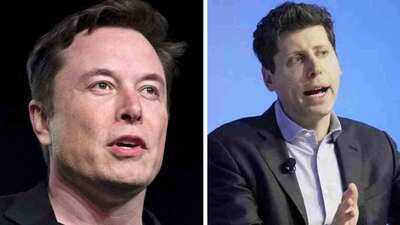
OpenAI co-founder and CEO Sam Altman has taken the witness stand in a high-stakes trial pitting some of the world's richest technology tycoons against each other.
Testifying on Tuesday, Altman rejected Elon Musk's claim that he betrayed the company's founding mission to serve the public good.
Altman said it was rather Musk, the world's richest person, who was interested in seizing control of the artificial intelligence startup.
Why is Musk suing Altman and OpenAI?
OpenAI, the creator of ChatGPT, was founded as a nonprofit in 2015 by several entrepreneurs, including Musk and Altman. It established a for-profit subsidiary in 2019.
In the civil lawsuit being tried in a federal court in Oakland, California, Musk accuses Altman, OpenAI president Greg Brockman and the company itself of abandoning its original mission to benefit humanity and instead become a for-profit corporation.
OpenAI counters that Musk, who is now also an AI player with xAI and its Grok chatbot, is motivated by petty revenge.
They claim Musk only filed the lawsuit after having failed to seize majority control of OpenAI's commercial entity.
Altman says Musk wanted OpenAI majority control
Asked by his lawyer on Tuesday whether Musk opposed the for-profit plan, Altman said: "Quite the opposite."
He alleged that Musk demanded a huge controlling stake.
"An early number that Mr Musk threw out was that he should have 90% of the equity to start," Altman told the jury. "It then softened, but it always was a majority."
He said he was "extremely uncomfortable" with ceding majority control even as Musk lessened his demands.
Musk even said he might pass the company onto his children, Altman said, when asked what would happen to OpenAI upon his death.
Musk's reply was a "hair-raising moment" in the early days of OpenAI, Altman said.
"I didn't feel comfortable with that."
Under ?questioning ?from his lawyer, Altman denied Musk's claim that he and Brockman tried to "steal a charity."
"It feels difficult to even wrap my head around that framing," Altman said.
He hoped that "as OpenAI continues to do well, the nonprofit will do even better," he said.
Musk is seeking about $150 billion in damages from OpenAI and co-defendant Microsoft, a major OpenAI investor, to be paid to an OpenAI nonprofit.
Musk's legal case demands that OpenAI revert to nonprofit status. This move would impact its position in the global artificial intelligence race against Anthropic, Google and China's Deepseek.
He also wants Altman and Brockman removed from their roles.
Altman faced questions about lying
Lawyers for Musk have sought to portray Altman as a liar about his plans for OpenAI.
During a cross-examination on Tuesday, Musk's lawyer Steven Molo challenged Altman's honesty.
He cited testimony from a former OpenAI board member that Altman fostered a "toxic culture of lying" and from seven former OpenAI officials who said Altman wasn't trustworthy.
"Have you misled people when you do business?" Molo asked Altman.
"I believe I am an honest and trustworthy businessperson," Altman responded.
"That's not my question. Have you misled people when you do business?"
"I do not think so."
OpenAI's chairperson, Bret Taylor, testified separately on Tuesday that OpenAI received a formal takeover offer from a consortium led by Musk's rival company ?xAI in February 2025, six months after Musk sued.
"I was surprised," Taylor said. "This proposal was to acquire this non-profit by a group of for-profit investors, which felt contradictory to the spirit of the lawsuit."
The trial is now in its third week. An advisory jury is expected to reach a verdict on any actual wrongdoing by the week of May 18.