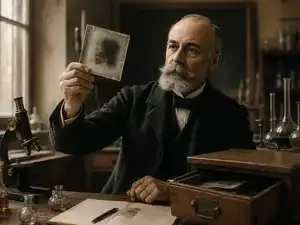
A cloudy day, a forgotten drawer, and a scientist who refused to ignore a strange result — that’s how the world accidentally stumbled into the terrifying and fascinating age of radioactivity.
Back in 1896, French physicist Henri Becquerel was trying to understand a scientific mystery sparked by Wilhelm Röntgen’s discovery of X-rays a year earlier. Like many scientists of the era, Becquerel wondered if glowing materials could produce similar invisible rays.
He picked uranium salts for his experiments and planned to expose them to sunlight before placing them on photographic plates wrapped in black paper. But nature had other plans.
Clouds rolled in. The experiment was delayed. The plates and uranium salts were shoved into a desk drawer and forgotten.
Days later, Becquerel developed the plates — and was stunned.
Even without sunlight, the photographic plates had turned dark. Something from the uranium itself had passed through the wrapping and exposed them. The element was mysteriously releasing energy on its own.
That shocking moment shattered one of science’s biggest assumptions: that atoms were stable and unchanging forever.
Instead, uranium appeared to be alive with invisible energy.
The discovery sent shockwaves through the scientific world. Becquerel realized he wasn’t looking at ordinary light or phosphorescence. He had uncovered an entirely new phenomenon — what the world would later know as radioactivity.
Soon, pioneering scientist Marie Curie expanded the research and coined the term “radioactivity.” Alongside her husband Pierre Curie, she discovered powerful radioactive elements like polonium and radium, opening the door to a scientific revolution.
What started as a few mysterious black spots on a plate soon transformed human understanding of matter itself.
Scientists discovered that atoms could break apart and release enormous amounts of energy. That breakthrough eventually gave birth to nuclear physics and paved the way for technologies ranging from cancer treatment and medical scans to nuclear power plants.
Science historian Spencer Weart later summed up the impact perfectly, saying the discovery “revolutionised the concept of matter itself.”
Ironically, one of the most important discoveries in history began with an experiment that never actually happened the way it was planned.
But experts say Becquerel’s genius wasn’t luck alone. Many strange things appear during scientific experiments — the real breakthrough comes from recognizing when something impossible is hiding in plain sight.
More than a century later, the image of those fogged plates sitting silently in a drawer remains one of science’s most iconic moments — proof that sometimes the biggest discoveries arrive when nobody is even looking for them.
Back in 1896, French physicist Henri Becquerel was trying to understand a scientific mystery sparked by Wilhelm Röntgen’s discovery of X-rays a year earlier. Like many scientists of the era, Becquerel wondered if glowing materials could produce similar invisible rays.
He picked uranium salts for his experiments and planned to expose them to sunlight before placing them on photographic plates wrapped in black paper. But nature had other plans.
Clouds rolled in. The experiment was delayed. The plates and uranium salts were shoved into a desk drawer and forgotten.
Days later, Becquerel developed the plates — and was stunned.
Even without sunlight, the photographic plates had turned dark. Something from the uranium itself had passed through the wrapping and exposed them. The element was mysteriously releasing energy on its own.
That shocking moment shattered one of science’s biggest assumptions: that atoms were stable and unchanging forever.
Instead, uranium appeared to be alive with invisible energy.
The discovery sent shockwaves through the scientific world. Becquerel realized he wasn’t looking at ordinary light or phosphorescence. He had uncovered an entirely new phenomenon — what the world would later know as radioactivity.
Soon, pioneering scientist Marie Curie expanded the research and coined the term “radioactivity.” Alongside her husband Pierre Curie, she discovered powerful radioactive elements like polonium and radium, opening the door to a scientific revolution.
What started as a few mysterious black spots on a plate soon transformed human understanding of matter itself.
Scientists discovered that atoms could break apart and release enormous amounts of energy. That breakthrough eventually gave birth to nuclear physics and paved the way for technologies ranging from cancer treatment and medical scans to nuclear power plants.
Science historian Spencer Weart later summed up the impact perfectly, saying the discovery “revolutionised the concept of matter itself.”
Ironically, one of the most important discoveries in history began with an experiment that never actually happened the way it was planned.
But experts say Becquerel’s genius wasn’t luck alone. Many strange things appear during scientific experiments — the real breakthrough comes from recognizing when something impossible is hiding in plain sight.
More than a century later, the image of those fogged plates sitting silently in a drawer remains one of science’s most iconic moments — proof that sometimes the biggest discoveries arrive when nobody is even looking for them.