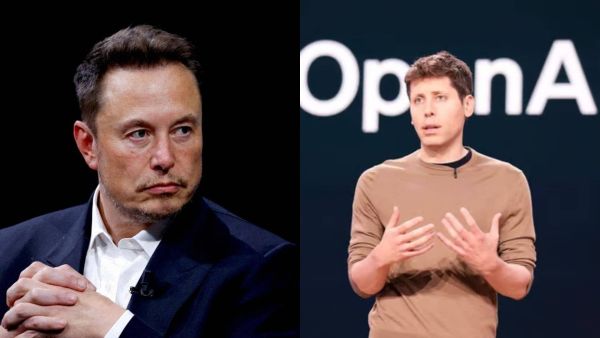
California: A federal court in Oakland has dismissed Elon Musk’s claims against Sam Altman-owned OpenAI and its senior executives, ruling that the billionaire waited too long to bring the case. The court's verdict has brought an end to a high-profile legal fight over the future direction of one of the world’s most influential artificial intelligence companies.
According to reports, after a 3 week trial, a 9 judges jury concluded that SpaceX founder Elon Musk had missed the statutory deadline for filing his lawsuit. The panel deliberated for less than 2 hours before returning its decision on Monday. Judge Yvonne Gonzalez Rogers accepted the jury’s advisory verdict as the court’s own and formally dismissed the claims.
Elon Musk, who co-founded OpenAI in 2015 and invested $38 million in its early years, had accused chief executive Sam Altman and co-founder Greg Brockman of abandoning the organisation’s non-profit mission and enriching themselves as the company shifted towards commercial operations. He has vowed to appeal.
The jury’s decision rested on a procedural point rather than the substance of Musk’s allegations. The jury found that the Tesla CEO filed his lawsuit outside the time limit allowed by law, a point OpenAI’s legal team had emphasised throughout the proceedings.
Outside the courthouse, OpenAI lawyer William Savitt stated that the jurors had seen the case as an “after-the-fact contrivance” to undermine a competitor. He stressed that the action was an attempt by the SpaceX CEO to sabotage OpenAI’s progress and to counter “a long history of very bad predictions about what OpenAI has been and will become".
Elon Musk pushed back on that framing in a post on X, saying the court had never addressed the substance of his case. “The judge and jury never weighed in on the merits of the case, just ‘a calendar technicality…..There is no question to anyone following the case in detail that Altman & Brockman did in fact enrich themselves by stealing a charity. The only question is WHEN they did it!” he wrote.
His lawyer Steven Molo suggested that the ruling was not the end of the dispute. Drawing a parallel with early American military defeats, he termed Monday’s verdict as comparable to the Siege of Charleston and the Battle of Bunker Hill, “major losses for Americans, but who won the war?”
OpenAI pointed out that during the trial, there had never been a binding promise to keep the organisation as a non-profit indefinitely. The company stated that Elon Musk was aware of this and filed suit only after failing to secure unilateral control over the firm.
The company also claimed that the lawsuit was intended to hinder OpenAI’s rapid growth and to benefit Musk’s own AI venture, xAI (Grok AI Chatbot), which he launched in 2023. Microsoft, an investor in OpenAI and a co-defendant in the case, welcomed the outcome. The company said that it remained “committed to our work with OpenAI to advance and scale AI for people and organisations around the world".
Reports suggested that OpenAI is now valued at $852 billion and is preparing for one of the largest initial public offerings in history. The trial put a spotlight on the scale of that transformation, as well as the personal rift between Musk and Altman.
The courtroom heard evidence from Elon Musk, Sam Altman, Greg Brockman, Microsoft chief Satya Nadella and several other figures close to the companies. During the hearing, Musk stated before the jurors that the dispute came down to a simple principle. “It’s not OK to steal a charity,” he said during his 3 days on the stand.
Tesla CEO Musk’s lawsuit alleged breach of charitable trust and unjust enrichment, arguing that Altman and Brockman had profited as OpenAI’s valuation soared. Brockman disclosed during testimony that his stake in the company is now worth about $30 billion.
On the other hand, Sam Altman stated in court that he had been wary of Musk seeking excessive control over OpenAI, which was created to develop artificial general intelligence safely and without concentration in the hands of a single individual. “Part of the reason we started OpenAI is we didn’t think AGI could be under the control of any one person, no matter how good their intents are,” he said.
The trial also revisited Altman’s brief removal from the board in 2023 before his reinstatement days later. Former board members Helen Toner and Tasha McCauley said that concerns had been raised about Altman’s truthfulness. Altman said that the fallout with Musk had been painful. “I felt like he had abandoned us, not come through on his promises, put the company in a very difficult place, jeopardized the mission,” he said.
Elon Musk had sought damages to be paid to OpenAI’s charitable arm and called for Altman’s removal from the board. He said that his decision to stop funding the company stemmed from deceptive conduct, which the board itself flagged when it dismissed Altman in 2023.
Although the court dismissed the case on timing grounds, the underlying disagreement over how OpenAI should be governed and who should control its development remains unresolved. Meanwhile, Elon Musk’s pledge to appeal suggested that the legal and public contest between the two Silicon Valley figures is not ending in the near future.