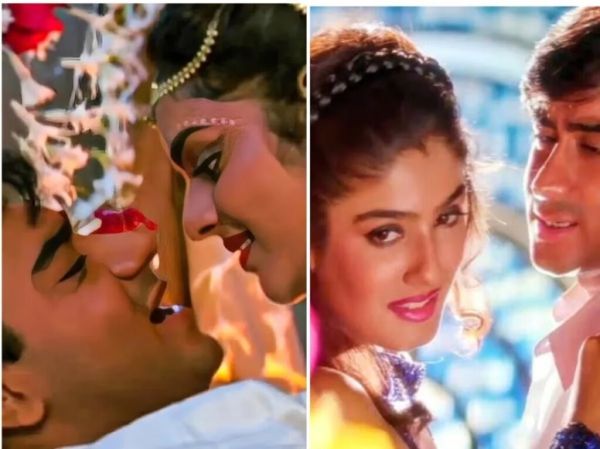
Bollywood’s intense action star Ajay Devgn has delivered countless blockbusters throughout his illustrious career. However, when discussing his defining early years, two cinematic gems instantly come to mind: his spectacular debut Phool Aur Kaante (1991) and the iconic romantic-drama Dilwale (1994). While one turned him into an overnight action sensation with that unforgettable two-motorcycle balancing stunt, the other cemented his status as a deeply emotional romantic hero. Beyond featuring the same leading man, these two blockbuster films share a fascinating, golden connection in their music departments that completely reshaped the landscape of 90s Bollywood music.
The most profound common thread between Phool Aur Kaante and Dilwale lies in the genius minds responsible for crafting their soundtracks. Both musical scores were composed by the legendary duo Nadeem-Shravan, who ruled the 1990s with their melody-driven compositions. Furthermore, the poetic soul of both albums was provided by the exact same lyricist, Sameer. During this golden era of Indian cinema, the combination of Nadeem-Shravan and Sameer was considered a foolproof guarantee for box-office success. They brought the exact same creative synergy to both of these Ajay Devgn starrers, resulting in tracks that remain timeless.
If you carefully analyze the tracklist and narrative placement of the songs in both movies, a striking structural similarity emerges. The emotional arc and thematic patterns of the romantic numbers are virtually identical. In Phool Aur Kaante, tracks like “Dheere Dheere Pyar Ko Badhana Hai” captured the slow, intense progression of love. Flash forward to Dilwale, and the musical trio replicated that exact high-intensity romantic fervor with cult classics like “Jeeta Hoon Jiske Liye” and “Kitna Haseen Chehra.” The use of heavy dholak beats, soulful flute interludes, and deeply passionate lyrics followed a distinct formula that perfectly complemented Devgn’s brooding, intense on-screen persona.
The sonic similarity between the two albums becomes even more obvious when you look at the playback singers chosen to give voice to these tracks. For both projects, Nadeem-Shravan relied heavily on the premier playback duo of the 90s: Kumar Sanu and Alka Yagnik. In Phool Aur Kaante, their collaboration gave us unforgettable duets like “Tumse Milne Ko Dil Karta Hai.” This exact vocal chemistry was replicated as the primary driving force for Dilwale, producing legendary love anthems like “Saaton Janam Main Tere.” Listening to both albums back-to-back feels like experiencing two parts of a single, continuous musical masterpiece because the vocal textures and arrangements remain beautifully consistent.
In the 1990s, a film’s musical success directly dictated its theatrical run, and both of these movies proved this rule perfectly. The chartbuster audio tracks of Phool Aur Kaante generated massive pre-release hype, ensuring packed theaters for a newcomer’s debut. A few years later, the soundtrack of Dilwale broke industry records for cassette sales, becoming one of the highest-selling albums of the year. Ultimately, this closely linked musical blueprint did not just define the soundtrack of a generation; it actively sculpted Ajay Devgn’s versatility as an actor who could execute deadly stunts while simultaneously making audiences weep with his heartbreaking romantic tracks.