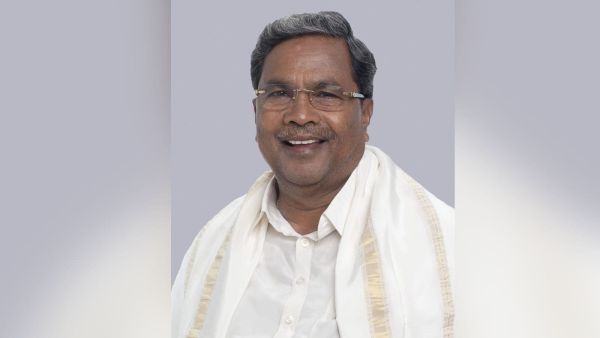
Bengaluru: The intense political suspense and high drama that had gripped Karnataka politics over the last several days finally came to an emotional end on Thursday, as Siddaramaiah officially resigned from the post of Chief Minister.
Ahead of submitting his resignation, Siddaramaiah held a final breakfast meeting with cabinet colleagues and close associates at the Chief Minister’s official residence, ‘Kaveri’. Usually crowded with political leaders, officials and party workers, the residence wore a sombre look as emotions ran high among ministers and supporters.
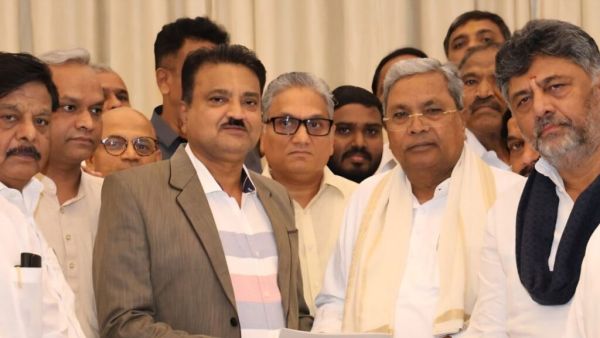
Several senior ministers who attended the meeting reportedly became emotional while recalling Siddaramaiah’s long political journey and contribution to Karnataka politics. Sources said some ministers were seen with tears in their eyes as the outgoing Chief Minister addressed the gathering and assured colleagues to remain united.

Despite the emotional atmosphere, Siddaramaiah appeared calm and composed and reportedly encouraged ministers to continue working together. After lunch, he left for Lok Bhavan carrying his resignation letter.
As Governor Thawar Chand Gehlot was out of Bengaluru, Siddaramaiah submitted his resignation letter to the Governor’s Special Secretary in accordance with official procedure.
Though the resignation letter has been received, it will become officially valid only after the Governor formally signs and accepts it as per constitutional norms. Sources said the Governor is expected to return to Bengaluru later in the evening, following which the official formalities regarding acceptance of resignation will be completed.
With this, Siddaramaiah’s second tenure as Karnataka Chief Minister has come to an end, marking the close of another major chapter in the veteran leader’s five-decade-long political career. Party sources indicated that Siddaramaiah decided to step down respecting the directions of the Congress high command and the message conveyed by senior leader Rahul Gandhi.
For a man rooted in ‘Janata Parivar’ for over two decades and known for a strident anti-Congress stance in the past, it has been a remarkable turnaround for Siddaramaiah, who managed to consolidate his position in the grand old party and went on to become the longest-serving Chief Minister of Karnataka.
The 77-year-old senior Congress leader, who made no secret of his ambition to complete his tenure as chief minister and to sign off on a “high,” was asked to resign two years ahead of the end of his term by the Congress high command to make way for a leadership change in the state.
During his second term as the CM, Siddaramaiah surpassed the record of Congress veteran and fellow Mysurian Devaraj Urs, becoming the longest-serving Chief Minister of Karnataka on January 7, reaching 2,792 days.
From the early 1980s to 2005, Siddaramaiah, who belonged to a poor farmer’s family, was a die-hard anti-Congressman. However, his ouster from the former Prime Minister Deve Gowda-led JD (S) brought him to a political crossroads, leading him to join in 2006, the very party he had opposed.

Siddaramaiah, an advocate, at one point in time talked about “political sanyas” and even toyed with the idea of going back to his law practice. He ruled out floating a regional outfit, saying he couldn’t muster the money or power. Both the BJP and the Congress wooed him to join them. Siddaramaiah said he did not agree with the BJP’s ideology and joined the Congress with his followers, a move considered “unthinkable” till then.
A product of the ‘Janata Parivar’, he was influenced by the socialism advocated by Ram Manohar Lohia. He left his profession as an advocate to pursue a political career, starting as a taluk board member. In the Congress party, his patience and persistence paid off, and the seasoned politician, known for his bluntness, became Chief Minister in 2013, thus realising his lifetime ambition. Such qualities once again catapulted the nine-time MLA to the top position in 2023, after a five-year gap.

After the fractured verdict in 2004, the Congress and JD(S) formed a coalition government. Siddaramaiah, then in JD(S), became Deputy Chief Minister while N Dharam Singh of the Congress became Chief Minister. Siddaramaiah always held the grievance that he had the opportunity to become Chief Minister then, but Gowda scuttled his prospects.
Following this, in 2005, Siddaramaiah, a Kuruba — the third largest caste in Karnataka — chose to position himself as a backward classes leader, by spearheading AHINDA (Kannada acronym for minorities, backward classes and Dalits) conventions, at a time when Deve Gowda’s son H D Kumaraswamy was seen as a rising star of the JD(S).
He made his Assembly debut in 1983, and he was elected from Chamundeshwari constituency in Mysuru on a Lok Dal party ticket. He was the first Chairman of the ‘Kannada Kavalu Samiti’, a watchdog committee mandated to supervise the implementation of Kannada as the official language, formed during Ramakrishna Hegde’s chief ministership. Later, he became the Sericulture Minister.
Born on August 12, 1948, at Siddaramanahundi, a village in Mysuru district, Siddaramaiah graduated from Mysore University with a BSc degree; later earned his Law degree from the same varsity, and practised law for some time.
Siddaramaiah is married to Parvati and has a son, Dr Yathindra, a Congress MLC. His elder son, Rakesh, who was once considered his political heir apparent, died in 2016.
The outgoing CM, who is popular for his populist guarantee schemes in the just-ended tenure, also faced allegations of irregularities in the allotment of MUDA sites in Mysuru to his wife. The veteran political leader, engaged in a long-drawn power tussle with his deputy and another claimant for the CM’s chair, D K Shivakumar and finally relented by stepping down as Chief Minister on Thursday, as per the “rotational power sharing formula”.