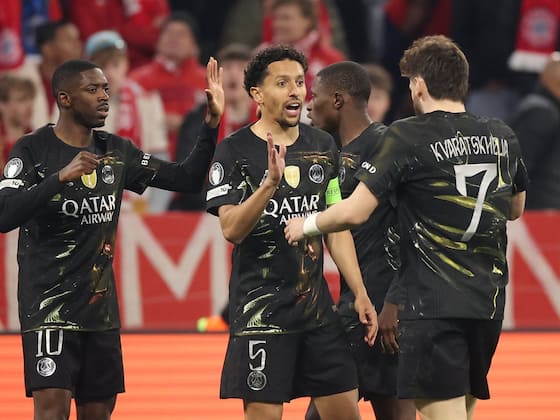
Paris Saint-Germain’s likely starting line-up may not be exactly what Luis Enrique fields against Arsenal, but it provides a telling glimpse into their squad depth. Lucas Chevalier takes charge between the posts, with Willian Pacho, Ilia Zabarnyi, Beraldo and Lucas Hernandez forming the backline. In midfield, Vitinha is joined by Warren Zaire-Emery and Senny Mayulu, while the attacking trio features Khvicha Kvaratskhelia, Bradley Barcola and Lee Kang-in.
Mikel Arteta would undoubtedly be relieved to face a PSG side missing some of its marquee names such as Ballon d’Or winner Ousmane Dembele, last season’s Champions League final hero Desire Doue, midfield orchestrator Joao Neves, dynamic full-backs Nuno Mendes and Achraf Hakimi, or captain Marquinhos. However, that scenario remains unlikely unless Hakimi is sidelined due to injury.
Despite appearing like a rotated line-up, this set of players represents the backbone of PSG’s Ligue 1-winning campaign. Based on minutes and starts, these are the most frequently used players as the club successfully defended their domestic title. Were appearances the metric, Goncalo Ramos and Ibrahim Mbaye would be included, though neither is expected to start in Budapest.
The Champions League final brings together two contrasting forces: PSG’s explosive attack against Arsenal’s formidable defence; a team that finished 11th in the league phase versus one that topped the standings with a perfect record; a club accustomed to domestic dominance against one celebrating their first league crown in 22 years.
PSG’s Ligue 1 triumph was achieved with relative ease, yet their approach differed markedly from Arsenal’s. While the Parisians could rotate freely and still dominate domestically, courtesy of the vast gap in resources compared to other French clubs, Arsenal had to grind through a relentless Premier League schedule. The result — PSG enter the final looking faster, sharper, and more rested, while Arsenal have endured an exhausting campaign across multiple fronts.
Arteta’s most utilised Premier League line-up would likely include David Raya; Jurrien Timber, William Saliba, Gabriel Magalhaes, Piero Hincapie; Martin Zubimendi, Declan Rice; Bukayo Saka, Eberechi Eze, Leandro Trossard; and Viktor Gyokeres. Notably, Rice ranks second in total minutes for Arsenal, while PSG’s equivalent in workload, Zabarnyi, hasn’t started a European match since October — a stark indicator of the rotation luxury Luis Enrique enjoys.
Marquinhos, PSG’s record appearance holder, has effectively become a big-match specialist. The Brazilian has featured only 14 times in Ligue 1 this season, with three as a substitute, and has started merely three domestic matches since early February.
Similarly, Dembele has been sparingly used — starting just 11 league matches and completing the full 90 minutes only once. Kvaratskhelia has managed the full duration on three occasions, last doing so in January. Little wonder, then, that the Georgian winger boasts more goals and assists in the Champions League than in Ligue 1, as this competition has become his primary stage. Dembele’s limited game time is partly due to recurring hamstring and calf issues.
PSG’s broader context is that their campaign has effectively spanned two seasons — with commitments in the Club World Cup and upcoming European Super Cup causing overlaps. Luis Enrique has had to carefully manage player workloads and rotation, strategically preserving his stars for crucial fixtures.
Although some might argue that failing to finish in the Champions League’s top eight group stage added extra fixtures via the play-off round — which Arsenal avoided — Enrique’s selection strategy has clearly prioritised fitness and recovery.
While this might appear one of PSG’s less dominant domestic triumphs — registering their joint-lowest points tally for a French champion since 2003 (excluding the Covid-shortened 2019–20 season) and scoring only 74 league goals compared to previous century-mark seasons — their European performances tell a different story. They have scored five goals apiece against Bayern Munich, Chelsea, and Tottenham, and seven against Bayer Leverkusen, showcasing exhilarating attacking football on the continental stage.
Institutional support has also played a part in PSG’s success. Ligue 1 authorities have allowed the club to postpone fixtures in preparation for Champions League ties. Their clash with title rivals Lens was delayed to give them a weekend off before facing Liverpool in the quarter-finals, just as their previous tie against Chelsea benefited from a similar postponement of their Nantes match.
This logistical advantage highlights a broader trend — PSG’s status within French football now aids their European ambitions. For years, critics claimed Ligue 1’s lower competitiveness left PSG ill-prepared for Champions League knockouts, where they repeatedly fell to the likes of Real Madrid, Barcelona, Bayern Munich, Chelsea, and Manchester City. Under Luis Enrique, however, the narrative has changed. Now, the relative ease of their domestic campaign has become one of PSG’s greatest weapons — giving them a vital edge as they look to defend their Champions League crown against Arsenal in Budapest.