The hosting of the world’s most-watched sporting event in 1994 not only transformed football in the United States but also helped an entire continent find its footing in the global game.
The tournament famously began with a missed penalty by Diana Ross and concluded with one by Roberto Baggio. Thirty-two years on, the 1994 World Cup in the USA stands as a pivotal moment in football history—one that saw the sport’s global influence expand dramatically, ownership models shift from car dealers to billionaires, and technology revolutionise how fans consume football.
Following the tournament, Major League Soccer (MLS) was founded, and today it boasts 30 teams, with more on the horizon. In 2013, NBC outbid competitors for exclusive Premier League rights, while broadcasters like BeIN, Fox, and ESPN shared coverage of Serie A, La Liga, Bundesliga, and Liga MX. Among American youth aged 12–20, football has become the second-most-watched sport, while major European clubs now regularly tour the US to packed stadiums during summer.
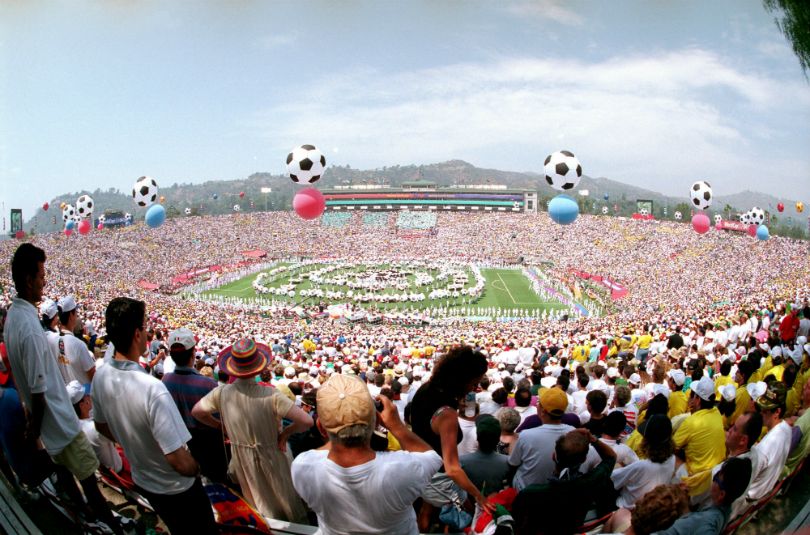
But back on June 17, 1994, when Diana Ross sprinted across Soldier Field in Chicago to perform during the opening ceremony, all that remained in the distant future. As her iconic track “I’m Coming Out” played, she famously missed a staged penalty kick, sending the ball wide of a pre-rigged goal. The goalpost collapsed anyway, symbolising a scripted success, though critics quickly seized on the moment to mock the hosts.
That single miss fuelled scepticism about America’s ability to host football’s most prestigious tournament. Many detractors, particularly from football-loving nations like Morocco, Chile, and Brazil, argued that the US was more concerned with showbiz than sport. To them, Ross’s misfire epitomised what they saw as American superficiality in football.
In the UK, ridicule of the American approach offered a welcome distraction from England’s own failure to qualify. Even Nick Hornby, chronicler of football fandom, poked fun in a pre-tournament guide, joking that if Jurgen Klinsmann went down, Americans should pray for him as though seriously injured.
Despite the mockery, FIFA had made a calculated choice. The USA’s infrastructure—its stadiums, transport systems, and broadcast networks—made it ideal for a large-scale event. Still, critics questioned the country’s lack of football heritage and a professional league. The decision, announced on July 4, 1988, was viewed as controversial from day one.
Few could have predicted that six years later, on the same date, a 10-man USA would push eventual champions Brazil to the brink before losing 1-0 in the second round. For context, the US hadn’t qualified for a World Cup since 1950, when they famously beat England 1-0. The North American Soccer League (NASL), which once featured the New York Cosmos, had folded in 1984, leaving a fragmented scene through the 1980s.
Peter Vermes, now known for his long tenure as Sporting Kansas City’s head coach, recalled, “At that time, being a professional footballer in the United States wasn’t realistic. The ASPL had started in 1989, but it wasn’t truly first-division quality, so if you wanted a career, you had to go abroad.”
Vermes played in Hungary, the Netherlands, and Spain before returning home to join MLS after USA 94. His story echoed many of his generation’s journeys. Their breakthrough came in 1989 when Paul Caligiuri’s looping goal against Trinidad & Tobago—dubbed the “Shot Heard ’Round the World”—secured qualification for Italia 90, the US’s first World Cup appearance in 40 years.
“It was vital that we qualified in 1990,” Vermes reflected. “People questioned why FIFA would give the World Cup to a country without a professional league. Our qualification gave credibility to that decision.”
Although the US lost all three matches in Italy, they earned respect and bought time for 1994 organisers. Alexi Lalas, who would become a symbol of USA 94, recalled attending Italia 90 as a fan, never imagining he would represent his country four years later.
With the World Cup approaching, organisers faced dual goals: stage a successful tournament and create a sustainable football structure. Alan Rothenberg, who had overseen the sell-out football events at the 1984 Olympics, became president of the US Soccer Federation in 1990. He brought in Hank Steinbrecher as general secretary, and together they began professionalising the sport.
In 1992, a landmark meeting united 250 stakeholders—from sponsors to journalists to players—under a single vision: to grow football in America. “We told everyone, ‘Leave your weapons at the door,’” Steinbrecher said. “Amazingly, we found consensus.”
US Soccer soon started paying players proper contracts and treated the national team like a club in preparation for 1994. Lalas remembered training twice daily in Mission Viejo, California, playing endless internationals. “That’s why players from my generation have so many caps—because that’s all we did,” he said.
Still, expectations were modest. Steinbrecher recalled rating their odds of success at “about 20 per cent.” The draw seemed unkind, pairing the US with Colombia, a pre-tournament favourite. Yet in one of football’s most infamous games, a tragic own goal by Andres Escobar helped the US to a 2-1 win—a victory forever overshadowed by Escobar’s death days later in Medellin.
For the players, it was vindication. “After that game, you felt the country erupt,” said Lalas. “It wasn’t just hosting a World Cup—it was proving we belonged.”
The tournament had drama beyond the hosts’ story. Diego Maradona’s expulsion for doping shocked the world, while Bulgaria’s Hristo Stoichkov and Yordan Letchkov stunned Germany. Ireland’s upset of Italy in New York added to the magic. Yet the final between Brazil and Italy—a goalless draw decided by Baggio’s missed penalty—felt anticlimactic to many.
Despite that, the event was a logistical and cultural triumph. “There’s no manual for running a World Cup,” Steinbrecher said, “but we knew we needed the grassroots base of US soccer. Those people bought tickets and made it happen.”
For many who had kept the sport alive during lean years, the World Cup was both vindication and renewal. It also inspired a new generation. One such youngster was eight-year-old Graham Zusi, who took part in the opening ceremony. “I didn’t realise how big it was at the time,” he said. “But everything I had later came from that World Cup.”
Landon Donovan echoed that sentiment. “After 1994, people saw us differently,” he said. “By 2002 we were beating Portugal and Mexico and competing with Germany. It all started in ’94.”
With 3.4 million fans attending across 52 matches—a record that still stands—USA 94 gave MLS a credible foundation when it launched in 1996. The sport’s popularity has only grown since.
Ultimately, Diana Ross’s miss may have symbolised more than a moment—it foreshadowed football’s merging with global entertainment. As Lalas noted, “It was a spectacle, a show—and nobody does that better than the US. The world learned from that. Look at how the EPL presents itself now: lights, glitz, narratives—it’s all part of the experience.”
For Steinbrecher, the legacy was long-term. “Overnight successes take 25 years,” he said. Leaving the Rose Bowl after the final, he was reminded of humility when a family asked him to take their photo—mistaking him for a bystander. “Welcome to the long haul,” he laughed. And indeed, the journey of American football was only beginning.