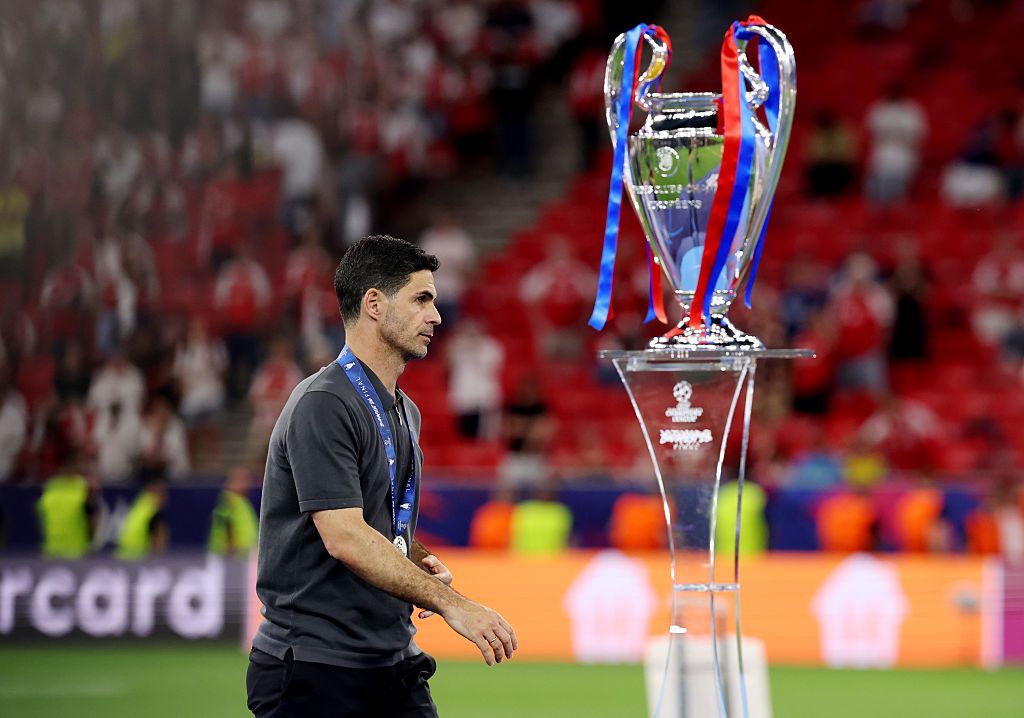
When Arsenal fell short in the 2006 Champions League final, it felt like the closing chapter for that generation. But if Eberechi Eze’s theory about football’s unseen ‘scriptwriters’ holds true, then the way this season concluded could hardly have gone any other way.
Two days after clinching the Premier League title, FourFourTwo met Arsenal’s Eberechi Eze. The emotions were still raw, the post-celebration haze lingering. He admitted he wasn’t thinking much about the battle awaiting in Budapest – his mind was still at the Palace party.
After five years at Selhurst Park, followed by a dramatic move to Arsenal, scoring against Crystal Palace, and hitting a hat-trick in the North London Derby, ending the campaign where it all began seemed almost poetic.
“Scripted,” as Eze called it. And indeed, it felt that way.
Heineken and content creator The Padded Seat arranged for competition winner Forest Robinson to occupy the most isolated seat at the Puskas Arena for the final. But he didn’t stay alone for long – football legend Xavi joined him, and the two watched the match from a luxury skybox before celebrating pitchside, a reminder that football is best enjoyed together.
Coincidence and destiny often walk the same tightrope. Perhaps in a world of endless possibilities – or even infinite parallel realities – Eze’s first Arsenal season is just a neat coincidence. Yet, consider the symmetry: Bournemouth’s no.22, Junior Kroupi, ended 22 years of Gunners’ frustration; “Puskas” translates roughly to “gun”; Arsenal knocked out Antoine Griezmann in a European semi-final, mirroring what he did to Arsène Wenger eight years earlier. And after West Ham United derailed Arsenal’s title chase last year – consistently troubling Declan Rice’s new team – it was fitting that a nervy 1-0 win against the Hammers cleared the final major hurdle toward the title.
Destiny isn’t selective. If some things are written, perhaps everything is. If Eze was destined to lift the title at Selhurst Park, if Arsenal were meant to end their drought in precisely this fashion, then Budapest was part of the same plan.
For years, this side was labelled “bottlers” – in print, on screens, and from fans across the country. But each Arsenal player’s personal struggles forged their resilience. William Saliba has never publicly spoken about losing a parent while abroad. Watching his composure, you’d never guess David Raya once suffered a horrific facial injury in 2018, his nose described as “hanging off.”
Raya arrived in England at 16, playing non-league football and missing home on weekends. Ben White toiled in the lower leagues after Southampton released him. Gabriel Martinelli was overlooked by top clubs while playing in Brazil’s fourth tier. Declan Rice was let go by Chelsea, his boyhood club. Eze himself was released by Arsenal before rebuilding his career in League One and suffering a ruptured Achilles before his return.
Jurrien Timber tore his ACL just 50 minutes into his Arsenal debut – for the club he’d always dreamed of representing. Riccardo Calafiori endured a knee injury so severe doctors compared it to a motorcycle crash, yet he fought back, developed at Basel, and became a cornerstone for his nation. Gabriel turned the pain of missing the 2022 World Cup into fuel, emerging as Brazil’s defensive linchpin four years later.
Bukayo Saka, meanwhile, faced one of the darkest moments in English sporting history after the Euro 2020 final. The racist abuse he endured was appalling. But he never backed down. He stepped up again – for Arsenal, for England, for himself.
This team is led by a man told he wasn’t good enough for Barcelona, his dream club. Mikel Arteta rebuilt himself elsewhere, donning the no.8 shirt, only to see an ACL injury rob him of an international cap. Years later, he would hand that same number to Martin Ødegaard, a player once deemed not good enough for Real Madrid, who also found purpose, stability, and leadership in North London.
The road was long and brutal. Chelsea beat Arsenal in Arteta’s first home game. Then came the pandemic. Manchester City crushed them. Eighth place followed. Another eighth the next year. Europa League heartbreak under Unai Emery. No European football. FA Cup exits. Brentford bullying them. Bottom of the table. The Aubameyang saga. The painful misses for top four. Newcastle away, twice. The Europa League collapse against Sporting. City’s dominance. Aston Villa losses. West Ham draws. The Declan Rice red card. The Lewis-Skelly dismissal. Endless injury crises. The “Be humble” moment. The “It’s not done” game. Carabao Cup and FA Cup failures.
These setbacks defined Arsenal as much as their triumphs under Arteta. To still call them bottlers after all they’ve endured feels unjust. Budapest wasn’t their destiny – it was another checkpoint along the journey.
The 2006 defeat symbolised an ending. This one doesn’t. Back then, Dennis Bergkamp retired, Robert Pires’ final appearance lasted under 20 minutes after Jens Lehmann’s red card, Sol Campbell and Ashley Cole left, and Freddie Ljungberg and Thierry Henry followed soon after. Within 18 months, that team’s core was gone. But two decades later, with the 2026 final in Budapest, this Arsenal team – Saliba, Rice, Timber, Calafiori, Lewis-Skelly, Saka, Ødegaard, Eze, Havertz – are all under 28. Their journey has only begun.
They won the league feeling there’s still another level to reach. Arteta’s side are not flawless champions – they have weaknesses to address. They squeezed opponents rather than dominated them. But they ended two decades of domestic frustration. They went unbeaten in Europe until the shootout, conceding no goals in open play. They kept the world’s best attack silent for two hours. Matvei Safonov never even got a hero moment – Paris Saint-Germain didn’t save a penalty; Arsenal missed theirs. The operation succeeded – but the patient didn’t survive.
Still, Arteta will face his squad next season and tell them, as always, they can go one better. Eighth, eighth, fifth, second, second, second, first in the league. Quarter-finals, semi-finals, final in Europe. Chelsea needed near misses before triumphing; Manchester City did too. Liverpool under Jürgen Klopp showed that persistence at the top brings reward. Arsenal have their domestic title now – Europe will come in time.
As Eze trudged off after missing his penalty, he looked devastated. It wasn’t the fairy-tale ending to his debut season he’d imagined. But perhaps he’s right about the football gods, the scriptwriters, or simply the resilience of elite athletes to rise again. Maybe Arsenal were meant to lose in Budapest. Maybe Eze was meant to miss. Maybe the best is yet to come. The chapter has closed; the story continues.