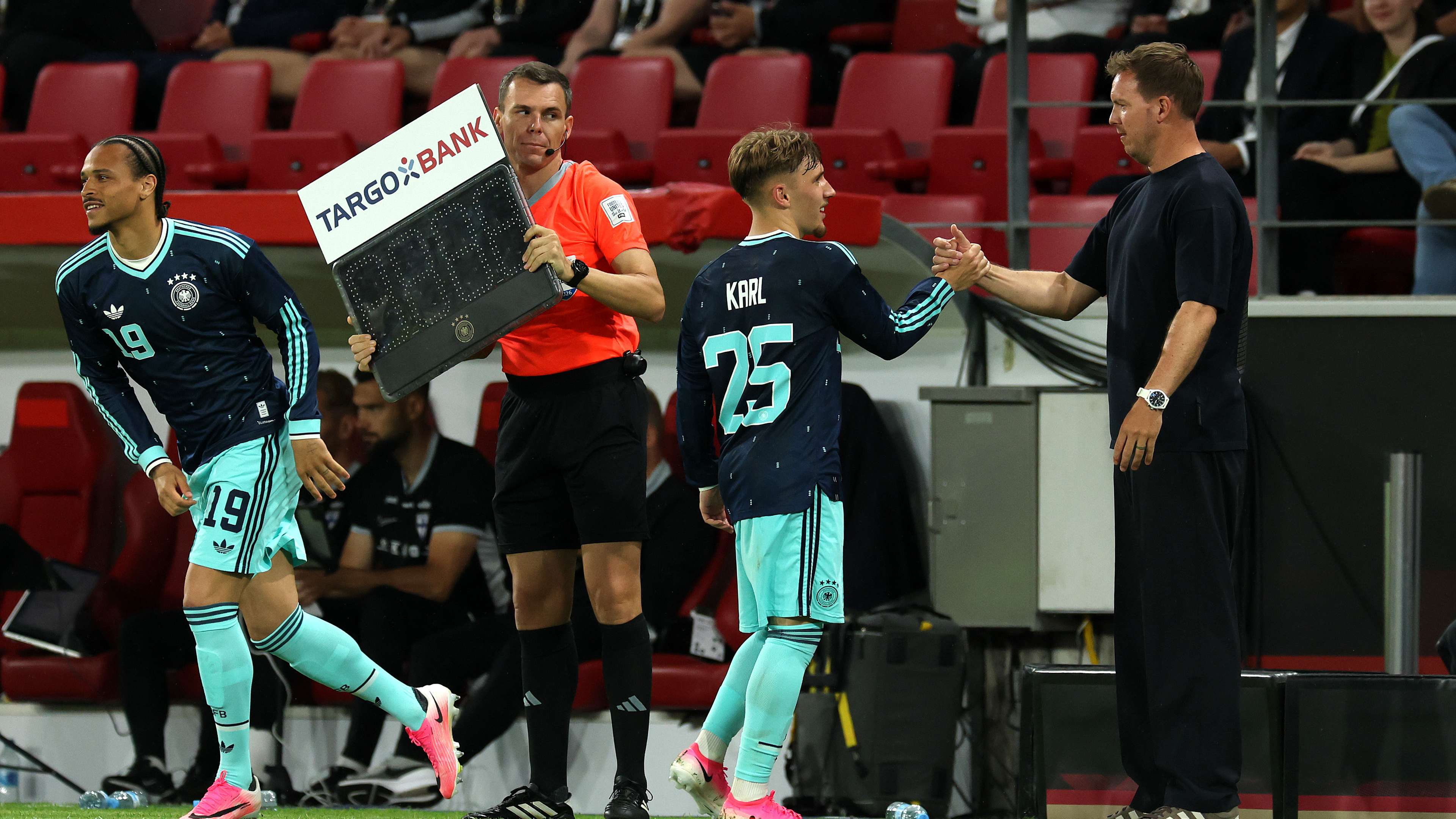
Julian Nagelsmann’s strategy alongside his assistant coach is beginning to bear fruit: Mads Butgereit and the players are executing their roles effectively.
Despite Germany’s emphatic 4–0 victory over Finland, moments of tactical inconsistency still surfaced. Nagelsmann’s decision to place faith in his young squad appears justified, with his judgment proving sound. Here are three main observations from Germany’s second-last friendly before the 2026 World Cup to be held in the USA, Canada, and Mexico.
Uli Hoeneß’s assessment stands correct — the German side still needs time to develop cohesion.
National team coach Julian Nagelsmann, captain Joshua Kimmich, and forward Deniz Undav were all pleased after Germany’s 4–0 friendly triumph against Finland — their penultimate match before the World Cup. Kimmich stated to ZDF: “We wanted to press high as often as possible, and that led to two of our goals today (the 2–0 and 4–0). Then we scored from deep when Lenny sent a through ball to Deniz (the 3–0), and added one from a set piece (the 1–0, see below). We managed to score in several different ways.”
Nagelsmann added, “We also got a counter-attacking goal, which is a nice change; we showed resilience. The result was good, and we kept a clean sheet. We can build on this.”
However, despite praise for their variety in attack, Nagelsmann did not overlook the first-half phase when his team, similar to previous matches, became impatient, pushed too far forward, and lost control.
He viewed the lapse positively — “because the lads want to prove themselves” — yet acknowledged that such tactical indiscipline cannot become habitual. “We must trust our strengths even more,” he remarked. The team still needs refinement, automatic movements, and consistent tactical structure.
These issues can be ironed out before the tournament, but Nagelsmann still needs to finalise his preferred starting XI — a point emphasised by Bayern Munich’s honorary president Uli Hoeneß. Two or three positions remain undecided: David Raum or Nathaniel Brown at left-back, and Leroy Sané, Lennart Karl, or even Maximilian Beier on the right wing. With two goals, an assist, and a complete performance described by Nagelsmann as one “with which you never play yourself out of the team,” the coach may even reopen the discussion around his striking partnership — a topic he had previously closed.
DFB team: Playing on the front foot should become instinctive.
Against Finland, Nagelsmann fielded his youngest-ever starting eleven, with an average age of just 26.29 years — 0.58 years younger than the side that defeated the Netherlands 1–0 in October 2024. The debut of Lennart Karl was only part of the youth wave. The promising Bayern youngster, aged 18 years and 98 days, became Germany’s third-youngest starter in history, behind Youssoufa Moukoko and Uwe Seeler. The inclusion of 22-year-olds Nathaniel Brown and Aleksandar Pavlovic, along with slightly older talents Jamal Musiala and Florian Wirtz, further lowered the average age.
Crucially, every one of these youngsters performed well. Karl impressed despite brief spells of impatience and nerves that slightly disrupted Germany’s rhythm against the overmatched Finns.
Aleksandar Pavlovic, already a regular starter, controlled the tempo superbly; Wirtz, like Musiala, scored to regain confidence after a challenging season in England and a lengthy injury layoff. Brown again demonstrated that he offers more creativity than David Raum and, similar to Kimmich, moves inside effectively. His flexibility might give Nagelsmann’s World Cup squad more tactical options than Raum, who is more of a wing-back and set-piece specialist. On current form, each of these young players deserves a place in the final tournament squad.
An added benefit: even with Manuel Neuer (40) returning, the team’s average age will hardly increase.
Nagelsmann’s plan with his assistant is working: Mads Butgereit and the players are producing results.
Germany’s 4–0 win against Finland continued their perfect eight-match run, during which they have scored 26 goals and conceded only six. Of those, eight goals have come from set pieces — four of them in the last four games — highlighting their growing effectiveness in dead-ball situations.
In March, Nagelsmann brought his former Hoffenheim assistant, Alfred Schreuder, into the DFB coaching team, explaining that this would allow set-piece coach Mads Butgereit to focus exclusively on his area of expertise. The results are evident: Butgereit and the players he trains are delivering consistently.
Even though the corner routine that produced the opening goal against Finland — Lennart Karl catching the opposition off guard with a quick short pass to Joshua Kimmich, whose curling cross found Deniz Undav’s head — looked spontaneous, such executions require both individual skill and the structured training that Butgereit provides.
Butgereit has been overseeing set-piece training for the DFB since 2021, and Germany have scored several unconventional goals from dead-ball situations in recent years. However, his record at major tournaments has not been strong: Germany failed to score a single set-piece goal in their last two major competitions. That statistic is overdue for improvement.
DFB: The youngest first-time starters
Venue
Name
Date of first start
Age at first start
1. Youssoufa Moukoko — 16 November 2022 — 17 years, 361 days
2. Uwe Seeler — 2 April 1956 — 18 years, 26 days
3. Lennart Karl — 31 May 2026 — 18 years, 98 days