This is Legacy, GOAL’s exclusive series and podcast counting down to the 2026 World Cup. Each week, it delves into the stories and spirit of the nations that shaped world football. In this edition, we revisit the matches that defined Morocco’s football identity, the managers and players who carried the hopes of millions, and the moments that proved that nothing is impossible when a nation dreams together.
This is the tale of lions who never learned to give up — men who carried Morocco’s flag across continents and made the world remember their nation. The journey began in the Mexican desert in 1970 and reached its greatest heights in Qatar more than five decades later.
Football is more than a sport; it mirrors life itself — it embodies dreams, ambitions, and national pride. Morocco became the first Arab team in history to reach a World Cup semi-final, but their story stretches much further. Across five tournaments, each World Cup wrote a new chapter in Moroccan football, each leaving behind either a smile or a scar in the hearts of the Atlas Lions’ faithful.
Planting the Seed
In 1970, history was made. Morocco became the first African team to officially qualify for the World Cup after the continent boycotted the 1966 edition. Representing Africa alone, they stepped onto football’s biggest stage for the first time.
Their inexperience showed early, with defeats to West Germany (2-1) and Peru (3-0). European media dismissed them, writing, “Morocco came to participate, not to compete.” Yet, the team’s pride remained intact.
In their final group match against Bulgaria, Maouhoub Ghazouani produced a stunning goal to secure a 1-1 draw — Morocco’s first World Cup point, and the first ever earned by an African nation. Only a few thousand Moroccan fans were in the stands, but their voices filled the arena. Back home, millions celebrated in the streets. That day, Morocco planted the seed of African hope and told the world never to underestimate them again.
Making a Statement
After 16 years of waiting, dreaming, and rebuilding, destiny brought Morocco back to Mexico in 1986 — as if fate wanted them to reclaim what was left behind. The team’s Brazilian coach, Jose Faria, embraced Islam and took the name Mahdi Faria, even receiving Moroccan citizenship from King Hassan II.
Drawn into a tough group with England, Poland, and Portugal, the North Africans were largely ignored by European pundits. While big teams stayed in luxury hotels, Morocco were given modest accommodation — but instead of feeling slighted, they turned it into motivation.
A 0-0 draw with Poland stunned the world. How could an African team hold the Europeans? Another 0-0 against England followed, with goalkeeper Badou Zaki — soon to be named African Player of the Year — performing heroics. The Spanish press mockingly called it the “Group of Sleep.” But in their final group match, the Atlas Lions awoke.
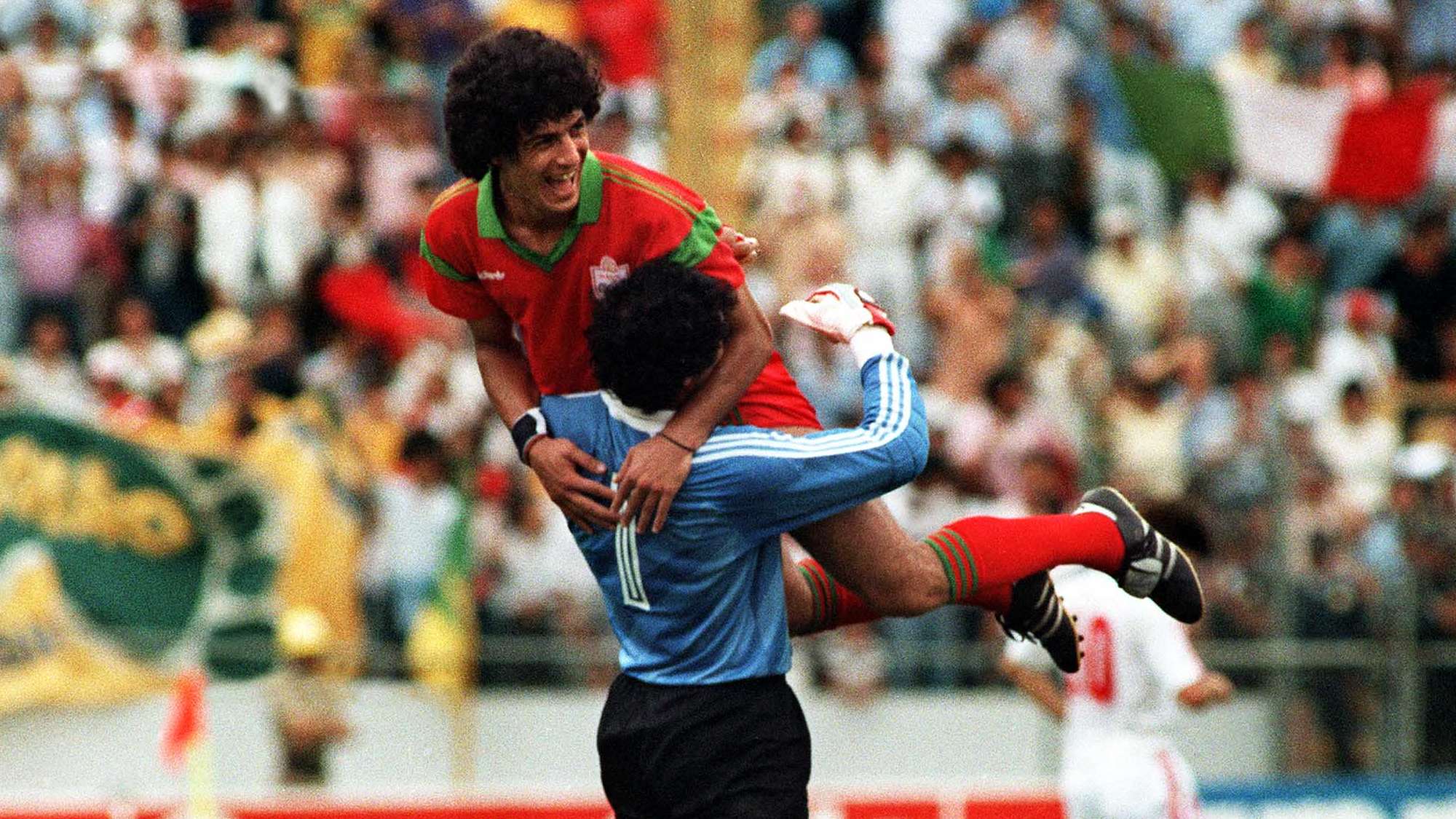
Portugal, who had earlier beaten England and reportedly mocked Morocco, were disjointed and distracted by internal disputes. Morocco, in contrast, were united and driven. Abderrazak Khairi struck twice within 27 minutes, and in the 62nd minute, Krimau added a third. Morocco won 3-1, scoring three goals in a World Cup match for the first time, and topped their group, becoming the first African side ever to reach the Round of 16. The nation erupted in euphoria — dancing, singing, and crying tears of joy.
Facing powerful West Germany next, Morocco held firm for 85 minutes, with Zaki producing incredible saves and Aziz Bouderbala nearly scoring. But Lothar Matthaus’s late free-kick sealed Germany’s 1-0 win. Despite the heartbreak, fans inside the stadium — including Germans — stood to applaud Morocco. The Times of London wrote: “Morocco changed the face of African football.” They lost the match but won global respect.
Cruel Exit
After a 12-year absence, Morocco returned to the World Cup in 1998 in France — home to thousands of Moroccan immigrants. Led by French coach Henri Michel, they were drawn into a demanding group alongside defending champions Brazil, Norway, and Scotland.
The Atlas Lions started strong with a 2-2 draw against Norway, thanks to goals from Abdeljalil Hadda and Salaheddine Bassir. They fell 3-0 to a dominant Brazil team but bounced back with a commanding 3-0 win over Scotland, with Bassir scoring twice and Hadda adding another. Moroccan fans filled the stadium, their pride unmistakable.
Believing qualification was secured, Morocco’s joy turned to despair. In Marseille, Norway faced Brazil, and while Morocco celebrated in Saint-Etienne, Norway equalised in the 83rd minute — and five minutes later, were awarded a soft penalty they converted. The 2-1 result eliminated Morocco.
Unaware, Moroccan players exchanged shirts with the Scots, only to discover the devastating news moments later. In frustration, Michel kicked the bench as players and fans broke down in tears. They had scored five goals but were denied advancement by a controversial penalty elsewhere. Even Brazil’s Leonardo said, “I feel sorry for Morocco. They played beautiful football. It’s sad.”
Despite the heartbreak, Morocco returned home proud. King Hassan II personally welcomed the team and granted Michel Moroccan citizenship as he had wished.
Out of the Wilderness
For two decades after 1998, Morocco vanished from the World Cup stage. Entire generations grew up without seeing their national team compete on the global platform. Every four years, Moroccans watched others play, often cheering for fellow Arab or African sides, but their own absence left a deep void.
In 2018, the drought ended. Morocco returned in Russia, reigniting hope. They fought valiantly against Iran, Portugal, and Spain but lost all three matches by narrow one-goal margins — close, yet not enough. But destiny was saving something greater for the deserts of Arabia.
The Miracle
In 2022, ahead of the first World Cup hosted on Arab soil, young coach Walid Regragui took charge just three months before kickoff. Many called it an impossible mission. But Regragui declared to his team: “Anyone who doesn’t believe we can win the World Cup will not come to Qatar.”
He united European-based stars like Hakim Ziyech, Achraf Hakimi, and Noussair Mazraoui with emerging talents from the Mohammed VI Academy — forging one team, one heart.
Placed in Group F with 2018 finalists Croatia, world no. 2 Belgium, and a spirited Canada, expectations were low. A 0-0 draw with Croatia opened their campaign. Then came the turning point — a 2-0 victory over Belgium that set the Arab world alight. From Egypt to the UAE, millions celebrated. Morocco followed up with a 2-1 win over Canada, topping the group just as they had in 1986 — but this time, they weren’t done.
In the Round of 16, they faced Spain, the 2010 champions who had scored seven against Costa Rica. Morocco fought for 120 minutes to a 0-0 draw. In the penalty shootout, Pablo Sarabia hit the post, and goalkeeper Yassine Bounou became a national hero, saving from Carlos Soler and Sergio Busquets. Spain failed to score a single penalty, and Hakimi sealed the win with a bold Panenka. Morocco became the first Arab nation to reach a World Cup quarter-final, sparking celebrations across the Arab world. The Burj Khalifa glowed in Morocco’s colours — a symbol of unity and pride.
Next came Cristiano Ronaldo’s Portugal, but Morocco were fearless. Regragui told his players: “You’re not less than them — you’re better. Go and prove it.” In the 42nd minute, Youssef En-Nesyri rose majestically to head home the decisive goal. Morocco won 1-0, becoming Africa’s first-ever World Cup semi-finalists.
After the match, Sofiane Boufal danced with his mother on the pitch — a beautiful moment of human warmth and pride that transcended football. Although Morocco later fell 2-0 to France in the semi-final, injuries taking their toll, they departed as heroes, their heads held high as the world applauded their journey.
Eternal Legacy
From Mexico’s deserts in 1970 to Qatar’s sands in 2022, from Africa’s first World Cup qualification to its first semi-final, Morocco have never been mere participants. The Atlas Lions learned that dreams never die — even if they take 36 years to come true. They learned that the small can defeat the mighty when belief runs deep, and that a loss is never the end. You may be beaten on the scoreboard, but Morocco never surrenders. As 2026 approaches, they stand ready once again to chase new history.