The Ministry of Education and Training announced on Sunday that the Prime Minister had approved a project to elevate several major universities in southern Vietnam to internationally competitive levels comparable with top universities across Asia.
Under the plan, the University of Economics Ho Chi Minh City (UEH), the University of Medicine and Pharmacy, Ho Chi Minh City (UMP), and the Vietnamese-German University (VGU), alongside Vietnam National University Ho Chi Minh City, will be developed into regional hubs for high-quality workforce training, scientific research, innovation, and technology transfer.
The initiative aims to strengthen higher education in southern Vietnam while supporting the Southeast region’s socio-economic development and international integration.
Targets by 2030
| Universities | Overall goal | Specific targets by 2030 |
|
University of Economics Ho Chi Minh City |
Rank among Asia’s top 150 universities in business and management by 2030. |
The university plans to train 9,000 high-quality graduates annually and increase the proportion of full-time faculty with doctoral degrees to at least 70%, including 12% international faculty members. It also aims to attract 30 leading global scholars and train around 50 young lecturers and researchers. Research targets include an average of at least 4.1 academic publications per faculty member, one patent per year, and 20 strong research groups. Internationalization goals include raising the proportion of international students to at least 3.1%, offering all programs in English, and establishing partnerships with 50 universities ranked among Asia’s top 250. |
|
University of Medicine and Pharmacy, Ho Chi Minh City |
Enter Asia’s top 150 universities in health sciences. |
The university plans to graduate 9,000 high-quality students annually and raise the proportion of full-time faculty holding doctoral degrees to at least 70%, including 12% international faculty members. It also seeks to attract 30 leading international scholars and train around 50 young lecturers and researchers. Research goals include an average of at least 4.1 academic publications per faculty member, one patent annually, and the establishment of 20 strong research groups. To expand its international presence, UEH plans to increase the proportion of international students to at least 3.1%, offer all academic programs in English, and establish partnerships with 50 universities ranked among Asia’s top 250. |
|
Vietnamese-German University |
Continue developing according to the model of Germany’s leading research universities. |
By 2030, it aims to train around 1,000 highly skilled graduates annually under German and European standards in core sciences, advanced technologies, strategic technologies, and emerging economic sectors. Approximately 95% of faculty members are expected to hold doctoral degrees or higher. The university plans to attract around 30 outstanding scientists and train at least 250 promising young lecturers and research assistants. Between 30% and 40% of professors and lecturers are expected to be German or other international citizens. Research targets include at least 300 Institute for Scientific Information-indexed publications annually and research revenue of around VND20 billion (about US$770,000) per year. The university also plans to attract approximately 200 international students and send at least 600 students to Germany through exchange programs. |
Long-term vision
By 2050, the three universities, together with Vietnam National University Ho Chi Minh City, are expected to maintain educational, research, and governance standards comparable with the top 100 universities in Asia.
They are also expected to play a leading role in education, scientific research, technology development, and technology transfer in fields with regional competitiveness.
|
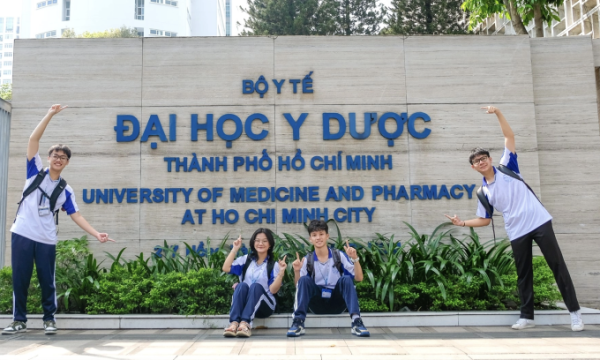
Students pose for photos at the main gate of the University of Medicine and Pharmacy, Ho Chi Minh City. Photo courtesy of the university |
Investment and expansion plans
To achieve these goals, the government will prioritize upgrading infrastructure, expanding campuses, investing in advanced research centers and laboratories, and strengthening digital infrastructure.
UEH plans to expand its campus in the Vinh Long Province in the Mekong Delta and develop a new branch in central Khanh Hoa Province, home to Nha Trang beach town. UMP will establish an additional clinical training facility in Dong Nai Province bordering HCMC.
The project also emphasizes recruiting and developing high-quality faculty and researchers, attracting domestic and international experts, nurturing young academics, and building strong research teams.
Universities are encouraged to modernize curricula in line with international standards, expand high-quality and talent-development programs, and strengthen partnerships with businesses and industry.
According to the 2026 Asian university rankings published by Times Higher Education, Vietnam has 11 ranked institutions, placing between 184th and the 801+ band, with UEH ranked highest among them.
Before the latest initiative, four other Vietnamese institutions had already been selected for investment with the goal of entering Asia’s top 150 universities: Vietnam National University – Hanoi, Vietnam National University – Ho Chi Minh City, The University of Danang, and Hanoi University of Science and Technology.