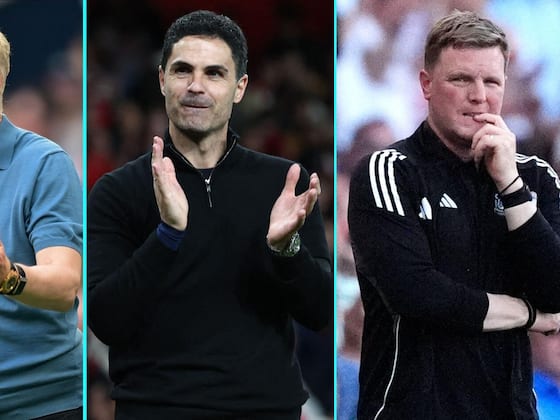
With Marco Silva now departing, the Premier League touchlines will have a very different look next season.
Liverpool, Chelsea, Manchester City, Bournemouth, Fulham and Crystal Palace are all set to begin the new campaign under fresh management, leaving only a handful of long-serving coaches to carry forward their projects. But how secure are they?
Only eight managers have managed to complete a full year in charge of their respective clubs, and it seems only fitting to assess which of them could be next in line for the sack.
Here’s a look at the eight longest-serving Premier League managers – excluding those from newly promoted sides – and an evaluation of how stable their positions appear.
There were whispers earlier this year about Mikel Arteta’s future at Arsenal, but winning the Premier League title has silenced all that speculation.
With just one year left on his current contract, an extension announcement seems imminent. The only scenario that might see him depart is if another elite club manages to lure him away, though that seems unlikely. Arteta has complete control at Arsenal, and with the long-awaited trophy finally secured, his focus will now shift to building a dynasty and contending for more honours.
Arsenal’s strong financial backing also strengthens his hand, and it is difficult to imagine another major European club offering him a better environment or more autonomy than he currently enjoys.
Unai Emery, meanwhile, continues to cement his legacy at Aston Villa. Securing another Champions League qualification spot along with a European trophy makes him arguably the most successful Villa manager in the modern era.
The supporters adore him, and he has met every target set by the club hierarchy. While rumours occasionally link him with bigger clubs, it’s worth asking – why would he leave? Villa have the resources to compete, and Emery’s experience at Arsenal likely taught him that prestige doesn’t always guarantee satisfaction.
It would take a dramatic downturn in form for Emery to be dismissed anytime soon.
Across at Brighton, Fabian Hurzeler’s three-year contract extension during a poor run of results demonstrated the board’s faith in him. The young German coach has been a revelation for the Seagulls, delivering results beyond expectations despite the inevitable ups and downs of a manager still learning his trade.
With European competition now on the horizon, Hurzeler faces new challenges, but even a mid-table finish next season is unlikely to put his job at risk given the club’s long-term outlook.
Brentford’s set-piece expert turned head coach, Ryan Andrews, was widely tipped to be among the first managers sacked last season. Instead, he confounded expectations and guided the Bees to another solid campaign.
While a slight drop-off next season may occur as rivals strengthen, Andrews has built enough goodwill and credibility to withstand a few bumps along the way.
Daniel Farke’s situation at Leeds United is another example of steady hands prevailing. Rumours of his dismissal surfaced just days after Leeds’ promotion, yet the calm and composed German has now completed over a year in charge.
Leeds may not have matched Sunderland’s heroics, but they comfortably avoided relegation by eight points, a respectable return for a promoted side. Farke looks safe heading into the new campaign, though as is often the case in the Premier League, a poor run before Christmas could change everything.
At Sunderland, Regis Le Bris faced intense pressure in April when reports suggested he might be sacked if the club missed out on European qualification – an extraordinary demand for a newly promoted side. Le Bris achieved that target, but the upcoming season poses a fresh test: balancing European fixtures with domestic consistency. Many managers have struggled in similar circumstances, and while he passed one major test, another could soon await.
For Everton, David Moyes’ position is a curious one. A glance at the table shows the Toffees in 13th, which on paper seems respectable. However, there’s an underlying sense of disconnect among the fans. Moyes did rescue the club from relegation, yet murmurs persist that he may have reached his limit. Everton’s poor end to the season and the sight of clubs like Brighton and Sunderland earning European spots have sparked debate about whether Moyes can truly elevate them further.
He deserves the chance to start the new campaign, but if Everton regress instead of progressing, the board may decide a change is needed.
Newcastle United’s Eddie Howe also finds himself on thin ice. A high-stakes meeting with the club’s Saudi owners at a luxury Northumberland hotel ended with a decision to keep him in charge – for now.
Newcastle endured a dismal season: a double defeat to fierce rivals Sunderland, a 12th-place league finish, big-money signings underperforming, a humiliating Champions League exit, and no silverware. Any other manager might have been dismissed, but Howe’s past achievements earned him a reprieve.
His future, however, is precarious. With several key players possibly leaving – Sandro Tonali reportedly attracting Arsenal’s interest, while Tino Livramento, Lewis Hall, and even Bruno Guimaraes could move on – Newcastle face a major rebuild this summer. Such transitions carry risk, and Howe may not be granted the time to make it work.