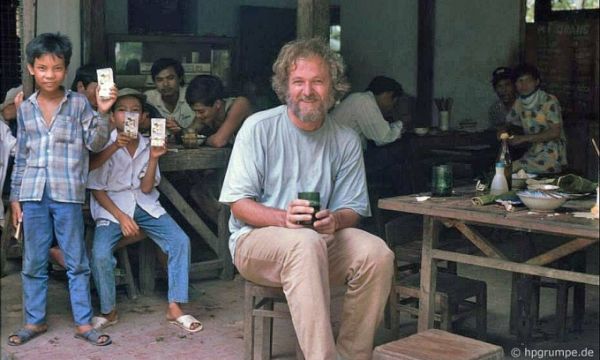
“When I got out of a car in a Thai village north of Dien Bien Phu, both adults and children screamed and ran away in panic as if they had just seen a demon,” the former German teacher recalls of his first trip to Vietnam.
Only after the guide introduced him to the village chief did residents gradually return and gather around the stilt house to talk.
Between 1991 and 1993, Grumpe spent 83 days traveling across Vietnam, documenting the country’s early postwar transformation and the beginning of its economic opening with thousands of photographs.
At the time, Vietnam was in the early years of the Doi Moi reforms, and tourism infrastructure remained underdeveloped while foreign visitors faced strict travel restrictions with special permits required for destinations outside established tourist routes.
Grumpe’s first journey began in Ho Chi Minh City and took him through Da Nang, Hoi An, Hue, Hanoi, Ninh Binh, and Ha Long Bay before continuing into northern provinces.
|
Hans-Peter Grumpe takes photos in Da Nang during his cross-Vietnam trip from 1991-1993. Photo courtesy of Hans-Peter Grumpe |
He later returned to explore the Central Highlands, the northwest mountains, and border provinces like Cao Bang and Lang Son.
“I was probably one of the first foreign tourists allowed to set foot in the northern part of Dien Bien Phu and along the Chinese border in 1992,” he says.
In many remote areas, locals had rarely encountered western travelers and often referred to him as “Mr. Soviet.”
Children and adults alike would curiously touch his beard and arm hair.
Accommodation in the highlands was limited, with Grumpe and his team frequently staying in guesthouses run by provincial people’s committees.
 |
|
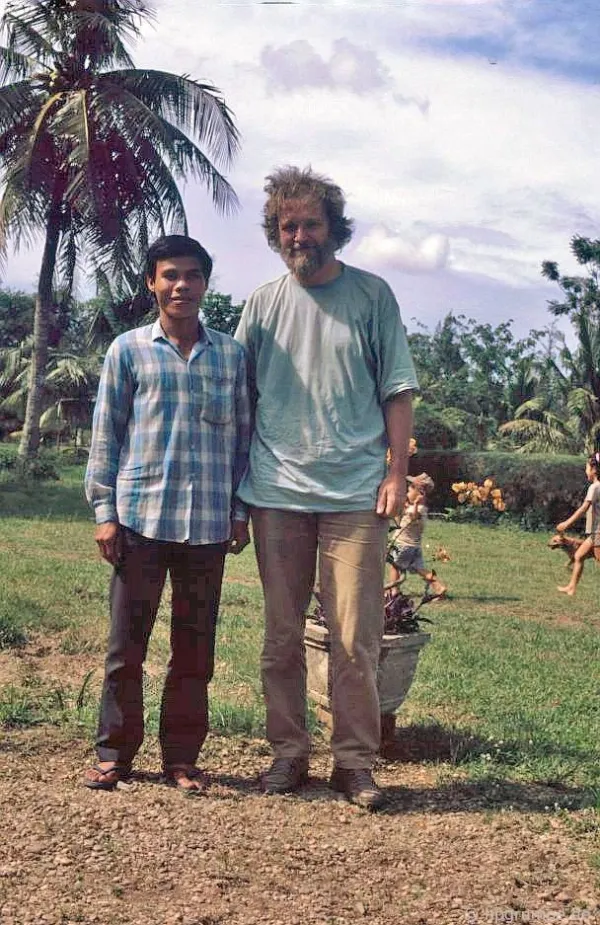
Hans-Peter Grumpe is pictured with his guide at My Lai, a surviving witness of the 1968 massacre by U.S. troops. Photo courtesy of Hans-Peter Grumpe |
He said the Vietnam he encountered in the early 1990s was filled with optimism despite the lingering scars of war.
During visits to sites such as the Cu Chi Tunnels, Vinh Moc Tunnels, Khe Sanh, and My Lai Memorial, he encountered unexploded ordnance, discarded artillery shells being sold as scrap metal, and abandoned tank wrecks repurposed as chicken coops.
His most haunting memory came from My Lai, where his guide was a survivor of the 1968 massacre by U.S. troops and had escaped death by hiding beneath cows in a rice field while the rest of his family perished.
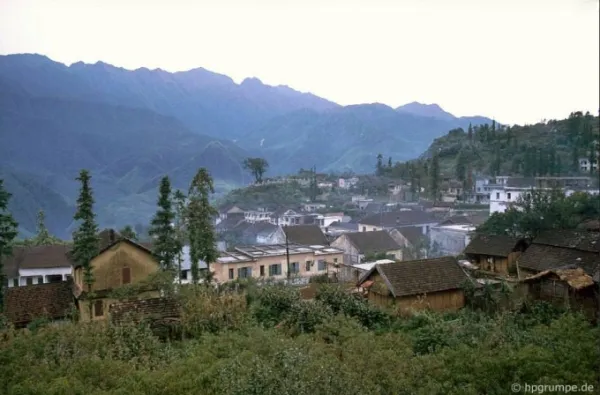
The northern highlands left the deepest impression on Grumpe, particularly Sa Pa before it became an international tourism hotspot.
Entering the town in 1991 had required hours of negotiations with the local police because of a typo in his travel permit.
He stayed in a renovated French colonial villa overlooking mist-covered mountains, with bats and rats often appearing in his room at night.
He also recalls the old Sa Pa weekend and love markets, where the Red Dao and Hmong peoples walked barefoot from distant mountain communities to trade goods and socialize through songs under the light of candles and oil lamps.
Just a year later, when he returned in 1993, Sa Pa had already begun to change. Travel permits had been abolished, tourist numbers were rising, and locals had started selling brocade fabrics and jewelry to visitors.
He recalls the local economies had visibly improving during his 1992-1993 journeys.
In Hanoi, the streets had become busier, with some roads banning cyclos. Video rental stores, shoeshine services, and arcade game machines were also becoming increasingly common.
While East German-made Simson and MZ motorcycles dominated the streets in 1991, they had largely been replaced by Japanese ones by 1993.
What saddened Grumpe most upon returning to Hanoi was the demolition of many old houses in the city center to make way for new developments.
Fifteen years after his journey, he published his Vietnam photo series online and received emotional responses from Vietnamese, who recognized images of Ho Chi Minh City, Hanoi, and Sa Pa during the early Doi Moi period.
 |
|
A pristine landscape in Sa Pa in 1991. Photo courtesy of Hans-Peter Grumpe |
In 2014, French architect Romain Orfeuvre contacted Grumpe regarding his archive of photographs. At the time, Orfeuvre was involved in developing the Hanoi Old Quarter Cultural Exchange Center, a joint project between Toulouse and Hanoi, and was searching for photographic material documenting Vietnam in the early 1990s.
Grumpe’s photographs were later incorporated into the center’s permanent exhibition space when it opened in February 2015.
According to Orfeuvre, the archive provides valuable documentation of Vietnam during its early years of economic opening, before rapid urbanization transformed the country.
Grumpe says for more than three decades, he had wanted to return to Vietnam as friends described a country changing day by day, but nostalgia kept him from revisiting.
“I want to preserve the memories of Vietnam from the old days.
“To me, the photos taken back then hold value as historical evidence.”