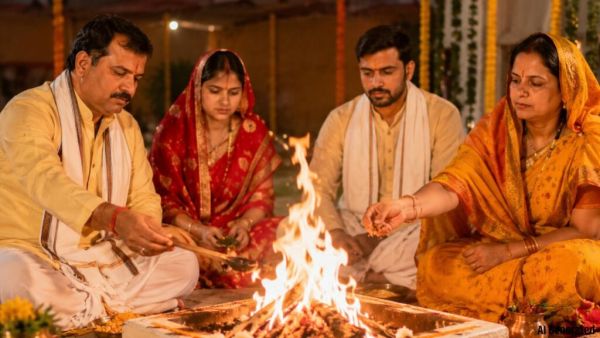
In Hindu religion, there are beliefs of performing many types of religious rituals. One of these rituals is to perform Havan. In Sanatan Dharma, worship, yagya and havan are considered to have special importance. The tradition of Havan has been going on since ancient Vedic times. Performing Havan in any auspicious work, religious ritual, house warming, marriage, mundan or special puja is considered auspicious. There is a religious belief that by performing Havan the environment becomes pure and the person gets mental, physical and spiritual peace.
In religious texts, Yagya has been described as a very virtuous act. According to Matsya Purana, the religious ritual which includes deity, mantra, offering, qualified Acharya and Dakshina is called Yagya. Through Havan, man conveys his reverence and devotion to the gods. This is why the word “Swaha” is chanted with every offering. Havan is considered incomplete without saying “Swaha”.
‘Swaha’ is made up of two words. Su and aah. According to religious belief, the word “Swaha” is considered to mean auspicious speech or good pronunciation. When “Swaha” is chanted along with mantras in Havan, then the offering reaches the Gods. Therefore, it is considered necessary to pronounce “Swaha” at the end of every mantra.
According to the legend, at the beginning of creation, Lord Brahma performed a yagya and offered it to the gods. The gods were satisfied with this, but the offerings made by humans were not reaching the gods. Troubled by this problem, the gods sought help from Brahmaji. Then Brahmaji remembered Adishakti on the instructions of Lord Vishnu. From his memory, Goddess Shakti appeared from her part in the form of “Swaha Devi”. After this Brahmaji sent Agnidev to Swaha Devi. Agnidev worshiped and praised Swaha Devi in the manner described in the Vedas. Pleased with his devotion, Swaha Devi accepted Agnidev and their marriage took place.
It is believed that since then, sages and scholars started offering offerings in Havan by saying “Swaha” at the end of the mantras. It is said that only Swaha Devi delivers a small part of the havan material dedicated to the fire to the gods. For this reason, pronunciation of “Swaha” at the time of Havan is considered very important.
According to religious beliefs, performing Havan makes the environment of the house and surroundings positive. This removes negative energy and gives a feeling of peace in the mind. Havan increases self-confidence and paves the way for spiritual progress. Havan has also been considered beneficial from scientific point of view. Samidha, herbs, ghee and other natural ingredients used in Havan help in purifying the atmosphere after burning in the fire. This destroys many types of germs and viruses present in the air. The aroma and heat emanating from Havan helps in reducing mental stress and fatigue. There is also a religious belief that the Gods are pleased with Havan and Yagya and bestow blessings of happiness, prosperity, wealth, strength and opulence. This is the reason that in Sanatan tradition, Havan is considered not only a religious ritual but also an important medium of a healthy and positive life.