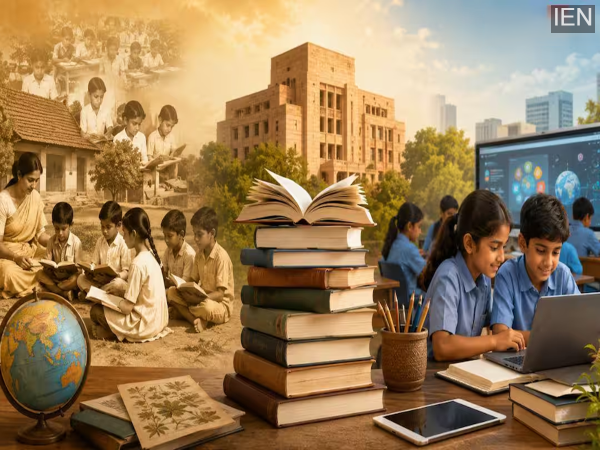
Established in 1961, the NCERT has played a pivotal role in shaping India’s school education system over the past six decades. Let us explore the details…
The National Council of Educational Research and Training (NCERT) is considered vital to the country’s school education system. Today, millions of students across the nation—including those under the CBSE board—study using NCERT books; these books also serve as a foundational resource for aspirants preparing for the UPSC and other competitive examinations.
NCERT was established on September 1, 1961, as an autonomous body under the Ministry of Education. Its primary objective was to develop uniform, high-quality standards for school education across the country. Additionally, it was tasked with providing policy advice on education to central and state governments and creating model textbooks for students.
NCERT was formed by merging seven major government institutions. These included the Central Institute of Education, the Central Bureau of Textbook Research, and the National Institute of Basic Education. The aim of integrating these entities was to bring research, training, and curriculum development in the field of education onto a single platform.
The Pivotal Role of the Kothari Commission
The Kothari Commission, constituted in 1964, played a crucial role in the evolution of NCERT. The Commission recommended comprehensive reforms in the Indian education system and provided a roadmap for developing a uniform curriculum and high-quality educational material at the national level. Subsequently, NCERT began working to strengthen the educational framework in alignment with the country’s changing needs.
In 1974, NCERT was officially registered as a literary, scientific, and charitable institution. Following this, the organization took several significant steps toward formulating the National Curriculum Framework (NCF).
Major Shift in 1975
In 1975, a “Ten-Year School Curriculum” was introduced at the national level for the first time. Its objective was to align education with Indian social and cultural realities. Subsequently, in 1988, the curriculum was revised in alignment with the National Policy on Education (1986), placing emphasis on student-centric education and reducing the academic burden on children.
In the year 2000, the curriculum incorporated a multicultural perspective, environmental education, and better inter-disciplinary coordination. Meanwhile, the National Curriculum Framework of 2005 is considered one of the most significant transformations in NCERT’s history. During this period, the focus shifted from rote learning to comprehension-based and holistic education, leading to major changes in textbooks and teaching methodologies.
Continuous Changes
In recent years, NCERT has continued to revise the curriculum. In 2023, a new committee was constituted in alignment with the National Education Policy (NEP) 2020, featuring prominent figures such as author Sudha Murty and renowned musician Shankar Mahadevan. This committee is currently finalizing the new curriculum and textbooks for classes 3 through 12.
Today, NCERT books serve as the primary study material for CBSE schools. Additionally, numerous state education boards base their own curricula on these books. NCERT books are also regarded as essential study material for aspirants preparing for the UPSC, SSC, and other competitive examinations.