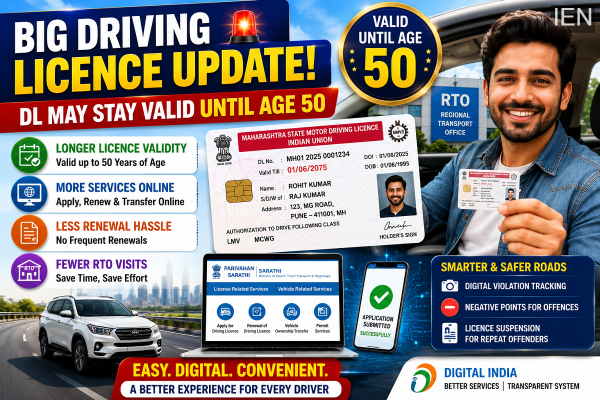
The central government is reportedly working on significant reforms aimed at simplifying driving licence and vehicle-related services across the country. If the proposed changes receive approval, millions of vehicle owners and drivers could benefit from a more convenient and digitally driven system.
One of the biggest proposals under consideration is extending the validity of a driving licence until the holder reaches the age of 50. The move could eliminate the need for frequent licence renewals and reduce administrative burdens for both citizens and transport authorities.
The proposed reforms are part of a broader effort to modernize transport services and expand digital governance in India.
At present, a standard driving licence is generally issued with a validity period of up to 20 years, after which the holder must undergo the renewal process.
However, the Ministry of Road Transport and Highways is reportedly evaluating a new framework that could significantly extend this validity period.
Under the proposal:
A driving licence may remain valid until the holder turns 50 years old.
Drivers may not need to undergo multiple renewal procedures during that period.
Administrative workload related to licence renewals could be reduced.
If implemented, the change could benefit millions of motorists by making the licensing process simpler and more efficient.
The proposed reforms go beyond driving licence validity.
The government is also exploring ways to make several transport-related services completely digital, reducing dependence on physical Regional Transport Office (RTO) visits.
Services that may become fully online include:
Vehicle ownership transfer
Permit renewal
Licence-related applications
Vehicle documentation services
This would allow citizens to complete most procedures from home using digital platforms.
The proposed changes align with the government's broader push toward digitization and paperless public services.
Officials believe that expanding online services can deliver several benefits:
Faster service delivery
Reduced paperwork
Greater transparency
Improved efficiency
Better citizen convenience
Digital systems can also help streamline operations and reduce pressure on transport departments.
According to officials, the digital transformation of transport services is not expected to affect government revenue collection.
Fees related to:
Driving licences
Vehicle registration
Ownership transfer
Permit services
will continue to be collected through online payment systems.
This ensures that citizens can complete transactions securely while maintaining existing revenue mechanisms.
While the government is considering easing administrative procedures, it is also exploring stronger enforcement measures for traffic rule violations.
Reports suggest that authorities are working on systems that can track repeat offenders more effectively.
Possible measures include:
Recording traffic violations digitally
Assigning negative points for repeated offences
Monitoring driver behavior over time
Taking action against habitual violators
The goal is to improve road safety while encouraging responsible driving practices.
One of the proposed enforcement mechanisms may involve a penalty points system.
Under such a framework:
Traffic violations could accumulate negative points.
Drivers repeatedly violating traffic rules may face stricter penalties.
Licences could potentially be suspended in serious or repeated cases.
Such systems are already used in several countries to improve compliance with road safety regulations.
If these proposals are approved and implemented, citizens could experience several advantages.
Longer licence validity
Fewer renewal requirements
Reduced paperwork
Less dependency on RTO visits
Faster online services
Improved transparency
Better road safety monitoring
The reforms could significantly simplify interactions with transport authorities while making services more accessible.
The proposed changes reflect India's ongoing effort to digitize public services and improve ease of access for citizens.
By combining longer licence validity with online service delivery and technology-driven enforcement, the government aims to create a more efficient and user-friendly transport ecosystem.
The proposed driving licence reforms could bring major convenience for millions of drivers across India. Extending licence validity until the age of 50, digitizing key transport services, and introducing smarter monitoring systems may transform how citizens interact with transport authorities.
While the proposals are still under consideration, they signal a strong push toward a more digital, efficient, and transparent transportation system in the years ahead.