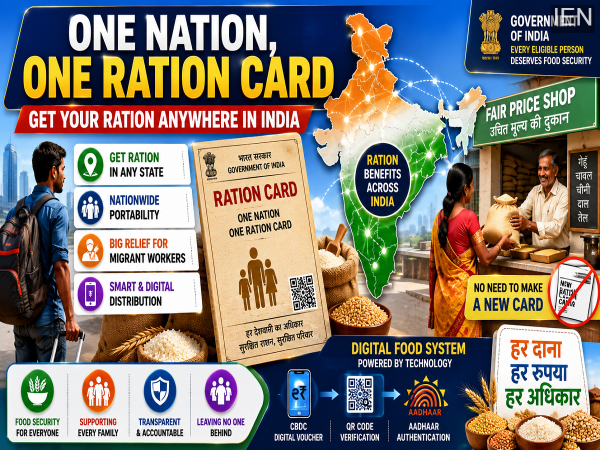
Millions of ration card holders across India can now access food grains from any eligible fair price shop in the country under the government's One Nation One Ration Card (ONORC) initiative. The scheme has significantly improved access to subsidized food for beneficiaries, especially migrant workers, students, and families who frequently move between states for employment or other reasons.
With ONORC, ration benefits are no longer restricted to a specific district, city, or state. Eligible beneficiaries can now receive their entitled food grains from any participating Public Distribution System (PDS) outlet across the country.
The initiative aims to ensure that no eligible citizen is deprived of food security simply because they have relocated from their home state.
The One Nation One Ration Card system is a technology-driven reform that allows ration card holders to access subsidized food grains from any Fair Price Shop (FPS) across India.
The scheme was introduced to make the Public Distribution System more portable and beneficiary-friendly.
Under this system:
Beneficiaries can collect ration from any authorized ration shop.
There is no need to obtain a new ration card after moving to another state.
Family members can also claim their share of ration from different locations if required.
The system works through Aadhaar-based identification and digital authentication.
The scheme supports beneficiaries covered under the National Food Security Act (NFSA) and other eligible government food assistance programs.
One of the biggest beneficiaries of the ONORC scheme is India's migrant workforce.
Millions of people leave their hometowns every year in search of:
Employment opportunities
Education
Business activities
Seasonal work
Earlier, many workers faced difficulties accessing ration benefits outside their home state because ration cards were tied to a specific location.
With ONORC, eligible beneficiaries can now receive their food grains from the place where they currently live and work, reducing hardships and improving food security.
The scheme offers several advantages for beneficiaries:
Ration can be collected from any participating ration shop in India.
People moving to another city or state do not need to apply for a new ration card.
Beneficiaries can continue receiving subsidized food grains regardless of location.
Digital verification helps reduce duplication and misuse.
Different family members can access their share of ration from different locations if necessary.
Alongside ONORC, the government is also testing new technologies to improve food distribution systems.
A pilot project based on Central Bank Digital Currency (CBDC) has recently been launched in Gujarat to modernize the Public Distribution System.
The initiative aims to simplify food subsidy delivery while improving transparency and efficiency.
Under the pilot project, eligible beneficiaries may receive digital food vouchers in the form of programmable digital currency (e₹), issued through the framework developed by the Reserve Bank of India (RBI).
The digital vouchers can be used to obtain ration from designated Fair Price Shops.
The system is expected to:
Improve transparency
Reduce distribution leakages
Enable real-time tracking
Strengthen accountability
Simplify subsidy delivery
Under the pilot framework:
Beneficiaries receive digital food vouchers.
Vouchers are linked to their entitlement.
Fair Price Shops verify the voucher.
Ration is issued digitally against the approved quota.
The system is designed to reduce dependency on traditional methods and enhance the efficiency of welfare delivery.
Officials believe that CBDC-based food distribution may help address some issues associated with biometric verification and e-POS systems.
The new framework is expected to:
Improve transaction reliability
Reduce authentication failures
Enhance beneficiary convenience
Provide secure digital records
After the initial rollout, the government plans to expand the pilot project to additional regions, including:
Chandigarh
Puducherry
Dadra and Nagar Haveli
Daman and Diu
The expansion will help evaluate the effectiveness of digital currency-based food distribution on a larger scale.
The One Nation One Ration Card scheme has transformed the way subsidized food reaches beneficiaries in India. By enabling nationwide ration portability, the initiative ensures that citizens can access their food entitlements regardless of where they live or work.
Combined with emerging digital innovations such as CBDC-based food vouchers, the government is moving toward a more transparent, efficient, and technology-driven public distribution system that aims to improve food security for millions of people across the country.