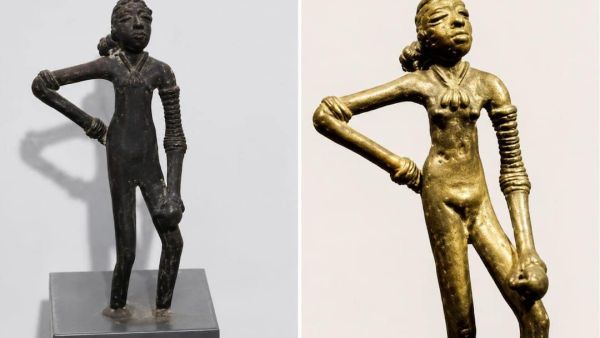
A fresh debate has emerged around the presentation of historical artefacts in school textbooks after the iconic Harappan-era “Dancing Girl” figurine appeared in a modified form in a newly introduced NCERT Class 9 arts textbook.
The bronze sculpture, one of the most recognisable relics of the Indus Valley Civilisation, features in the opening chapter titled History of Arts in Madhurima, NCERT's new textbook for Class 9 students. However, observers have pointed out noticeable differences between the textbook illustration and photographs of the original artefact.
The image published in the textbook appears to have shading across the figurine's upper body, obscuring anatomical details that are visible in the original sculpture. The representation has drawn attention because a version of the same artefact featured in NCERT's Class 6 Social Science textbook appears closer to the original object.
The issue has reignited discussions about how historical and artistic artefacts are depicted in educational material.
Historian and author Michel Danino, who chaired the textbook development committee for NCERT's new Class 6 Social Science books, said concerns regarding the figurine's suitability for younger students had been raised earlier.
“This refers to our Grade 6 Social Science textbook. The reason I was given was that the image of the Dancing Girl was not age-appropriate,” Danino told PTI. “Our team disagreed; we even checked with teachers of class 6, and they told us there was never a problem with the Dancing Girl,” he said.
Danino questioned the rationale behind modifying the depiction of the artefact.
“The notion that nudity is inappropriate is, in my opinion, an obsolete Victorian view. Yet we speak of decolonising Indian education.”
Commenting on the image used in the Class 9 textbook, he said the change was difficult to comprehend.
“If the Dancing Girl cannot figure as she is, and with proper dimensions, in a chapter on Indian art, then we have a serious problem,” he said.
According to Danino, altering the image changes the way students perceive an important historical object.
“The modification misrepresents the original artefact just as the Church's addition of a fig leaf to Michelangelo's statue of David in the Middle Ages misrepresented that beautiful work of art,” he said.
The scholar further argued that educational resources should present historical artefacts faithfully unless changes are clearly identified as reconstructions.
“Unless this is clearly done to indicate the possible reconstruction of a partial artefact, altering such an image amounts to creating a fake artefact. It points to a serious lack of understanding of how historical artefacts are to be pictured,” Danino said.
Speaking about the cultural importance of the figurine, he noted that researchers continue to debate its exact meaning and purpose.
He said similar akimbo postures discovered on potsherds from the Harappan site of Bhirrana in Rajasthan suggest the figure may have held “a precise cultural value, probably an artistic one.”
The textbook describes the Dancing Girl as a bronze figurine discovered at Mohenjo-daro and dating back to around 2600 BCE. It also notes that the sculpture was produced using the “lost-wax technique prevalent in West Bengal, Jharkhand, and Chhattisgarh.”
“This sculpture depicts a posture with one knee bent, one hand on the waist and a slightly lifted chin,” the textbook says.
Students are also encouraged to analyse the figurine's posture and participate in activities that involve recreating and sketching the pose.
The Dancing Girl remains one of the most celebrated artefacts from the Indus Valley Civilisation. So far, NCERT has not publicly responded to questions regarding the apparent difference in the representation of the figurine across its Class 6 and Class 9 textbooks.