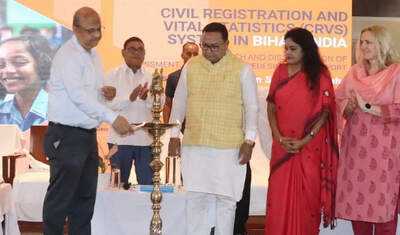
The Department of Planning and Development, Government of Bihar, in collaboration with the United Nations Children's Fund (UNICEF) and the United Nations Economic and Social Commission for Asia and the Pacific (UNESCAP), organized a workshop today in Patna focused on improving the Civil Registration and Vital Statistics (CRVS) system in Bihar. During the event, progress reports, policy briefs, and awareness materials aimed at strengthening the CRVS system were unveiled.
The chief guest, Honorable Minister of Planning and Development, Shri Shri Bhagwan Singh Kushwaha, emphasized that birth and death registration is not merely an administrative task but a crucial means to ensure citizens' access to government services and rights. He highlighted the necessity of extensive public relations and community involvement to ensure that every birth and death event is reported at the local level. He instructed officials to enhance the local information system and raise awareness about registration by reaching out to families. He also stressed the importance of utilizing information boards and other local media for effectively disseminating birth and death data.
In her address, Additional Chief Secretary of the Planning and Development Department, Dr. N. Vijayalakshmi, stated that the CRVS system has two primary objectives: timely collection of accurate and reliable data and effective utilization of that data for policy-making and development planning. She noted the need to develop modern, citizen-centered services that meet the demands of contemporary society. Dr. Vijayalakshmi pointed out the awareness gap among migrant and marginalized families and the practical challenges related to registration. She mentioned that various communication materials such as information boards, pamphlets, booklets, street plays, and community campaigns would be extensively used for public awareness. Additionally, she emphasized the need for continuous efforts to resolve discrepancies in registration and improve the quality and accuracy of future data.
Development Commissioner of Bihar, Shri Mihir Kumar Singh, noted that approximately 90% of births in the state currently occur in health institutions, providing an opportunity to further strengthen the birth registration process. He stressed the importance of effectively implementing the rules and procedures for registering both institutional and non-institutional births. He praised the collaborative efforts of the Directorate of Economics and Statistics, UNICEF, and UNESCAP in organizing the workshop, calling it a significant initiative.
The AAR report presented during the workshop provided a comprehensive assessment of the state's civil registration and vital statistics system, identifying challenges related to service delivery, institutional capacity, public awareness, coordination, and accessibility. The report includes recommendations aimed at making the system more citizen-centered, efficient, and accountable, ensuring universal and timely registration of births and deaths.
Dr. Chloe Mercedes Harvey, a statistics expert from UNESCAP, and Dr. Abhay Kumar from UNICEF Bihar presented detailed insights on the key findings and recommendations of the report. The workshop saw participation from state and district-level officials, representatives from various departments, and development partner organizations, who discussed practical and actionable measures to strengthen the CRVS system.
Special emphasis was placed on how the conclusions and suggestions from the report will be instrumental in developing standardized operating procedures (SOPs), facilitating phased implementation of improvement initiatives in the state, enhancing service delivery, increasing registration coverage, and better utilization of significant statistical data in policy-making. At the conclusion of the program, Ranjit Kumar, Director and Chief Registrar (Birth and Death), Directorate of Economics and Statistics, delivered a vote of thanks. This workshop is expected to be a crucial step towards strengthening the birth and death registration system in Bihar, providing timely services to citizens, and guiding data-driven governance.