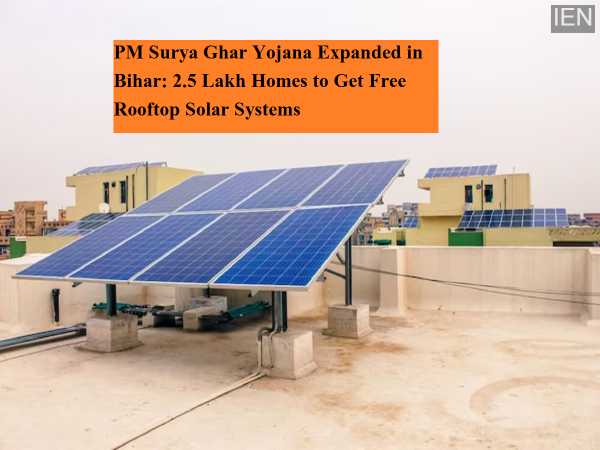
The Bihar government has accelerated the implementation of the PM Surya Ghar Muft Bijli Yojana, aiming to bring affordable and clean energy to economically weaker households across the state. As part of the initiative, rooftop solar power systems are now being installed on the homes of eligible beneficiaries, helping families reduce electricity costs while promoting renewable energy adoption.
Officials have announced that the program will initially cover 2.5 lakh households, with plans to significantly expand its reach in the coming years.
The state government has begun installing rooftop solar plants for Kutir Jyoti consumers under the PM Surya Ghar Muft Bijli Yojana. The initiative forms part of Bihar's broader strategy to improve energy access and encourage sustainable electricity generation.
According to state officials, the scheme is being implemented across all 38 districts and is expected to benefit millions of economically disadvantaged families over time.
The government has identified BPL (Below Poverty Line) households as one of the primary beneficiary groups under the expanded program.
Deputy Chief Minister Samrat Choudhary stated that rooftop solar installations have already begun for 2.5 lakh eligible households.
The objective is to provide long-term access to clean and affordable electricity while reducing dependence on conventional power sources.
Officials have also indicated that the state intends to expand the initiative gradually and eventually provide solar power benefits to approximately 25 lakh households.
The government has outlined an ambitious roadmap for the coming years.
Key targets include:
Installation of rooftop solar systems on 2.5 lakh homes in the initial phase.
Expansion to nearly 25 lakh households in future stages.
Inclusion of economically weaker families across urban and rural areas.
Increased adoption of renewable energy throughout the state.
The initiative is expected to play a major role in Bihar's clean energy transition.
Eligible beneficiaries can receive several advantages through the program.
Solar energy can significantly reduce monthly electricity expenses.
The scheme encourages the use of renewable energy and reduces dependence on traditional power sources.
Once installed, rooftop solar systems can generate electricity for many years, lowering energy costs over the long term.
Households can generate a portion of their own electricity rather than relying entirely on grid power.
State leaders highlighted the remarkable growth in electricity access over the past two decades.
According to government data:
Bihar had around 17 lakh electricity connections in 2005.
The number has now increased to more than 2.22 crore connections.
Electricity demand in the state has risen from approximately 400–500 MW to nearly 9,000 MW.
Officials believe the solar initiative will further strengthen Bihar's energy infrastructure while reducing pressure on conventional electricity networks.
The state government has emphasized its commitment to supporting electricity consumers through substantial subsidy programs.
Officials stated that Bihar provides one of the highest electricity subsidy levels in the country, with annual support running into thousands of crores of rupees.
The rooftop solar initiative is expected to complement these efforts by helping households reduce their dependence on subsidized electricity.
Applicants must meet certain basic requirements to qualify for the scheme.
Must be an Indian citizen.
Must have a valid electricity connection.
Must have sufficient rooftop space for solar panel installation.
Should not already be receiving benefits under another rooftop solar subsidy scheme for the same property.
The scheme is available for:
Individual residential houses
Flats and residential units (subject to applicable conditions)
Small business establishments
Urban households
Rural households
The Bihar government has directed officials to complete rooftop solar installations on 2.5 lakh homes by November 20, 2026.
In addition, the central government has reportedly set a target of connecting approximately 4.82 lakh homes to solar energy systems by March 31 of the next phase.
These targets reflect the growing emphasis on renewable energy and household-level power generation.
Rising electricity consumption and increasing energy demand have made renewable energy an important part of India's future power strategy.
By helping low-income households adopt solar power, the PM Surya Ghar Muft Bijli Yojana aims to:
Reduce electricity expenses
Improve energy security
Promote environmental sustainability
Encourage clean energy adoption
Support economic empowerment
Bihar's expansion of the PM Surya Ghar Muft Bijli Yojana marks a significant step toward bringing affordable solar energy to economically weaker families. With rooftop solar systems being installed on 2.5 lakh homes in the first phase and plans to eventually reach 25 lakh households, the initiative has the potential to transform energy access across the state.
For eligible families, the scheme offers an opportunity to benefit from clean, reliable, and cost-effective electricity while contributing to India's broader renewable energy goals.