DON'T MISS A MOMENT OF THE WORLD CUP
Inside Marcelo Bielsa’s turbulent reign as Uruguay’s head coach: ‘El Loco’s’ methods examined ahead of the World Cup opener.
For a coach who has spent nearly four decades in professional football, Marcelo Bielsa’s trophy cabinet remains surprisingly sparse. Yet, Pep Guardiola insists that this does not diminish his legacy. “To be loved is the greatest title – more than the Champions League or Premier League or anything else,” said the Catalan manager. “To be loved is the most important thing, and I think Marcelo has that more than any other manager in the world.”
Among coaches, Bielsa is revered as one of the game’s most influential thinkers. Fans from Leeds to Bilbao hold him in near-mythical regard. In Uruguay, however, the Argentine remains a deeply divisive figure – and not because of his nationality.
The issue lies in his personality. Bielsa’s nickname, ‘El Loco’ (The Madman), is well-earned. He calls himself a “generator of tension” – an obsessive perfectionist who some players find inspiring, while others find exasperating.
That intensity is one reason Uruguay enter the 2026 World Cup as perhaps its most unpredictable team. Bielsa has already indicated that he will step down after the tournament, but whether he will depart as a genius or a self-acknowledged madman remains to be seen.
Encouraging Beginnings
It is somewhat surprising that Bielsa still holds the position as Uruguay prepare to face Saudi Arabia in their World Cup opener on Monday, considering how promisingly his tenure began.
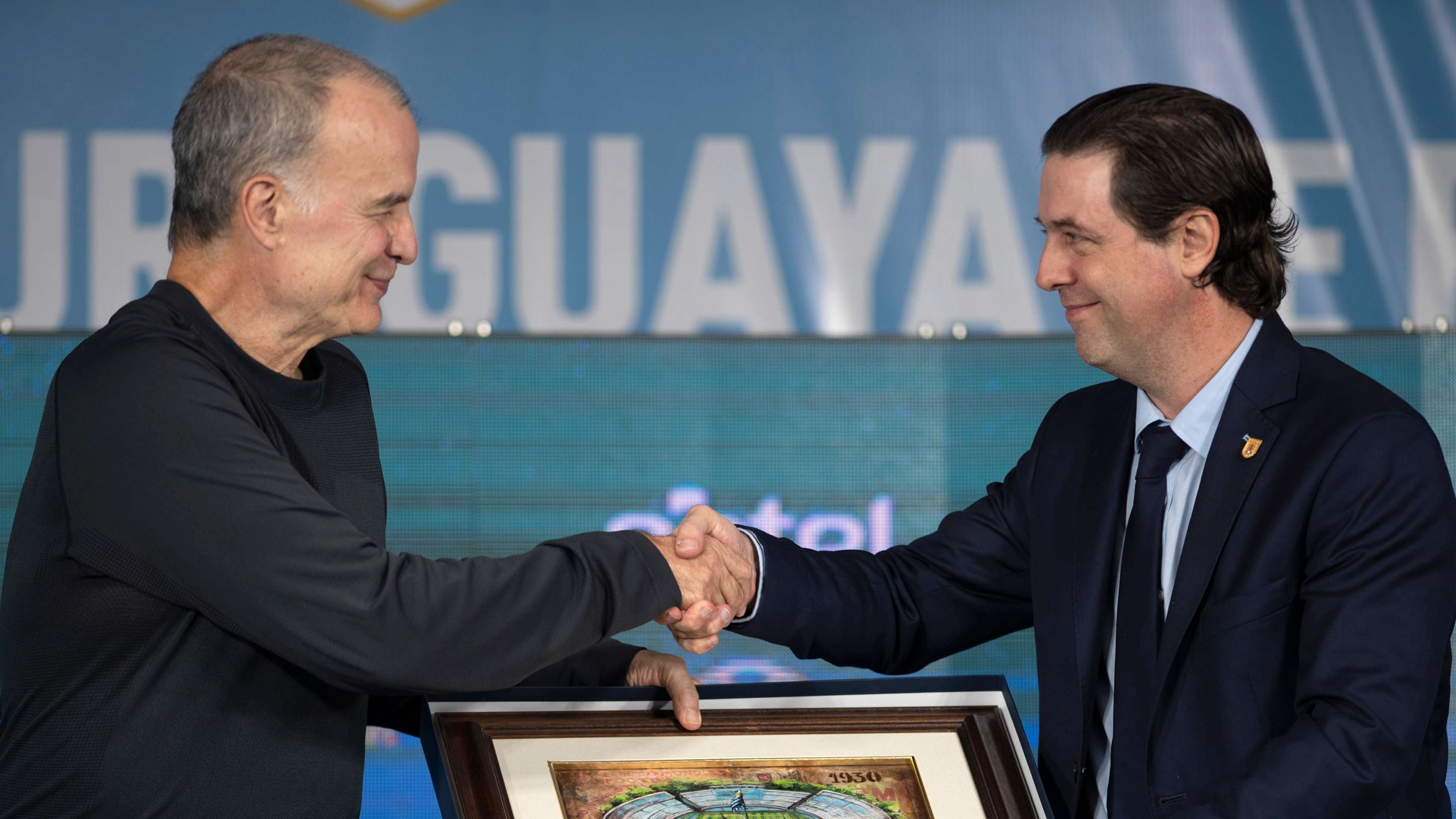
At his unveiling in May 2023, Bielsa struck all the right notes. His lucrative contract – among the highest in international football – raised eyebrows at home, but he was adamant that money was not his motivation.
“The AUF (Uruguayan Football Association) didn’t have to convince me; if anything, it was the opposite,” he told journalists. “My desire to be part of this project comes from two strong reasons: the quality of Uruguay’s players and the fact that this team belongs to its people.”
Winning Over Messi
Fans agreed that the national squad needed a reset after a dismal group-stage exit at Qatar 2022. However, Bielsa’s swift removal of icons like Edinson Cavani and Luis Suarez drew heated debate across the country.
By the end of 2023, many sceptics had come around. Uruguay recorded back-to-back World Cup qualifying wins over Brazil and Argentina, including a 2-0 triumph in Buenos Aires – their first away victory against Argentina since 1937. Argentina had lost only one of their previous 51 matches in all competitions, yet Lionel Messi admitted that his team could not handle Uruguay’s relentless pressing and quick transitions.
“You can see Bielsa’s influence in the way Uruguay play,” Messi said. “In every team he’s managed, including Argentina, his style is distinct. And he has a good generation of players in Uruguay.”
That belief that Bielsa was building something special only grew after Uruguay finished third at the following summer’s Copa America in the United States. Yet, almost immediately after the tournament, cracks began to appear.
Suarez’s Frustration
Two-time Champions League winner Javier Martinez once remarked that every player should work under Bielsa “at least once in their life.” Luis Suarez, however, suggested he would prefer never to meet the Argentine again, following his retirement from international football in September 2024.
Suarez had contributed positively during the Copa America, scoring a last-minute equaliser in the third-place play-off against Canada. Still, he described his experience under Bielsa as overwhelmingly negative.
The former Barcelona and Liverpool striker accused Bielsa of repeatedly disrespecting his players, saying that he “wouldn’t even say hello” to them.
“There were situations during the Copa America that were painful to watch, which I didn’t speak about at the time for the good of the team,” Suarez told DSports Uruguay. “But it will keep happening. The players will reach their limit and eventually explode.” His warning proved prescient.
‘No Way to Justify This Result’
On 18 November in Tampa, Florida, Uruguay suffered a humiliating 5-1 defeat to a depleted United States side. Though only a friendly, the performance was atrocious. True to form, Bielsa accepted full responsibility.
“There is no way to justify this result,” he admitted. “What was most affected tonight was my approach to the game and how I prepared the players. This outcome reflects my role as a coach, the way I set up the team, and the style I imposed. There’s no reason why our best players should lose to a second-string U.S. side.”
Bielsa sounded like a man whose players were drained – perhaps not mutinous, but certainly fatigued. It wouldn’t be the first time.
The Blessing and the Curse
Bielsa’s teams are synonymous not only with pressing but also with exhaustion. His style demands such intensity that squads often fade late in campaigns. The toll is both physical and mental.
He resembles Rust Cohle from the series True Detective – brilliant, tortured, and self-aware. Cohle once said, “I’m just not good for people. I wear them down.” Bielsa could easily relate.
In a two-hour press conference following the Tampa loss, Bielsa confessed: “When I arrive, the atmosphere becomes tense. That’s why I appear infrequently. I’m toxic. Associating with me makes you worse. Do you understand?”
He elaborated: “There are toxic people who only focus on correcting errors, who are demanding and never satisfied. They talk only about their work. When they go out to eat, they read the newspaper to avoid conversation, to stay disconnected from distractions.”
“Don’t think I enjoy it. For me, it’s karma. I’m shy, obsessive, robotic. I dislike disorder. Those are my flaws. I find it difficult to be spontaneous and friendly.”
Genius or Madness?
As Uruguay head into the World Cup in North America, expectations are unpredictable. Encouraging draws against fellow qualifiers England and Algeria in March offered some stability, but the absence of warm-up matches has deepened uncertainty around the Celeste.
Uruguay remain one of the tournament’s great enigmas – capable of brilliance or collapse. Their campaign promises to be as fascinating as their mercurial coach.
Bielsa’s methods are now under more scrutiny than ever. Is he still the visionary who sees what others cannot, or has he fallen behind in a game he helped shape?
Whatever happens, his reputation among elite coaches is secure. Guardiola and others will continue to admire him. U.S. coach Mauricio Pochettino described Bielsa as “special” precisely because he is “very different from us, the normal coaches.”
Whether Bielsa’s time with Uruguay ends in triumph or turmoil will soon be clear. The coming weeks will reveal whether ‘El Loco’ has truly lost his magic – or whether there is still method in his madness.