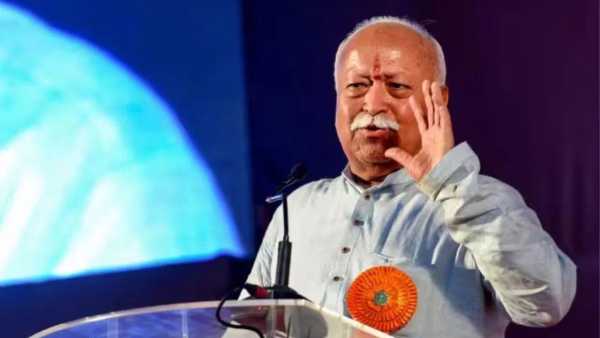
Rashtriya Swayamsevak Sangh (RSS) chief K Mohan Bhagwat flatly refused to respond to the open letter of Karnataka Home Minister Priyank Kharge. In the letter, Kharge had demanded RSS to clarify its legal status, get it registered and make public the information related to income-expenditure, property as well as funding.
Speaking at an event in Thrissur, Kerala, Bhagwat said, 'I will not respond to Kharge's letter. We have nothing to hide. There are many things which are not registered and we are not doing any secret work. We are working openly. We call people and tell them about the Sangh.
Terming Kharge's demand as politics and gimmick, he said that the Sangh is used to such attacks. He said that this is politics and such tactics are being adopted. We are used to it. He said that we had to face all this only 10-15 years after the establishment of the Sangh. If this is not the case then we feel something is missing.
#WATCH | Thrissur | Reacting to Karnataka Minister Priyank Kharge's statement, RSS Chief Mohan Bhagwat says, “I don't need to respond. There are so many unregistered things going on, and we are not secretive. We are working in the open. We are calling people and telling them pic.twitter.com/3zDXPJVZp4
— ANI (@ANI) June 16, 2026
On the demand for registration, the RSS chief argued that many things are not registered. He said Hindu religion is not registered. Many things are not registered. He said that registration is necessary only for those who want to receive money from the government, that should be the case, but in the case of RSS, the government knows that the Sangh exists.
Bhagwat said that if he banned RSS, it meant that he accepted its existence. He said that this is all politics, nothing serious. He said that on one hand they want to hinder the work of the Sangh and on the other hand they want to create doubt in the minds of people, but now this is not possible because people know us. He said that they say that we work secretly, whereas our workers live in all the areas, people see them every day, the branches of the Sangh are set up in open grounds. We have public events.
Referring to the history of the Sangh, Bhagwat said that the RSS was started during the British rule. He said that the government had banned the Sangh twice and the ban was lifted both times. Once through the judicial process and second time after Satyagraha. He said that if the government had imposed the ban, it means that the government knew that RSS existed. He said that the ban on RSS is proof that the identity and activities of the organization are not hidden from the government. Along with this, he also said that the written constitution of the Sangh has been handed over to the government in the 1950s and in the last 100 years it was never said that RSS should be registered separately.
In fact, Karnataka Home Minister Priyank Kharge, in a letter posted on his social media handle, had demanded RSS to clarify its legal status, make information about registration, funding, income-expenditure and assets public. Kharge had said that if RSS is an organization with a large number of branches and volunteers across the country, then it should also follow the standards of transparency and accountability under the Constitution.
Dear Shri Mohan Bhagwat ji,
My letter will reach you soon. However, I thought it was important to draw your attention to this matter early.
——————————-Firstly, congratulations to the RSS on completing 100 years.
An organization that claims over 60,000 shakhas and crores of pic.twitter.com/IZy4oeKdMp
— Priyank Kharge (@PriyankKharge) June 15, 2026
Kharge raised the question in the letter that when citizens, companies, trusts, NGOs and other institutions have to register and provide information under the rules, then why should RSS be kept out of it. Citing the 2025-26 report of the RSS's All India Pratinidhi Sabha, he said that thousands of Sangh branches and many social activities are being conducted in Karnataka. He told that 4,127 daily shakhas, 1,389 weekly meetings and many other programs of RSS are organized in the state. He said that an organization with such a huge social impact should clarify information related to its officials, financial sources, expenditure, taxes and public activities.