ELEVEN days before the Iran National Football Team was set to play its first match at the 2026 World Cup, Marjane Satrapi passed away in Paris, France — the city where she had lived for 32 years.
Perhaps not many people in Iran mourned her death. There were no flags flown at half-mast, no public ceremonies or processions — not in Tehran, not in Mashhad, and not even in Shiraz, a city known as the heart of Iranian culture and literature. Only a handful of activists, particularly those championing women’s and human rights causes she had long supported from afar, held modest, private gatherings to revisit her body of work — perhaps with a hint of fear.
In Iran, Satrapi’s monumental work, Persepolis — a graphic novel (though Satrapi herself preferred to call it a comic) — has long been viewed as an act of fierce political resistance against the state, especially the ruling theocratic Islamic Republic. She was branded a supporter of Shah Reza Pahlavi, the monarch overthrown during the 1979 revolution. At that time, Marjane Satrapi — affectionately called Marji by her parents — was only ten years old, fond of denim jackets and braided hair.
Satrapi never denied that Persepolis carried political undertones. Yet, she rejected being labeled a traitor to her country. She dismissed accusations of rebellion. In numerous interviews, Satrapi insisted she loved Iran wholeheartedly. But love, she said, does not mean submission. Love does not mean blind praise. Sometimes, love is the courage to refuse deceit.
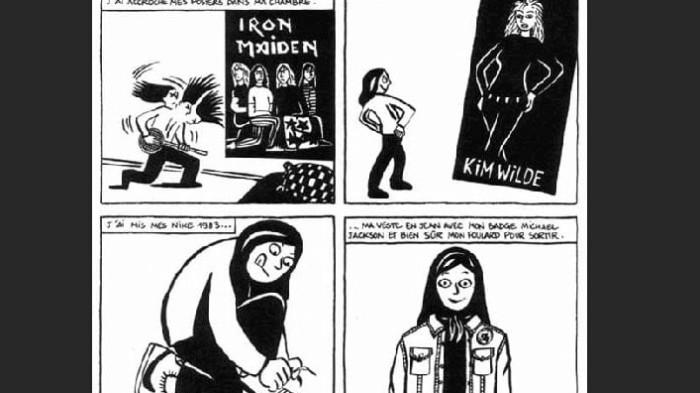
In the preface to the first edition of Persepolis, published in 2000, Satrapi wrote: “I want Iran not to be seen only through the lens of fundamentalism, fanaticism, and terrorism. Iran, a great nation with a glorious history, should not be judged by the actions of a few extremists.” In other words, through Persepolis, Satrapi sought to show the world the real Iran — a nation wounded, but whose scars did not form in a vacuum. To some extent, she succeeded, although in the West — particularly in France, across Europe, and in the United States — what often resonated most was the irony, the absurdity of politics, and the romanticism of a young girl who loved Iron Maiden and Michael Jackson and once dreamed of becoming a prophet.
When Iran faced discrimination at the 2026 World Cup, a consequence of its prolonged political rift with Israel — backed by the United States — Marjane Satrapi remained silent. She had long withdrawn from the chaos of the world, consumed entirely by grief. Satrapi had fallen into deep depression following a series of personal losses, culminating in the death of her husband, Mathias Ripa, a Swedish photographer. Ripa, her last source of strength, died in a road accident.
Perhaps the Iranian players selected for the 2026 World Cup knew little about Satrapi. Perhaps they had never even heard of her. Perhaps, for them, Persepolis meant only the legendary football club that produced icons like Ali Daei, Ali Karimi, Mehdi Mahdavikia, and most recently, Mehdi Taremi.
Yet, knowingly or not, every Iranian player carried within them the spirit Satrapi described in Persepolis — resilient, patriotic, though not necessarily heroic.
The United States — narrow-mindedly and cowardly — used politics and old grudges as instruments of pressure against nations it opposes, even within sports. Iran became the victim. FIFA merely watched from afar, taking no action when President Donald Trump ordered immigration authorities to restrict the Iranian squad’s stay in the U.S. to no more than 12 hours. This meant they had to arrive, play, pack up, and leave — all within the same day.
As a result, after being barred from staying in the U.S., the Iranian National Team had to relocate to Mexico — specifically, Tijuana. The journey from there to SoFi Stadium in Inglewood, California, took nearly six hours. And that was only the beginning. In their final group stage match, Iran was scheduled to play at Lumen Field in Seattle. The distance from Tijuana? Nineteen hours!
Logically, such circumstances should have destroyed Iran’s chances. Completely. How could they possibly perform when still battling jet lag? Their stamina would surely be depleted. The weather — hot and humid — would only worsen things. Even hydration breaks would offer little relief.
Yet, on June 16 at SoFi Stadium, the opposite unfolded. True, signs of fatigue were visible, especially early in the game. There was perhaps some psychological tension too. New Zealand scored the opening goal just seven minutes in. But gradually, Iran found its rhythm. The match ended 2-2 — a respectable result by any measure. Around 70,000 spectators applauded the team as they left the pitch, including FIFA President Gianni Infantino.
During the post-match press conference, Mehdi Taremi, after answering several questions, turned to an American journalist and asked, “You keep asking about politics, about our country. Don’t you have any questions about football?”
Taremi did not wait for a reply. He stood, smiled, and walked out of the room. And perhaps that smile would have grown even wider if he knew that in Persepolis, Marjane Satrapi once wrote: “In life, you’ll meet plenty of idiots. If one day their stupidity hurts you, just remember — they’re nothing more than a bunch of fools.” (t agus khaidir)