Beyond the visible marks of effort and passion, the football jerseys showcased at the World Cup carry deep cultural and historical resonance. As the world’s biggest sporting spectacle unfolds across the United States, Canada, and Mexico, the kits worn by each national team often reveal fascinating — and occasionally contentious — stories stitched into their designs.
Making their debut at the World Cup, Cape Verde, the smallest nation in the tournament by population, exceeded expectations with a spirited performance. Representing roughly 525,000 people spread across 10 volcanic islands off the coast of Africa, the team embodied a powerful sense of national unity.
This unity is literally woven into their blue home and white away kits, which feature a geometric, triangular pattern. The motif represents flight paths that connect the islands, symbolising the idea that the entire nation stands behind its players. That spirit was evident on the pitch as the squad battled to a hard-earned 0-0 draw against a heavily favoured Spain in their opening fixture.
Belgium’s away jersey carries a thought-provoking message on its collar: “This is not a jersey.” This unusual detail pays tribute to the country’s rich surrealist legacy and particularly to the groundbreaking work of early 20th-century artist René Magritte.
Magritte, celebrated for exploring the tension between perception, language, and reality, famously painted the words “Ceci n’est pas une pipe (This is not a pipe)” beneath his depiction of a pipe in “The Treachery of Images.” The light-blue Belgian shirt, adorned with vibrant pink graphics and black details, features classic football imagery such as pitch markings and a ball. According to the Belgian Football Federation, “True to the surrealism theme, the kit sparks the imagination and invites conversation.”
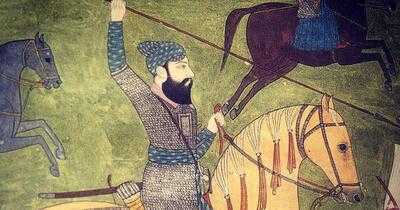
Haiti faced an unexpected challenge when FIFA rejected its original jersey design. The initial concept, produced by Colombian manufacturer Saeta, boldly displayed an image of the final battle of the Haitian War of Independence in 1803 across the front. Saeta described the artwork as a “tribute to the men and women who contribute every day to Haiti’s future.” However, FIFA deemed the design “too political,” forcing the Caribbean nation to produce a revised blue kit that omitted the historic imagery.
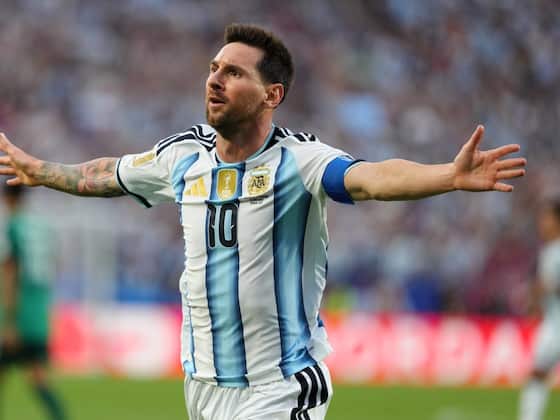
Argentina, the reigning World Cup champions, have merged their illustrious football tradition with artistic flair in their latest kits. The home shirt, worn by Lionel Messi during his hat-trick against Algeria on Tuesday, features stripes in three different shades of blue — a nod to the team’s World Cup-winning uniforms from 1978, 1986, and 2022. The dark blue away kit, meanwhile, draws inspiration from filete porteño, a traditional decorative art form from Buenos Aires recognised for its swirling patterns and ornate lettering.
France’s away jersey delivers a striking homage to a historic symbol of Franco-American friendship: the Statue of Liberty. The shirt’s distinctive green tone reflects the oxidised copper of the famous monument, designed by French sculptor Frédéric-Auguste Bartholdi and presented to the United States in 1886. A copper-hued emblem recalls the statue’s original shine, while the inscription “Nos différences nous unissent” (Our differences unite us) reinforces the theme of unity and shared values.
Iran’s home (white) and away (red) jerseys feature one of the most striking images of the tournament — the silhouette of an Asiatic cheetah running across the chest, with spots extending up the sleeves. The Asiatic cheetah, a critically endangered relative of the African species, has long been a symbol of Iran’s conservation efforts. Once numbering around 400 in the 1990s, fewer than 70 are now believed to remain in the country.
Norway’s World Cup kit stands out for its sharp design and historical depth. The angular font used for player names and numbers is inspired by runic writing — the ancient Germanic alphabet used across northern Europe before the adoption of Latin script. The geometric, pointed typeface reflects Norway’s embrace of its Viking-era heritage, complemented by intricate Urnes-style patterns surrounding the shirt’s bold blue cross.
Colombia’s bright yellow jersey hides a subtle yet poetic detail: a pattern of butterflies spread across its surface. This design pays homage to Nobel Prize-winning author Gabriel García Márquez and his classic novel “One Hundred Years of Solitude,” where magical realism merges everyday life with the extraordinary — such as the iconic image of yellow butterflies trailing a character through the story.
Mexico’s home kit revives a fan favourite from the 1990s — the Aztec calendar motif. Ahead of the tournament, the national team visited Mexico City’s National Museum of Anthropology and posed before the Aztec “Piedra de Sol” or Stone of the Sun, the ancient sculpture that inspired the design. The jersey’s intricate patterns connect modern football to Mexico’s rich pre-Columbian heritage.
Saudi Arabia’s dark green home jersey is decorated with symmetrical lavender squares and diamond shapes, echoing geometric motifs found in traditional doorways throughout the kingdom. The purple tone, associated with wild lavender that blossoms across the desert in spring, is regarded as a colour of generosity and national pride.
Brazil’s navy blue and black away kit, crafted by Nike, features a yellow “Jumpman” logo — a nod to Michael Jordan’s iconic brand. Yet its deeper inspiration lies closer to home: the design draws from the vivid skin of the Amazonian poison dart frog. The choice of colours reflects both the natural beauty and the underlying danger associated with the record five-time world champions.