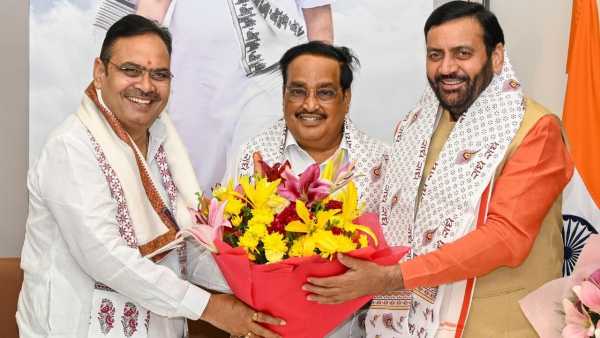
The water dispute that was stuck between Haryana and Rajasthan for the last three decades has finally been resolved. To formalize this historic agreement, an official Memorandum of Understanding (MoU) will be signed between the two states in the presence of Union Home Minister Amit Shah on Monday. In this program, Union Jal Shakti Minister C.R. Along with Patil, the Chief Ministers of both the states will also be present. Earlier in Delhi, Union Jal Shakti Minister C.R. The permanent solution to this dispute was finalized in a high-level tripartite meeting chaired by Patil.
In the meeting, Rajasthan Chief Minister Bhajan Lal Sharma and Haryana Chief Minister Naib Singh Saini approved the action plan to end the decades-old dispute with mutual coordination. Actually, this deadlock between the two states was mainly regarding the implementation of the Yamuna Water Agreement signed in 1994. Under this agreement, Rajasthan was allotted its share in the surplus water received during monsoon.
However, due to infrastructure and technical constraints, this scheme could not be implemented for the last 32 years. Due to this, Shekhawati region of Rajasthan (Churu, Jhunjhunu and Sikar) was facing severe water crisis for a long time. Now, after the consensus reached in this high level meeting held on Tuesday, the way has been cleared to supply water by laying pipeline from Hathnikund Barrage to Rajasthan, which will quench the thirst of Shekhawati region.
Haryana Chief Minister Nayab Singh Saini while assuring Rajasthan of supply of water allocated under the Upper Yamuna River Board Agreement of 1994 said that Haryana respects Rajasthan's right to receive water under this agreement. According to the agreement, its share of water will be provided to Rajasthan through the pipeline and the agreement in this regard will be signed within a week.
At the same time, Rajasthan CM Bhajanlal Sharma said that Rajasthan is only demanding the quantity of water allotted to it under the agreement. He said that if the excess water flowing in the rivers during the monsoon season is used effectively and given to Rajasthan, it can provide a permanent solution to the drinking water crisis in large parts of the state. In this regard, officials said that during the meeting, Haryana CM said that Renuka, Kishau and Lakhwar dam projects are very important for the states of North India and efforts will be intensified for their early implementation.