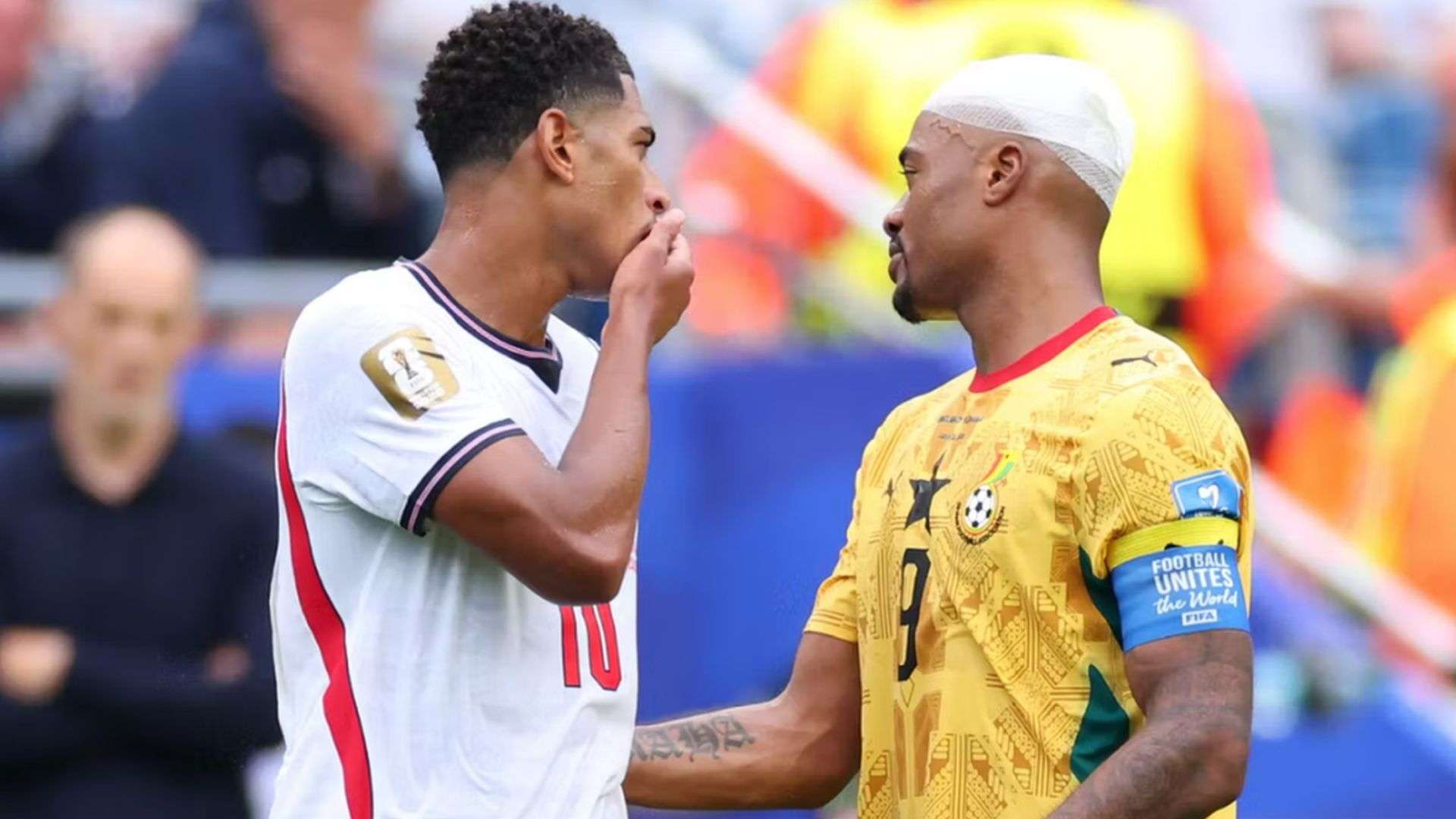
Jude Bellingham became the focus of post-match discussion after England's goalless draw with Ghana in the World Cup, when photos circulated showing him covering his mouth while speaking to Jordan Ayew. Despite FIFA’s newly implemented regulation for the 2026 World Cup that could lead to a red card for such actions, the England midfielder was not penalised and finished the match.
The new FIFA mouth-covering regulation
The debate surrounding Bellingham’s gesture originates from a recently introduced FIFA rule for the 2026 World Cup, which states that players may be sent off if they deliberately conceal their mouth while addressing an opponent. This rule was strongly promoted by FIFA President Gianni Infantino after an earlier case involving Benfica’s Gianluca Prestianni, who received a six-match suspension for homophobic behaviour earlier this year.
The intent behind this law is to promote transparency and respect on the field. Infantino explained, “It’s about respect. It’s about setting the right example. If you have nothing to hide, you shouldn’t feel the need to cover your mouth when speaking to someone. The rules have been made very clear to everyone.”
Why Bellingham was not punished
Although images captured Bellingham covering his mouth in conversation with Ayew, officials emphasised that context determines whether such behaviour warrants punishment. Pierluigi Collina, FIFA’s head of referees, had previously clarified that the act itself is not forbidden—it only becomes an offence if it occurs during a heated or confrontational exchange. “Players can continue to cover their mouth with an arm or their shirt when talking to friends,” Collina had explained. “If the conversation is friendly, they can do so without any issue.”
In this instance, between the Real Madrid star and Ayew, there was no visible hostility or argument. Match officials viewed it as a harmless tactical discussion or friendly exchange. This stood in contrast to the earlier dismissal of Miguel Almiron, whose similar gesture took place amid a tense altercation, prompting VAR intervention. Bellingham’s behaviour did not meet that threshold.
The Almiron case and debate over consistency
The football community took note when Paraguay’s Miguel Almiron became the first player to be dismissed for this rule during a match against Turkey. That incident occurred during a broader on-field fracas, and Almiron’s decision to cover his mouth while addressing Mert Muldur was deemed an attempt to conceal abusive language. He was handed a one-match suspension for the offence.
However, questions continue to be raised about the consistency and fairness of the law. Critics warn that it could be misused by players seeking to provoke opponents into red-card situations by starting conversations and then highlighting the mouth-covering gesture to referees. For now, the rule remains optional for competitions, and it is uncertain whether domestic leagues such as the Premier League will implement it, given its potential for controversy.
Touchline drama and Queiroz’s anger
Bellingham’s evening involved more than just the mouth-covering episode. The midfielder clashed verbally with Ghana’s coach Carlos Queiroz during the half-time break. Queiroz later accused the England player of using “one word that is not in the book of life” after being challenged over a rough tackle on Jerome Opoku.
After the match, Queiroz continued his criticism, suggesting that VAR officials failed to act appropriately during a late penalty appeal. Speaking to reporters, the former Manchester United assistant remarked, “I’m not sure VAR is still functioning in the World Cup… They were very lucky. Once again, VAR went for a coffee. It’s natural, I’d also like to take my coffees sometimes, but that was a clear penalty and a red card.”