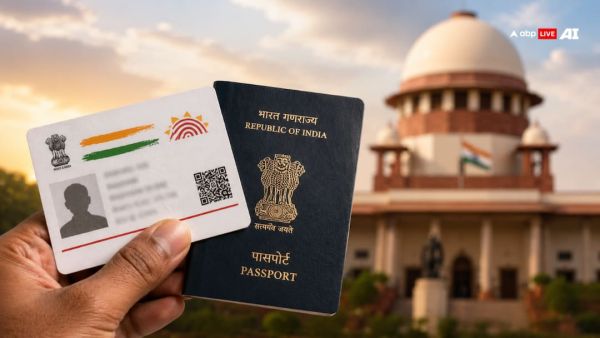
The Supreme Court has recently upheld the Election Commission's documentation framework for the Special Intensive Revision (SIR) of electoral rolls, ruling that the process is neither arbitrary nor inconsistent with existing law. In a significant judgment, the court reinforced the Election Commission's authority to determine the documents required for voter verification.
A bench comprising Chief Justice of India Surya Kant and Justice Joymalya Bagchi held that Aadhaar cannot be regarded as proof of citizenship or domicile. The ruling came while examining the validity of the documentation process prescribed by the Election Commission during electoral roll revision.
The 124-page verdict stated that the Election Commission is entitled to classify documents according to their evidentiary value while determining statutory requirements such as residence and eligibility for voting.
One of the central questions before the court concerned the legal status of Aadhaar in the voter verification process. The bench clarified that the law governing the 12-digit unique identification number does not recognise Aadhaar as proof of citizenship or domicile.
The court said the Election Commission was justified in not treating Aadhaar as a primary document for establishing eligibility to vote. It noted that Aadhaar was designed as an identity document and not as evidence of citizenship status.
At the same time, the judgment referred to Section 23(4) of the Representation of the People Act, which permits Aadhaar to be used for the limited purpose of establishing an individual's identity.
The verdict reaffirmed the court's earlier directions regarding Bihar's electoral roll revision and instructed the Election Commission to treat Aadhaar as an additional twelfth document for identity verification.
The bench emphasised that Aadhaar is not conclusive proof and that authorities retain the power to seek further material if necessary to verify the genuineness of a voter.
According to the court, preparation of electoral rolls is not a mechanical exercise but a constitutional responsibility that requires careful verification of statutory conditions.
The Supreme Court also endorsed the Election Commission's decision to exclude ration cards from the prescribed list of documents for the intensive verification exercise.
The bench observed that unlike passports or birth certificates, ration cards cannot be considered conclusive proof of citizenship and may be susceptible to misuse.
It further held that the Commission possesses the discretionary authority to replace certain documents with more reliable evidence when conducting intensive verification exercises.
The judgment stated that decisions regarding acceptable documents and their evidentiary standards fall within the discretionary domain of the Election Commission.
The bench said courts should not ordinarily substitute the Commission's assessment so long as the exercise remains reasonable and consistent with the law.
Concluding its analysis, the court held that the documentation framework adopted for the Special Intensive Revision is based on intelligible criteria and is directly connected to the objective of maintaining a leak-proof electoral roll.
In a separate development, the Supreme Court recently issued notices to the Centre, states and Union Territories on a petition alleging misuse of Aadhaar cards as proof of citizenship, domicile and residence.
A bench led by Chief Justice Surya Kant and Justice V Mohana sought responses from the Centre and state governments on the plea filed by advocate Ashwini Kumar Upadhyay. The matter has been tagged with similar pending cases.
The petition seeks directions to ensure that Aadhaar is used strictly as a document for identity verification and not as proof of citizenship, domicile, address or date of birth.
The issue of citizenship documentation has also gained attention after the Ministry of External Affairs clarified that a passport is primarily a travel document and should not be treated as definitive proof of citizenship.
Officials said that a passport certifies the nationality of Indians while they are abroad, but it is not intended to serve as a standalone citizenship certificate.
These remarks have revived the larger debate over which documents can establish Indian citizenship and how authorities should verify citizenship status.
India does not have a single universal citizenship certificate that every citizen possesses. Citizenship is governed by the Citizenship Act, 1955, under which citizenship may be acquired through birth, descent, registration, naturalisation or incorporation of territory.
As a result, citizenship is often established through a combination of documents depending on the circumstances of each individual.
Documents commonly relied upon include:
The Supreme Court's ruling makes clear that no single document automatically establishes citizenship in every case and that authorities may seek additional evidence depending on the legal requirements involved.