When a new car launches, a great name will stick out of a crowd and live in the collective memory long after the model ceases to exist. A bad name doesn’t do a car model any favors. Driving a Mitsubishi Minica Lettuce doesn’t sound particularly enticing, even though you’ve likely never heard of the car before, and depending on your grasp of Spanish, a Mazda LaPuta can be offensive.
The official names don’t always end being the ones to boost or harm a car’s image with the public, though. Sometimes, car models develop monikers in pop culture, and these nicknames become synonymous with them over time. They can be unique to a particular country — the Mitsubishi Pajero’s “Shogun” title in the United Kingdom comes to mind, and the seventh-generation Honda Accord’s “End of Discussion” Nigerian alias hasn’t gone global. Others are more ubiquitous.
From build characteristics to movie references and sly digs, we’ve compiled a list of 12 of the most fun nicknames car models have earned. We’ll provide a brief backstory where the model name demands, too.
Toyota Tacoma — Taco
The Tacoma model name has its roots in American history. After a series of uninspiring rollouts with alphanumeric names like the N80, Toyota decided to explore a different creative direction in the 1990s. With Hilux being phased out of the American market, the automaker pivoted to a name for its successor that evoked a sense of cultural resonance and identity. The Tacoma moniker is a reference to Washington’s Mount Rainier, which is called “Tahoma” or “Tacoma” by Native American tribes. The name is Toyota’s way of speaking to the ruggedness and off-road capabilities of the mid-size pickup.
Over time, though, the Tacoma would come to be shortened to just “Taco” in slang abbreviation. There’s a bit of cognitive dissonance about this name if you take it at face value — tacos are traditionally small (most corn tortillas range between 4 and 6 inches across) and soft to the bite, though hard shell tacos have become more mainstream in the past few years. Those characteristics aren’t reflective of the Tacoma at all; the 2026 Tacoma can pull a maximum of 6,500 pounds, and it’s far from the smallest pickup on the market.
If anything, the fun is in the paradox. You could hear “Taco” for the first time and assume the car model in question was a cute, compact thing, and then scratch your head in confusion when the 74.6-inch body pulls up.
Lamborghini LM002 — Rambo Lambo
Lamborghinis have been christened “Lambos” for quite some time now. The shortened version is understandable — having to enunciate four syllables whenever you talk about your car can get tedious fast. The Italian automaker typically specializes in race cars, luxurious sports cars, and even tractors, and it’s been expanding its horizons into the SUV market with the Urus line.
However, it’s easy to forget that the Urus isn’t the first SUV Lamborghini has made. The LM002 is a Lamborghini you’ve probably never heard of, but it was a pop culture icon in its heyday, with a list of celebrity owners including Tina Turner, Malcolm Forbes, and, more pertinent to its nickname, Sylvester Stallone. Only in production between 1986 and 1992, the LM002 was the spiritual successor of a military ATV prototype known as the Cheetah, which never made it to testing.
During that time, Sylvester Stallone’s popularity was near its apex, thanks to his role as John Rambo in the Rambo franchise. Thus, his ownership of a unit of the LM002 was particularly influential in the birth of the “Rambo Lambo” moniker, especially since only 300 examples were ever produced. For the super SUV’s 40th anniversary, Lamborghini put the LM002 up for permanent display at the Lamborghini Museum in Sant’Agata Bolognese.
Porsche 930 Turbo — Widowmaker
The Widowmaker is a particularly ominous moniker for anything, much less a car that you’re hoping to drive safely. That doesn’t stop it from being cool, though. At the time of the Porsche 930 Turbo’s rollout between 1975 and 1989, it had few equals in raw power. That status was part of a broader sphere of dominance for the German brand; Porsche crushed its competition across racetracks, starting with the 917’s win at Le Mans in 1970. Wins at Daytona and Sebring followed with the 911 Carrera.
For more context, the publicly available 911 and 911S were powered by engines that could make 150 and 173 hp, respectively. The Porsche 930 Turbo, however, eclipsed those numbers with its 250 hp ability in its 3.0-liter trim. That number may not seem like much these days, but in the ’70s, 250 hp was a lot of responsibility to hand over to the average driver. Also, the weight distribution between the front and the rear wasn’t perfectly equal, and it had a relatively short wheelbase. These factors meant the 930 Turbo was prone to different types of oversteer.
There’s one more culprit we haven’t talked about that played a part in the 930 Turbo’s Widowmaker etymology: turbo lag. Delayed power transmission was a common feature of turbocharged engines of that era, since the turbo needed enough time to spool up. This problem was particularly deadly at corners in the 930 Turbo with the threat of oversteer, hence the nickname.
Nissan Skyline GTR — Godzilla
If you’re remotely familiar with cinema, you have an idea of what the “Godzilla” name represents. Of Japanese origin, Godzilla is a giant atomic reptilian kaiju that has been on the silver screen in different franchises since 1954. Naturally, one might wonder the correlation between a fearsome creature of cinematic lore and a car like the Nissan Skyline GTR — it’s far from the biggest vehicle on the road.
While the Godzilla moniker is used to refer loosely to the GTR trim, the model that actually earned the title was the 1989 R32. Through it, Nissan brought the Skyline model back to life after a 16-year absence. As part of the hype, Australian magazine Wheels featured the R32 on its cover for its July 1989 issue, calling it “Nissan’s new Godzilla,” presumably as a tip of the hat to its 276 hp engine power. The R32 wasted no time living up to the billing.
Nissan developed a separate 550 hp version for racing at the annual Bathurst 1000 in New South Wales, becoming the first Japanese car to win the event. It also dominated the 1991 Australian Touring Car Championship with podium finishes in all nine races. Thus, the Godzilla alias stuck permanently to the GTR, born in Australia before its popularization in England. David Yu actually sat down with Read to talk about his role in the propagation of the Godzilla nickname in the United Kingdom.
Subaru Impreza WRX — Scooby Rex
Sometimes, it’s not just car models that get nicknames. We’ve seen brands like Motorola get shortened to “Moto,” which the phone maker has leaned into for its motto. Lamborghini is of course another example. However, nicknames aren’t always a simple abbreviation of the original. In the case of the Subaru, for instance, its Scooby moniker is derived from the legendary children’s cartoon, “Scooby Doo.”
This time, there’s no deeper meaning behind the name — Subaru simply rolls off the tongue in the same way Scooby does, and it’s a syllable shorter. Logically, it’s an evolution from the shortening of Subaru to Subie, but because Scooby Doo was a part of pop culture across generations (it originally ran from 1969 to 1976 on CBS before its Cartoon Network reboot between 2010 and 2018), it was easy for Subie to transition to Scooby.
For the WRX in particular, Rex is also used colloquially. For logical reasons, instead of having to spell out the letters every time, Rex offers an easy way out. A 1994 issue of Car and Driver suggests the name came about as a tip of the hat to Rex the Wonder Dog, a superhero dog from DC Comics. If that’s actually the case, then both nicknames concerning the Subaru brand are closely tied to dogs, which makes for a fun bit of trivia.
Chevrolet Caprice — Bubble/Box/Donk Chevy
Not many car models have nicknames that stick, but Chevrolet has a rich history in this department. Depending on the model, some of these nicknames can spin off into new ones when a redesign rolls around. The Caprice is an example of this — the line gained new nicknames over three consecutive generations, each adding a bit of personalized lore.
The naming began with the second generation of the Caprice. The higher-end trim of the Impala, produced between 1971 and 1976, was dubbed “Donk.” This moniker actually came from its less luxurious sibling, though. You see, the Caprice and Impala had different logos; the Caprice bore a golden crown emblem with a fleur-de-lis, while the Impala featured, no surprises, an Impala. However, the logo also closely resembled a leaping donkey, so it started being called one. Over time, the moniker shortened to just “donk” and was used to refer to both the Caprice and Impala, and the name still endures in the niche sub-category of donk cars — big wheels, elevated suspensions, custom paint jobs — to this day.
The very next generation (produced from 1977 to 1990) is known as Box Chevys. Sometimes, they’re mischaracterized as the donk label, but their length, straight lines, and sharp edges make them easy to distinguish, since they look like a literal box. Following an industry-wide change in automobile design tastes in the 1990s, Chevrolet pivoted to a rounded aesthetic for the Caprice’s fourth generation, which led to the “Bubble” moniker.
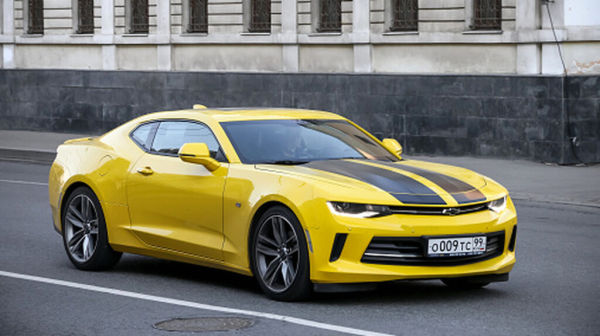
Chevrolet Camaro — Bumblebee
In terms of cultural impact, few models have benefited more from a nickname than the Chevy Camaro. Like the Nissan Skyline GTR’s Godzilla moniker, the Camaro’s alias stems from the silver screen by way of the “Transformers” franchise. Before the first of Michael Bay’s productions hit the cinemas in 2007, the Camaro model line had been lying dormant since its discontinuation in 2002. A couple of factors informed Chevrolet’s decision at the time: declining sales as more drivers looked to the SUV market, and tightening borders in the wake of the 9/11 attacks.
The hiatus didn’t last very long, though. By 2006, Chevrolet was planning a comeback for the nameplate, releasing a concept car that would eventually reach production in 2009. Ahead of the launch came “Transformers,” and more importantly, the role of Bumblebee. The most high-profile character besides Optimus Prime, Bumblebee was played by two versions of the Chevrolet Camaro: a beat-up 1977 model and the 2006 concept. The film was a huge commercial success, grossing north of 700 million dollars, and Bumblebee (the Camaro) enjoyed a lot of fanfare from it.
As a result, the Camaro sold over 61,000 units in 2009 alone, despite only going on sale around April. In fact, before the Camaro had even left the production line, Chevrolet had received 14,000 pre-orders. Bumblebee’s popularity across the Transformer films gave the Camaro a much-needed lift, and although Chevrolet retired the nameplate again in 2023, it’ll always be associated with the Autobot.
Mitsubishi Lancer Evolution — Evo
Much like the aforementioned Taco, the Mitsubishi Lancer Evolution is another car model whose name can prove a little cumbersome to enunciate every time. Thus, you’ll find it commonly referred to as just “Evo” among car enthusiasts. The etymology of the nickname isn’t well-known, but the Lancer line itself has its roots in knighthood, named after a medieval cavalry soldier.
More specific to the Evo’s history, the trim was born out of sheer necessity. Mitsubishi’s cars had been racing at rallies since 1961, and the Galant was the Japanese automaker’s initial shot at the World Rally Championship. However, while the 4G63T engine that powered the Galant VR-4 from 1987 was juiced enough to put up a fight, the Galant’s body was just too large to keep up with the competition. So, Mitsubishi decided to modify the comparatively lithe Lancer model to produce the Evo in 1992. The engine remained the same from models one to nine, and Tommi Mäkinen powered to victory behind an Evo’s wheels in four consecutive years between 1996 and 1999.
Following the string of successes, the Evo landed on American shores in 2003 with the Evo 8. Mitsubishi eventually pulled the plug on the Evo line in 2015, and the broader Lancer model followed shortly after in 2017, with the Mirage taking over the automaker’s small sedan interests.
Subaru Forester — Fozzy
We’ve mentioned that the Subaru brand is sometimes referred to as Subie, but the Forester model has its own moniker. Known as “Fozzy” or just “Foz,” the name can be quite a headscratcher — it’s not necessarily a straight line conversion from the Forester nameplate to its nickname.
The Fozzy alias comes from Australia, although there’s more than one plausible theory behind the coinage. The first sounds like something out of a children’s book: Given that the Forester is, well, associated with the forest, the “fozzy wozzy bear” children’s rhyme provided a neater abbreviation to speak aloud or type. Given that there’s a popular character from “The Muppet Show” called Fozzie Bear, and that bears seem to love breaking into Subarus, it’s understandable why the name became a part of the Forester’s identity.
A second theory is a direct play on the Forester’s Australian history. After launching in Japan in 1997, Australia was the first global market that the Forester shipped to, before touching down in the United States a year later. Australians are fondly referred to as “Aussies,” which is pronounced “Ozzy” in the singular form. Hence, an amalgam of the car model and the nationality yields the Fozzy name. That could be a happy accident, though.
Tesla Cybertruck — Cyberstuck
The other nicknames on this list have been largely either terms of endearment or names rooted in pop culture, the Cybertruck’s alias is less illustrious. At the time Tesla was rolling out its full-size pickup, CEO Elon Musk’s popularity on the internet was starting to take a turn for the worse. The Cybertruck presented an easy target for ridicule; it had a few high-profile failures in off-road conditions.
Perhaps the most viral of such fails was the Cybertruck getting stuck in a little bit of snow on a sloped hill back in 2023. Several more have popped up in the last few years, but that was the genesis of the “Cyberstuck” moniker — Cybertrucks that couldn’t move for one reason or another. In fact, the pile-on got so bad that Wes Morrill, the Cybertruck’s lead engineer, considered adding a stuck detection pop-up feature to help stranded drivers.
Admittedly, the original video that brought a hailstorm of bad press for Tesla was slightly misleading. Aside from all the unverified third-party information concerning the poster’s identity, the Cybertruck in the video had “RC” on its side — a mark that indicates the model was a prototype. Further evidence supports this theory; it didn’t have any towing points and had to be towed out by its suspension. However, the damage was pretty much done. Every time one breaks down, it’s an internet meme being lived out all over again. For what it’s worth, the Cyberstuck nickname is actually one of the kinder ones out there.
Chevy Corvette ZR-1 — King of the Hill
The third Chevrolet model on this list, the Corvette ZR01, may not have the multi-generational narrative of the Caprice or the cinematic blockbuster boost of the Camaro. However, that didn’t stop it from being dubbed one of the coolest nicknames there is — King of the Hill. Precious few of the monikers on this list exude that type of arrogance, and such a name demands some accolades to back it up.
The “King of the Hill” name actually came from within General Motors’ own doors, which makes it a bit of an anomaly. In 1986, GM had just acquired Lotus — the start of a seven-year partnership — and it wanted to engineer the fastest production car. That’s how the C4 ZR-1 was floated, and while it was being built, the engineers who were working on the project started referring to the ZR-1 by the moniker. After some initial hesitance, GM leaned into the hook, and it caught on through publications like Car and Driver, which denoted the alias in its official review.
Powered by a 5.7L V8 engine that churned out 375 hp, it did the 0-60 mph sprint in just 4.4 seconds with a top speed of over 180 mph. These marks were enough to earn the ZR-1 seven world records at a test track.
BMW Z3 M — Clown Shoe
Although this nickname isn’t quite of the same caliber as the likes of Bumblebee and Godzilla in terms of scoring cool points, it’s definitely fun. One look at the oddly shaped exterior of the 1999-2002 BMW Z3 M is all it takes for the hilarious mental image to form. That disproportionately stretched bonnet and a high back make the car resemble a funny-looking shoe.
The questionable nature of the Clown Shoe ended at it looks, however. On the road, the Z3 M was a spry 325 hp model in its later versions, powered by an inline-six engine. That performance was one of the main reasons BMW ever even allowed it to see the light of day. It’s believed that BMW didn’t sign off on the Z3 M until testing because of its poor aesthetic. For the full backstory behind the Z3 M’s evolution through the years, check this out.