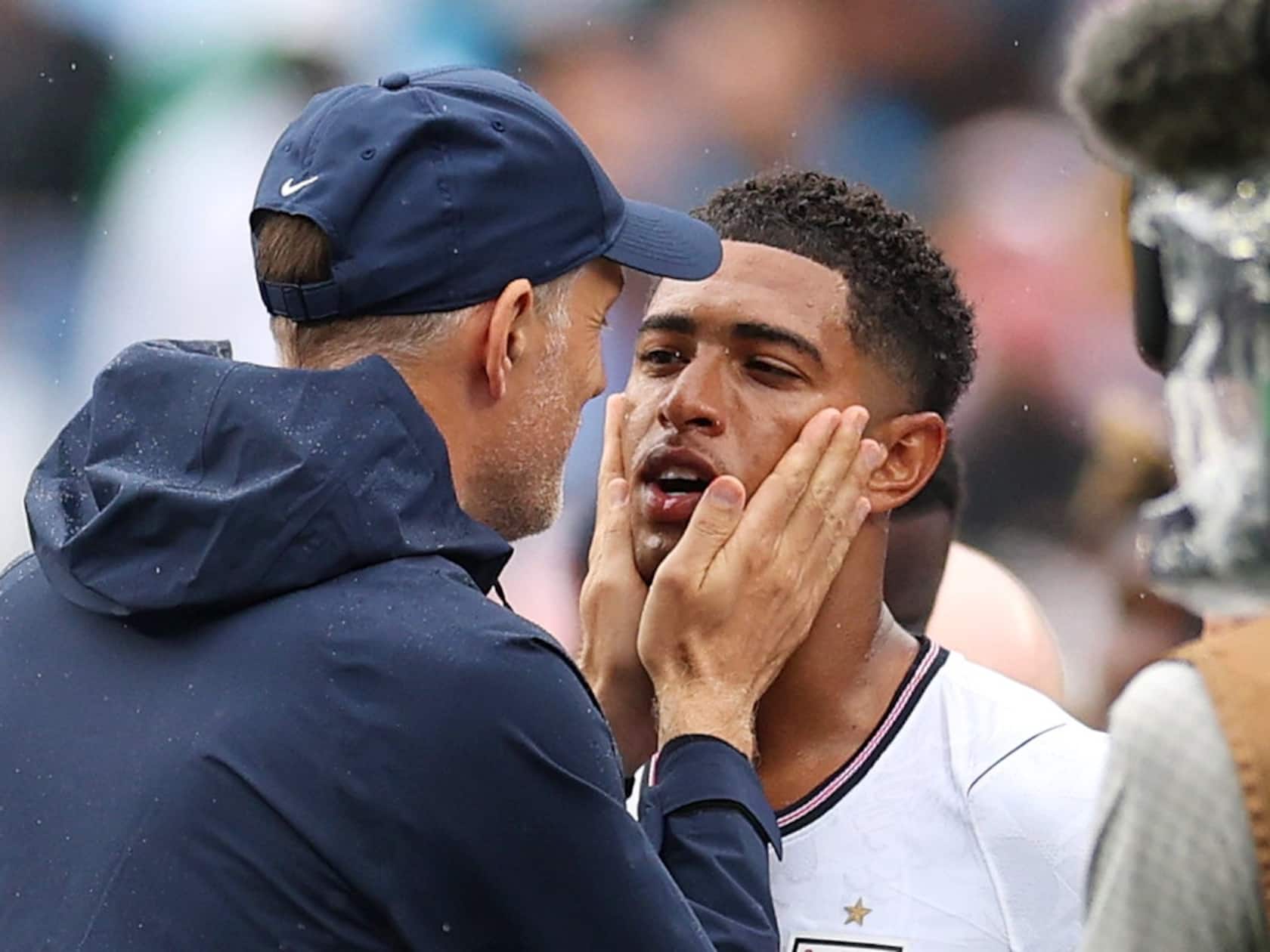
Hydration breaks have become a mandatory feature in every match of the 2026 World Cup, sparking mixed reactions among coaches, players, and fans.
Roughly 30 seconds into a hydration pause during the second half of England’s opening match against Croatia at Dallas Stadium, staff realized they needed to act fast. The loud boos from England fans echoed around the arena — the Three Lions’ rhythm had been disrupted after a spell of fluid play. To ease the tension, stadium operators blasted “Mr Brightside” across the speakers, turning frustration into a singalong. Yet, while that lightened the mood, England’s momentum waned. After a blistering 20-minute start that hinted at a possible 6-2 victory, they eventually settled for a 4-2 result, with a shaky stretch in between. Such is the compromise created by hydration breaks.
Fans have booed them, television viewers remain divided, and managers appear conflicted. FIFA, however, insists they are essential for player welfare and fairness. Regardless, these pauses have become one of the most hotly debated features of an already unpredictable World Cup.
“I think it interrupts and changes the identity of a football match far more than I imagined. I’ve had hydration breaks before when it was really hot and necessary, but those were shorter,” Thomas Tuchel remarked in a press conference before England’s clash with Ghana.
‘Absolutely, they’re necessary’
Questions about hydration breaks have surfaced in nearly every post-match press conference throughout the tournament. Many coaches treat them as mini half-times, using the moment to reorganize their teams. In fact, one British television broadcast even dubbed the second half’s cooling break the “third quarter.”
The principle behind these breaks is simple: they allow players to refuel during high-intensity contests. Each half now includes a three-minute hydration period, applied uniformly across all matches, irrespective of venue or climate. FIFA announced the policy last December, following a successful trial during the Club World Cup.
Hydration pauses aren’t new. They were first introduced at the 2014 World Cup, mandated when temperatures exceeded 32°C (about 90°F). In such conditions, the logic is clear.
“Absolutely, they’re necessary. It’s a chance to break up long stretches of play and stay hydrated. Our bodies are about 70 percent water, and most of that is in our cells. If our cells and muscles become dehydrated, they won’t function properly — that can cause cramps and other issues. Overheating is a serious risk,” explained Chris Minson, Kenneth and Kenda Singer Professor in Human Physiology at the University of Oregon.
Few managers disagree with that reasoning in theory. Some have voiced support, while others, like PSG manager Luis Enrique, have complained about the extreme heat during past tournaments in the United States. “The teams are suffering. It’s impossible to perform at a very high level for 90 minutes,” Enrique said about the conditions in Pasadena, California, during last year’s Club World Cup.
More than just heat
However, determining when hydration breaks are truly necessary involves more than just temperature. FIFA uses the Wet Bulb Globe Temperature (WBGT) index, which accounts for both heat and humidity, to guide such decisions. “To put it simply, if it’s hot, sunny, and humid, the WBGT will be high, which increases the risk,” Minson explained.
When humidity rises alongside heat, the human body struggles to regulate temperature. “In those conditions, we’re pushing beyond what humans can tolerate for long periods. When it’s humid, sweat doesn’t evaporate, which means we can’t cool down. That leads to dehydration and, eventually, serious physical problems,” Minson added.
USMNT manager Mauricio Pochettino supported the use of breaks after an early-afternoon match in Seattle. “I think it was necessary. It was really hot, and the water helped both teams recover,” he said.
Scientific evidence supports this view. FIFPro, the international players’ union, recommends cooling breaks whenever the WBGT exceeds 28°C.
‘People have played in those conditions for years’
Yet, controversy arises when conditions are mild. During England’s match against Ghana in Boston, WBGT readings hovered between 18 and 21°C — a cool, cloudy day in Foxborough, Massachusetts. Despite the mild weather, hydration breaks were still enforced in the 22nd and 67th minutes. “Do I think a hydration break is needed if it’s 82 degrees and raining? No. People have played in those conditions for decades and been fine,” Minson said.
The rule even applies to indoor venues such as Dallas, Atlanta, and Los Angeles, where climate control eliminates heat concerns. FIFA, however, insists on uniformity. “What matters even more to us is ensuring all teams, in every match, play under the same conditions,” said FIFA President Gianni Infantino.
The coach’s perspective
Throughout the tournament, many coaches have noted that hydration breaks can alter a match’s flow. Carlo Ancelotti pointed out that his side improved after the first-half pause in their 3-0 win over Haiti, with Matheus Cunha scoring soon after. “It allows players to recover, and you can make tactical tweaks,” Ancelotti said.
Haiti manager Sebastien Migne also saw the benefits. “We had the cooling break, and it aligned perfectly with our tactical plans,” he said.
For managers, these breaks function much like timeouts. Tuchel, Ancelotti, and others are often seen using the opportunity to issue instructions as players rehydrate. Tuchel even considered overhauling England’s attacking system against Ghana during a break but ultimately decided the change was too drastic mid-match. “I had an idea during the last water break but hesitated. Maybe we’ll try it later in the tournament,” Tuchel admitted. Still, the fact that such strategic discussions are possible mid-game highlights their influence.
Breaking the flow
Football’s allure lies in its uninterrupted rhythm. Critics argue that hydration breaks disrupt that flow, much like how some Premier League teams slowed play last season for set-piece routines. Momentum is crucial in football, especially in international play where structure and chemistry vary. It’s no surprise that Uruguay’s Marcelo Bielsa, known for his high-intensity “murder ball” style, expressed frustration. “In my view, it adds nothing and takes away a lot. When matches were split into four periods, no one considered how it might affect what makes football so captivating,” Bielsa said before facing Cape Verde.
Germany’s Kai Havertz, whose team also relies on pressing and tempo, echoed the sentiment. “They’re usually annoying, especially when you’ve had a few good situations and your rhythm gets broken,” he said. Even Tuchel admitted nostalgia for the old format: “I liked football more when it was two halves.”
‘This is not a financial issue for us’
The Club World Cup hinted at what might follow. During last year’s event, broadcaster DAZN inserted split-screen ads during pauses, having paid about $1 billion for rights and projecting $300 million in advertising revenue. FOX has now gone further, cutting away entirely for commercials during hydration breaks — a move expected to generate around $300 million during the World Cup. However, this has occasionally led to missed action when play resumed mid-ad.
Not all networks have followed suit. Telemundo, for instance, declared it would not air ads during these periods, insisting, “This World Cup is ours — we’re not taking a break from it.” FIFA, meanwhile, maintains that its motives are purely sporting. “There is no additional revenue for FIFA, as all commercial agreements were signed in advance. This is not a financial issue for us — it’s purely about player welfare,” Infantino stated.
Still, the commercial implications are hard to ignore. Advertising revenue fuels sponsorships, which in turn sustain football’s financial ecosystem. As teams and associations seek new income streams, hydration breaks could become yet another commercial avenue. Football has long tried to resist over-commercialization, but from shirt sponsors to corporate tie-ins, the sport has steadily yielded ground. Now, even the sanctity of the on-field experience feels less certain.