Walid Regragui concluded his World Cup journey with a clear vision for the future. Though pragmatic in his tactical approach, he spoke like a dreamer, the first manager to guide an African nation to a World Cup semi-final, known for his ability to inspire through words.
As Morocco’s 2022 campaign wrapped up with a fourth-place finish, Regragui declared, “We want to give our children the footballing DNA and one day we will be able to win the World Cup. You build that DNA gradually so that one day a team can achieve the dream of all Africans. Morocco has shown African teams can go toe to toe.”
At that time, there were doubts about whether Morocco’s remarkable run was a one-off feat. They had defeated Belgium, Croatia, Spain, and Portugal, but managed only two goals in their last four matches in Qatar. Their defence was exceptional, yet they also capitalised on their opponents’ attacking lapses.
Four years later, some answers have emerged. Even if Morocco’s latest World Cup campaign ends in the round of 32, it would still show their consistency. Facing the Netherlands—ranked seventh while Morocco sit sixth by FIFA—suggests a clash of equals. Scotland coach Steve Clarke’s repeated mentions of Morocco’s high ranking highlight that their 2022 success was no fluke.
There is now a possibility that Morocco could become the first African nation to sustain strong performances across multiple World Cups. As co-hosts of the 2030 edition, they stand to gain further advantages. Once dismissed as outsiders in their earlier World Cup bids, Morocco now aim to host the final itself—a sign of their growing influence both on and off the field.
The contrast with history is stark. Africa’s three previous quarter-finalists—Cameroon in 1990, Ghana in 2010, and Senegal in 2002—failed to build on their achievements. Cameroon and Ghana finished bottom of their groups at the next tournament, while Senegal failed to qualify. Their success had always been fleeting. Morocco’s continued strength signals real progress.
This resurgence reflects a wider transformation. Though Regragui’s semi-final squad could have been preserved, Morocco chose evolution over nostalgia. Regragui stepped down despite reaching and losing the final of the African Cup of Nations, under pressure to modernise. His successor, Mohamed Ouahbi, represents a more progressive footballing philosophy, and under him Morocco matched Brazil stride for stride.
Regragui’s squad has largely been overhauled. Many stars of 2022 are absent. Hakim Ziyech and Sofiane Boufal have not featured since 2024, Romain Saiss retired in February, Nayef Aguerd is sidelined with injury, and Sofyan Amrabat, now in the United States, was an unused substitute against Brazil and Scotland. Most surprisingly, striker Youssef En-Nesyri, a standout in Qatar, was left out of the squad. Only Yassine Bounou, Achraf Hakimi, Noussair Mazraoui, and Azzedine Ounahi remain central to the current side.
Morocco’s connection to the Netherlands is another intriguing subplot. In this World Cup of global diasporas, a Moroccan victory over the Dutch would carry symbolic weight. Mazraoui and Amrabat were born in the Netherlands, while Ismael Saibari has spent his entire professional career there.
Morocco continue to benefit from Europe’s football academies, drawing players whose parents emigrated from North Africa. They have consistently convinced those with Moroccan heritage to represent their ancestral homeland, promising the chance to compete deep into the World Cup.
Some players in this team once represented France or Belgium at youth levels. Brahim Diaz even made a senior appearance for Spain. Given that many European nations have long relied on players with African roots, Morocco’s ability to reverse that pattern feels fitting.
The squad could easily be composed of players born abroad: Bounou in Canada; Hakimi, Chadi Riad, and Diaz in Spain; Ayyoub Bouaddi, Neil El Aynouai, and Issa Diop in France; Chemsdine Talbi and Bilal Al Khannouss in Belgium; and Ouahbi, Mazraoui, and Amrabat in the Netherlands.
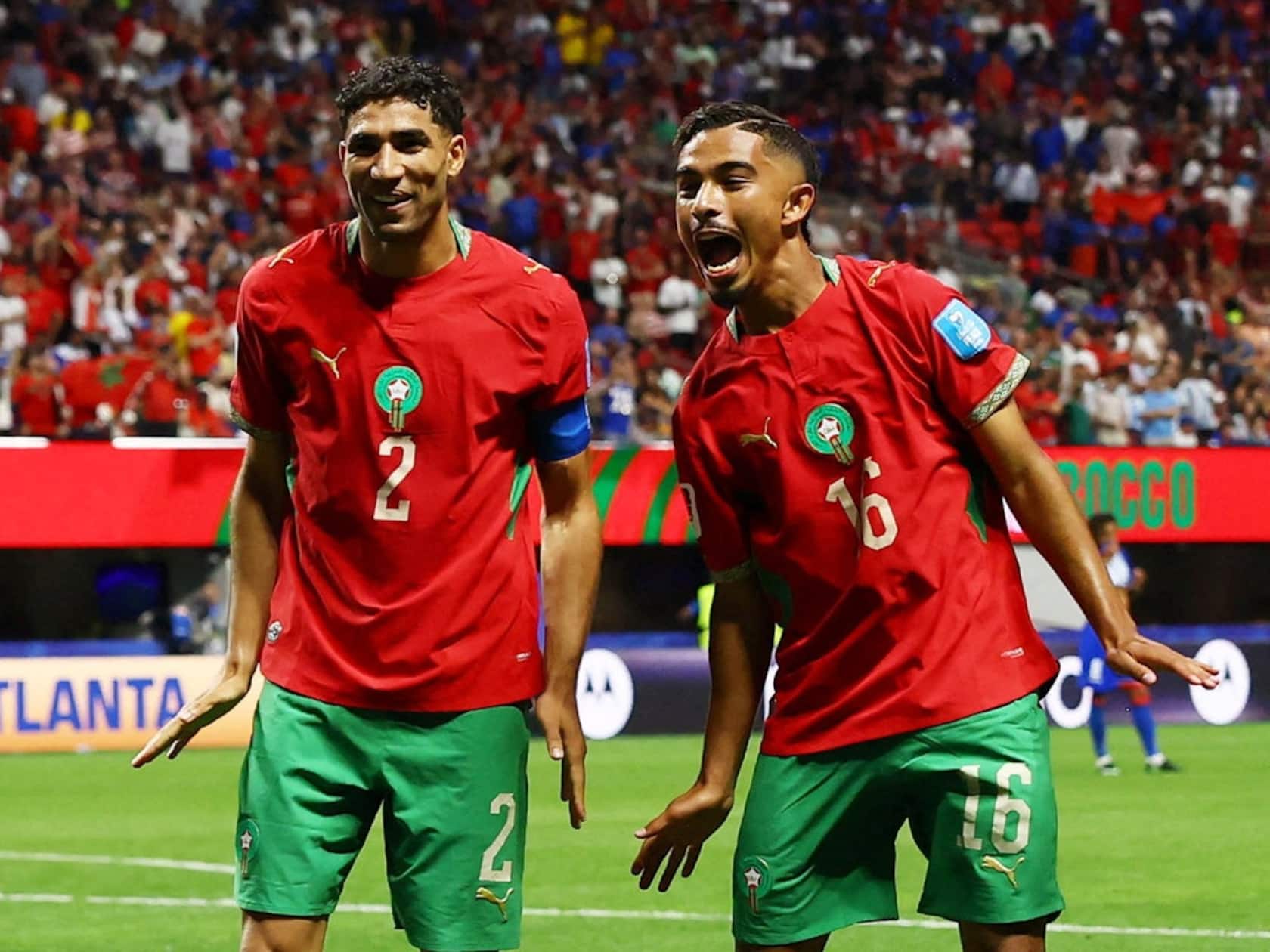
Crucially, Morocco now boast genuine world-class talent. Captain Achraf Hakimi remains their linchpin, while two breakout stars have emerged: Lille midfielder Ayyoub Bouaddi, reportedly attracting interest from clubs such as Arsenal, and PSV forward Ismael Saibari, who is close to joining Bayern Munich.
Perhaps in 2022, Morocco’s run was powered by a touch of inferiority complex. They held just 23% possession against Spain and 27% against Portugal. Now, with a more adventurous mindset, they had 49% possession against Brazil, started strongly, and posted a superior expected goals (xG) figure. It signals a team ready to compete at the highest level for years to come.
The Netherlands now stand as Morocco’s biggest hurdle in their bid for a second straight quarter-final, with South Africa or Canada awaiting in the next round. Another deep run would mark another milestone. “It is a big message to the world,” Regragui had said after eliminating Portugal four years ago. “Now we are in the history books.” The story of Morocco—and African football—may be due for another chapter. The DNA of Moroccan football is evolving.