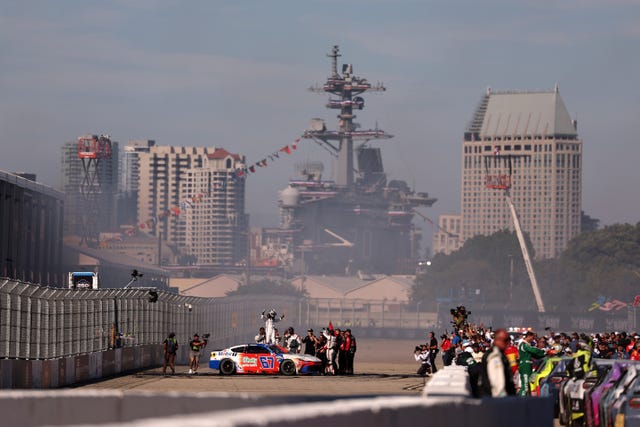
Throughout the 2020s, NASCAR has demonstrated a bold approach to experimenting with new and unconventional venues for its flagship Cup Series. From a street circuit in Chicago to a dirt-covered Bristol track and even an exhibition race inside an Olympic stadium, the organisation has not shied away from innovation. This year, the schedule took an even more radical turn with a temporary circuit built on a functioning naval base just outside downtown San Diego.
While the event at Naval Base Coronado drew sell-out crowds on both Saturday and Sunday, the three-race weekend was overshadowed by four red flags caused by issues with the track's construction and two large-scale crashes. Saturday’s O'Reilly Auto Parts Series race turned particularly chaotic—it began when a manhole cover dislodged and damaged a car’s radiator, and ended nearly five hours later after a mid-race crash that involved more than half the field.
Early signs of trouble surfaced during Friday’s Truck Series race, which had to be paused three times to repair a wall that shifted after a collision. In an interview with Road & Track, two key figures from Joe Gibbs Racing voiced their concerns over the temporary track’s numerous issues.
Chase Briscoe, a Cup Series driver for Joe Gibbs Racing, told Road & Track that the track offered “way less grip than we anticipated before coming here.” He explained that the real-world layout was drastically different from what simulations had suggested, with actual lap times coming in a full 10 seconds slower than expected. Another driver from a different team reported that their simulated times were off by around eight seconds, showing that this was a widespread problem.
“Whenever you go to a new track,” Briscoe said, “especially a street circuit, some corners naturally differ in real life compared to the sim. Once it’s built, things can change. That was part of the issue, but the grip level was another. Even some of the asphalt patches—we had an idea about them, but new ones were added in the last couple of weeks. Normally, a circuit has one or two surface types. This one’s got six. Sometimes you turn in on one surface, the mid-corner is another, and the exit is yet another. It’s really hard to replicate that before you arrive.”
The track’s layout also drew criticism. Briscoe described it as “just so challenging” that maintaining consistency was nearly impossible. “Every corner is so unique and rough, and the grip is so poor, that you never feel like you’ve nailed it. You might miss three or four corners on what ends up being a decent lap, just because it’s so difficult,” he added.
He further likened the surface to “a cheese grater,” citing severe tire wear. Unlike purpose-built circuits that tend to rubber in as more laps are completed, the Coronado track didn’t show much improvement. Although NASCAR gave teams an extra set of tires, most Cup Series runs were still limited by tire degradation rather than fuel capacity.
Spire Motorsports driver Carson Hocevar echoed these sentiments, telling reporters after practice that while he “had fun,” the track felt “sketchy.” He added, “I was more mentally drained than physically. You have to stay alert all the time. The first half is super tight, then you suddenly go into fast sections, so you’re constantly balancing your risk. It’s more mentally exhausting than anything else.”
Before the race, 23XI Racing owner and Joe Gibbs Racing driver Denny Hamlin expressed concern about tire wear. Hamlin said that during his first run, he managed only eight laps before the tires were completely spent. The circuit layout itself, however, was largely in line with his expectations. “A few walls were maybe a foot off from what I thought, but you adapt. It’s pretty much what we expected,” Hamlin noted.
Adam Stevens, crew chief for Briscoe and Joe Gibbs Racing teammate Christopher Bell, told Road & Track that the Naval Base Coronado track was “something else.” He observed that the race distances across all three series were “comically too long,” made worse by lengthy caution laps on the 3.4-mile course and frequent red flags for repairs.
Stevens also pointed out that the mixed-surface track was “really, really using up the rear tires in practice.” The newer concrete sections, he explained, had particularly low grip, causing drivers to spin their rear tires and shred the rubber quickly. Before race day, he warned of a potential tire shortage by the end of the event. “No car in practice ran six laps without the rear tires dropping off. If we use all the tires evenly, we can go 11 or 12 laps per set. If that doesn’t improve, some teams will run out of tires before the end. It might get a bit better, but not dramatically,” Stevens predicted.
As Sunday’s main event unfolded, the anticipated problems largely materialised. A collision among the leaders just past Turn 1 bent a wall out of shape and brought out another red flag for repairs. Tire wear was somewhat improved, but most cars still showed heavy wear by the end. Nevertheless, top teams managed to complete the final stint on a single pit stop instead of the two that had been expected. That tire-saving strategy, especially among the 23XI Racing entries competing for the win, seemed improbable before the race began.
At present, the race remains a one-off event. Should NASCAR choose to bring it back, experts agree that the pavement, walls, and layout will all require significant refinement.
“If we were going to fine-tune it—and obviously we would after a weekend like this—they could definitely make it a bit better,” Stevens said. “A few layout changes could reduce caution laps and red flags. Nothing major—just opening up some of the exits would help. There are definitely improvements to be made, but that’s all hindsight.”
NASCAR has yet to release its 2027 schedule or confirm whether it will return to the Coronado Naval Base. The organisation did not respond to Road & Track’s request for comment. The series is also not currently racing at the Chicago street circuit, Bristol dirt track, or Los Angeles Coliseum infield. If the Coronado race remains a one-time event, it may join the list of bold yet unsustainable experiments in NASCAR’s recent history.