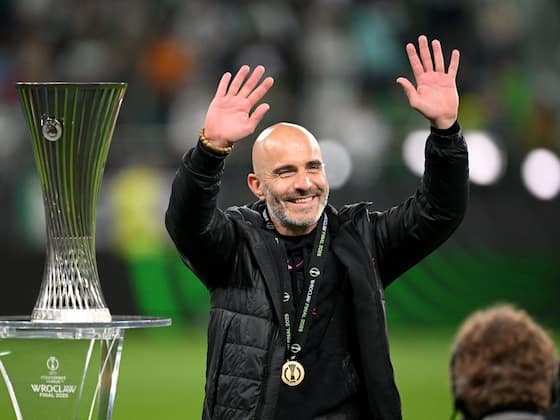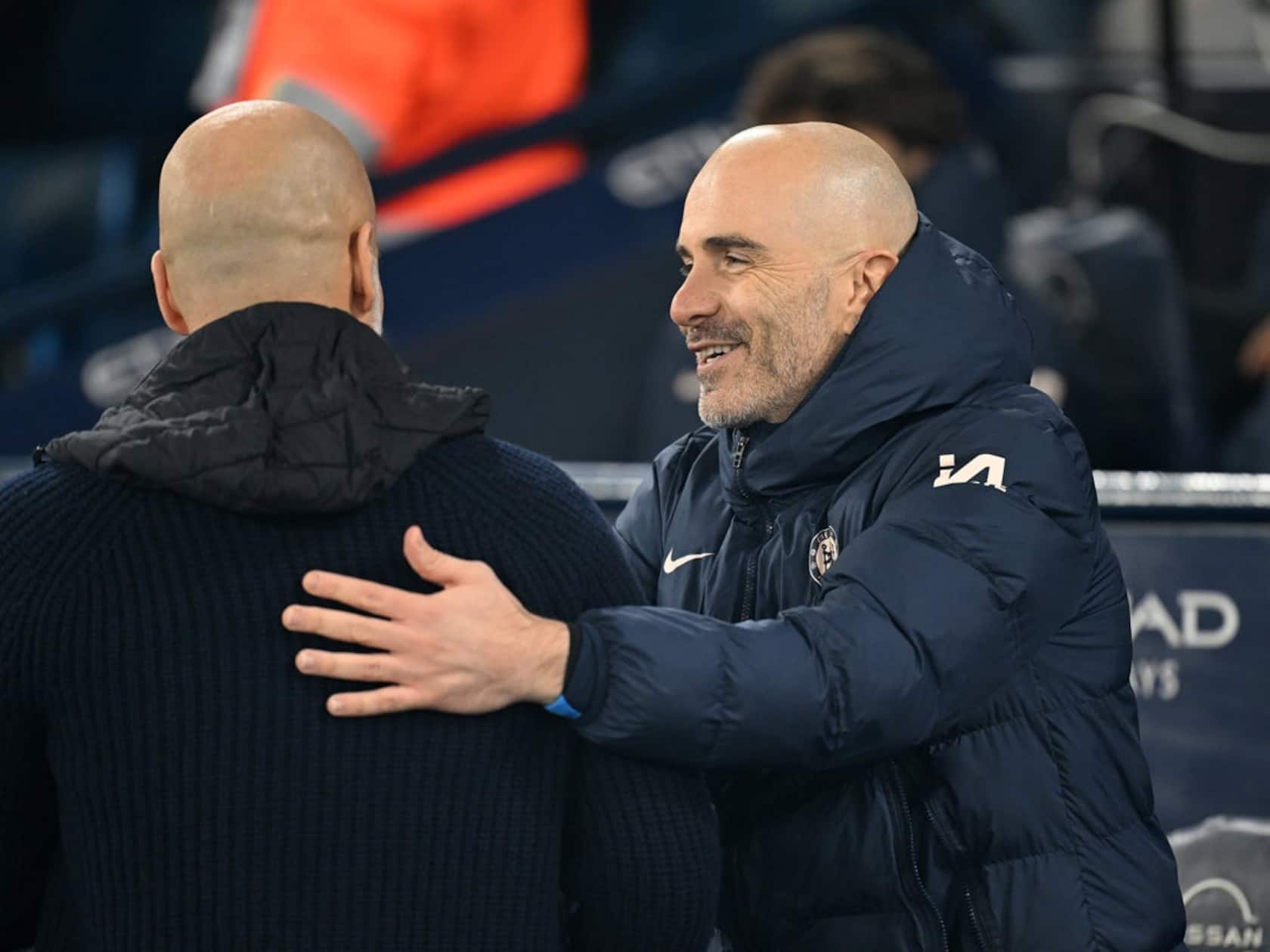
Manchester City have finally secured their preferred choice, and Enzo Maresca stands out as the natural continuity figure to take over from Pep Guardiola — not only because he previously managed City’s Elite Development Squad and served as Guardiola’s assistant.
Maresca’s managerial roots in the blue half of Manchester go back even before Guardiola’s decade-long reign. The Italian may always operate under the long shadow of his legendary predecessor, yet his footballing philosophy is also shaped by another City manager — the one Guardiola replaced.
Maresca played under Manuel Pellegrini at Malaga and later joined his coaching setup at West Ham United. Pellegrini might be remembered as the overlooked Premier League title winner, his tenure feeling like a transitional phase as City awaited Guardiola. The club may now be satisfied with a similar outcome: if Maresca can stay for three years and deliver one Premier League trophy, proving that there is life after Guardiola. For those succeeding the greats, the challenge is to emulate someone like Arne Slot — rather than becoming Manchester United’s David Moyes or Arsenal’s Unai Emery. Or at least, to replicate Slot’s success from last season.
Enzo Maresca, who once served on City’s coaching staff before moving to Leicester City, has long been seen as part of the club’s succession planning. His strained relationship with Chelsea reportedly stemmed from admitting to the London club that he had been in talks with City, even before it was confirmed there would be a vacancy at the Etihad Stadium this summer.
That loyalty to City may have won him favour in Manchester while aggravating Chelsea — their strongly worded statement after his departure made that clear. Yet, it also paved the way for a seamless transition, even if three other managers schooled in Guardiola’s methods seemed to have stronger credentials. Mikel Arteta, Guardiola’s former assistant, has built an impressive project at Arsenal, and Vincent Kompany has earned admiration at Bayern Munich. These apprentices may now arguably oversee squads superior to that of their former mentor.
Meanwhile, any approach to Xabi Alonso last autumn would likely have been rebuffed, as the Basque was then managing Real Madrid. Now, he finds himself part of Chelsea’s succession plan following Maresca’s exit.
Alonso’s achievements at Bayer Leverkusen give him a more accomplished résumé, suggesting that Maresca may have been somewhat fortunate to land the City job — unless, of course, the Premier League’s ongoing case involving 115 charges against City turns it into a poisoned chalice.
Maresca’s managerial journey began with a brief 14-game spell at Parma, sandwiched between two stints at City. He guided Leicester City to the Championship title, a feat that looks even more impressive given their subsequent decline. It remains their only success in four seasons — the other three being disastrous — making him arguably their sole effective appointment during that period. Yet, he was never truly embraced by supporters. Similarly, his tenure at Chelsea did not win much affection from their fans.
During his time at Stamford Bridge, Maresca’s record could be described as steady — neither underwhelming nor exceptional. Chelsea finished fourth last season and were fifth when he left, capturing the Conference League title, a competition in which their financial strength far exceeded their rivals. His standout achievement was winning the Club World Cup, where he tactically outclassed Luis Enrique and dismantled a dominant Paris Saint-Germain side in the final.
Could that foreshadow his potential at City? Possibly. Maresca was part of Guardiola’s staff during City’s historic treble-winning 2022–23 season, which included devastating wins over Bayern Munich and Real Madrid in the Champions League.
However, the current City squad bears little resemblance to that team. Following significant turnover in the past 18 months, Maresca will inherit only a handful of familiar faces — with Bernardo Silva and John Stones set to depart, the core will consist mainly of Erling Haaland, Phil Foden, Rodri, Ruben Dias, and Nathan Ake. Moreover, the club’s football operations are now overseen by Hugo Viana rather than Txiki Begiristain, who was in charge during Maresca’s previous stint.
This shift may be relevant given how things unravelled for Maresca at Chelsea. His apparent meltdown can partly be attributed to the challenges of working under BlueCo’s ownership structure — an environment he might argue was far more difficult than replacing Guardiola. In his defence, he performed better than most of Todd Boehly and Clearlake Capital’s other managerial appointments: Mauricio Pochettino did a reasonable job, while Graham Potter and Liam Rosenior struggled badly.
Maresca was said to command respect within the dressing room. Spanish-speaking players such as Enzo Fernandez and Marc Cucurella reportedly preferred him to Rosenior, and results took a downturn after his departure, albeit not immediately.
His appointment at City could be viewed as proof that the City Football Group’s global structure is functioning effectively, or as an admission that any post-Guardiola successor would inevitably seem a downgrade. Other clubs have taken different paths after Guardiola’s exits. Barcelona promoted his assistant Tito Vilanova — the ultimate insider — while Bayern Munich turned to the vastly experienced Carlo Ancelotti, already a three-time Champions League winner at the time.
Both Vilanova and Ancelotti delivered domestic league titles in their debut seasons following Guardiola’s departure, but neither faced the relentless competitiveness of the Premier League.
Maresca now enters a post-Pep Premier League era featuring several of Guardiola’s disciples — including Arteta, one of his former assistants; Alonso, one of his ex-players; and Roberto De Zerbi, a manager Guardiola openly admires. City may have appointed the man once nicknamed ‘Diet Pep’, but in doing so, they are bidding farewell to the original.